Retaliatory attacks among the US, Israel, and Iran have spread instability across the Gulf region, directly affecting areas from Europe to Asia. Within just the first three days of the current conflict, oil prices have risen by about 22 per cent. Current market analysis indicates that maritime risks in the Strait of Hormuz are likely to increase significantly, putting roughly 30 per cent of global seaborne crude oil and 20 per cent of liquefied natural gas (LNG) shipments at serious risk of disruption.
According to forecasts from several market institutions, crude oil prices could surge to between 100 and 110 USD per barrel and remain elevated for one to two months. This would raise the cost of energy and chemical raw materials for global manufacturing, eroding corporate profit margins. Energy-intensive industries such as steel, chemicals, and cement could face widespread production suspensions, while even large companies may be forced to cut capacity due to prolonged cost pressures. Persistently high oil prices would also accelerate investment in alternative energy solutions, potentially triggering structural shifts in related industrial value chains.
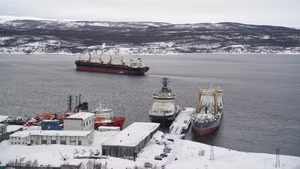
The Gulf region and the Red Sea, vital trade corridors linking Europe and Asia, could face serious disruption. Security threats in the strategic Strait of Hormuz would undermine the ability to transport oil out of the Gulf region, thereby disrupting global supply chains. Rising fuel prices would in turn affect both consumer price indices and producer price indices.
As oil and gas prices rise, the costs of petrol, diesel, electricity, and household gas would also increase, directly pushing consumer prices higher. These are essential inputs for industries, restaurants, hotels, and retail businesses. Meanwhile, maritime insurance costs have surged — potentially by as much as 50 per cent — significantly increasing transport expenses.
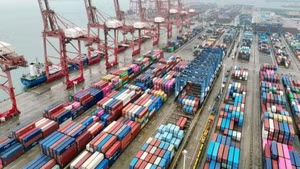
Manufacturing sectors dependent on Middle Eastern trade routes are likely to face both cost inflation and delivery delays. Logistical bottlenecks may emerge as shipping companies reroute vessels, cancel sailings, or extend delivery schedules. Potential airspace closures could further complicate international logistics. Global manufacturing delivery cycles may lengthen, export orders could be cancelled or become subject to disputes, and cross-border logistics providers may face significant financial strain. As a result, imported raw materials, industrial components and food supplies may become scarcer and more expensive.
If conflict and instability persist, businesses may be forced to raise prices, thereby influencing inflation expectations. When households and companies believe that prices will not only rise but remain elevated, economic behaviours may change, potentially triggering a wage–price inflation spiral.
The greatest risk now lies in the possibility that a price shock could evolve into a supply shock. To address this risk, European policymakers have begun considering measures aimed at mitigating potential economic damage.
Philip Lane, Chief Economist of the European Central Bank (ECB), warned that a prolonged energy shock could generate secondary effects, slowing progress in bringing inflation under control.
While diplomatic efforts continue to urge the parties involved to de-escalate the conflict, many countries and regions are preparing contingency scenarios in case the Strait of Hormuz is blocked for an extended period or energy export infrastructure in the region is destroyed. Should such a scenario unfold, the world could face a severe quantitative supply shock, with deeper impacts on inflation and growth, leaving dark clouds hanging over the outlook for the global economy.