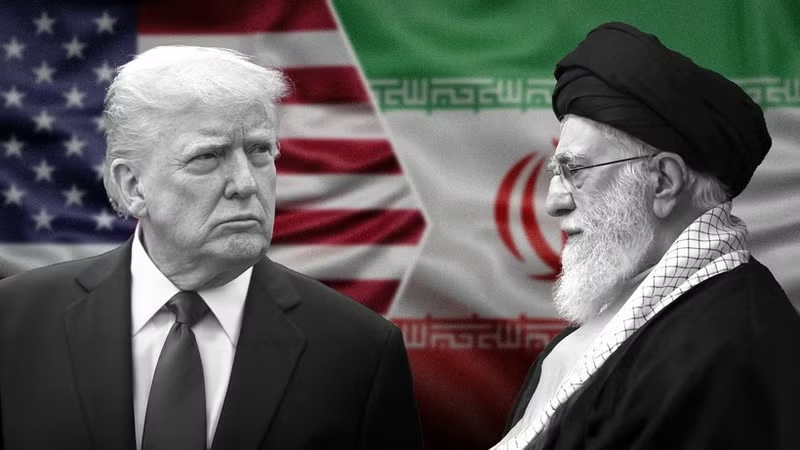
The most striking feature of this third round since the start of the month has, ironically, been the contradictory assessments of its results. Omani Foreign Minister Badr Albusaidi, widely seen as the most active mediator seeking to ease tensions between Iran, the US, and Israel, said the talks concluded with notable advances. He announced that, on the back of this positive momentum, technical-level discussions would be convened in Vienna, Austria, next week.
Albusaidi thanked all parties involved, including negotiating teams, the International Atomic Energy Agency (IAEA), and the Swiss Government as host, for their tireless efforts to preserve what he described as a fragile hope for peace.
Iranian Foreign Minister Abbas Araghchi characterised the meeting as the most serious round of nuclear negotiations yet between Tehran and Washington. He said both sides discussed Iran’s nuclear programme and US sanctions imposed on Tehran.
According to Araghchi, common ground had been reached on several issues, though differences remained; nonetheless, both parties demonstrated seriousness at the negotiating table.
Iranian President Masoud Pezeshkian reiterated that Tehran does not seek nuclear weapons, underscoring Supreme Leader Ali Khamenei’s long-standing religious decree prohibiting such arms. While signalling readiness to strengthen international oversight of its nuclear facilities, Iran maintained a firm stance on its right to enrich uranium to a certain level for civilian purposes.
In contrast, Israeli media portrayed a less optimistic picture. They reported that envoys of US President Donald Trump departed the talks “disappointed”, citing a persistent and wide gap between the two sides.
US Special Envoys Steve Witkoff and Jared Kushner held two meetings with Araghchi, involving both direct and indirect exchanges, mediated by Albusaidi and attended by IAEA Director General Rafael Grossi.
According to Israeli reports, Iran refused to scale back significantly, proposing limits on uranium enrichment for medical purposes and only a temporary suspension of certain nuclear activities.
Washington, however, reportedly maintained a hard line, demanding an open-ended agreement without a “sunset clause” and accepting only low-level enrichment at a research reactor in Tehran. Analysts suggest US demands, including the complete dismantlement of Iran’s nuclear facilities and the removal of all enriched uranium from Iranian territory, would be difficult for Tehran to accept.
The Trump administration has demanded an agreement without a “sunset clause”, meaning one with no fixed expiry date.
US Special Envoy Steve Witkoff made it clear that Washington wants Iran’s commitments to be long-lasting, rather than automatically expiring after a number of years, as was the case in the 2015 agreement.
While Iran has consistently emphasised that its nuclear programme serves peaceful purposes only, the US remains sceptical, viewing current activities as posing a potential proliferation risk and calling for more stringent restrictions.
The White House has repeatedly warned that it could consider stronger measures, including air strikes, should the dialogue fail to make substantive progress.
The ambiguous signals from the Iran–US nuclear talks underscore that the Middle East remains a “powder keg”. Observers must now wait, hoping for clearer outcomes at the upcoming technical-level negotiations between Washington and Tehran in Vienna, Austria, next week.