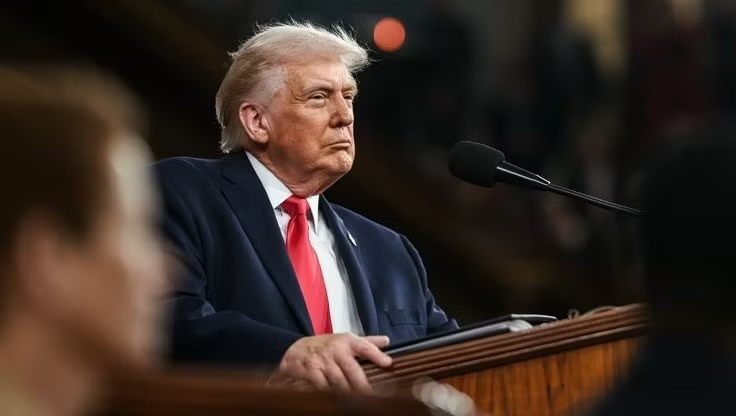
The address was given at a time of mounting pressure on President Trump, as the US midterm elections draw near.
With only about eight months remaining until the midterm elections, the struggle for control of the US Congress remains intense, while the Republicans hold only a fragile majority in the House of Representatives. Public support for President Trump has fallen to what is seen as an almost “rock-bottom” level since he began his second presidential term.
Meanwhile, political tensions have continued to rise following a Supreme Court ruling rejecting sweeping tariffs, dealing a heavy blow to the “tariff diplomacy” approach long pursued by President Trump. The ruling reflects deep polarisation within US politics.
This year’s State of the Union has therefore attracted particular attention, serving not only as a review, but more importantly as a key opportunity for President Trump to consolidate his leadership image and strengthen public confidence at a critical juncture, amid mounting economic, legal and foreign-policy pressures.
Against this backdrop, President Trump delivered a record-long State of the Union address, lasting 1 hour and 48 minutes. The speech focused on what he described as the achievements the US has made in key areas such as the economy, technology, immigration and foreign affairs. President Trump declared that “America is back”, asserting that his administration is ushering in the “golden age of America”.
The US leader said that more Americans are currently in employment than at any point in the country’s history, and that he has secured investment commitments worth more than 18 trillion USD from around the world.
Looking back at the first year of President Trump’s second term, it is evident that a series of unexpected and bold policy decisions have generated considerable friction within the US and delivered shocks to Washington’s allies and partners. With 229 executive orders signed during the first year of his second term, some observers argue that these measures were aimed more at leaving a strong personal imprint than at building broad social consensus.
In this year’s State of the Union address, President Trump has treated the economy as a strategic card to consolidate his standing among voters. However, in reality, Americans’ experiences do not fully align with aggregated economic data. A Reuters/Ipsos poll shows that 56% of respondents are dissatisfied with the administration’s handling of the economy.
Many have expressed concern about the cost of living, an issue that often plays a decisive role in voting behaviour. Similarly, on foreign policy issues such as Iran’s nuclear programme, the conflict in Ukraine and the situation in the Middle East, a gap remains between the effectiveness of the “America First” policy as presented by the administration and public expectations.
Taking place at a pivotal moment, covering major issues and drawing significant public attention, this year’s State of the Union is viewed by observers as a tool serving the election strategy of President Donald Trump and the Republican Party.