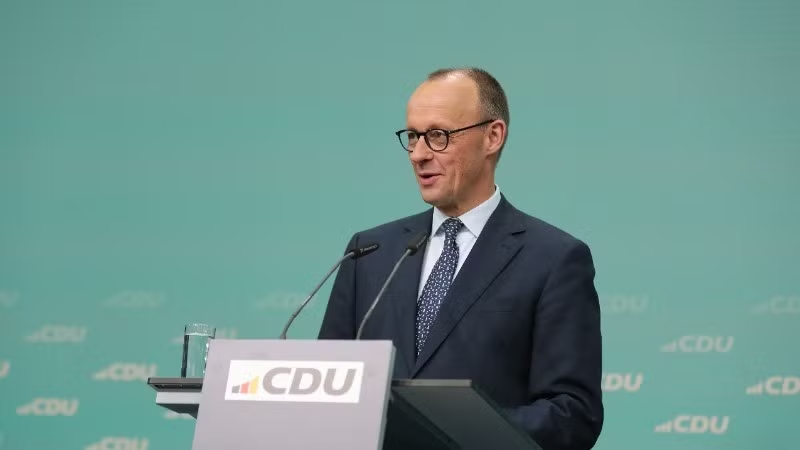
The visit provided an opportunity for Europe’s largest economy to strengthen ties with three major oil-producing nations, thereby bolstering energy security and expanding export markets.
It is not difficult to see why the German leader chose Saudi Arabia, Qatar and the UAE as destinations for his inaugural Gulf tour as Chancellor. With vast hydrocarbon reserves, all three are leading energy and financial powers in the region. Saudi Arabia has long been known as the world’s largest crude oil exporter, wielding considerable influence across the Arab world. The UAE is the second-largest economy in the Gulf and the fourth-largest oil producer within the Organisation of the Petroleum Exporting Countries (OPEC). Qatar, meanwhile, ranks among the world’s highest in per capita income and is one of the largest exporters of liquefied natural gas (LNG). For Germany, these are all partners with significant potential.
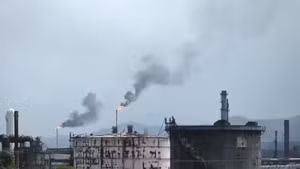
The sizeable business delegation accompanying Chancellor Merz to the three Gulf states underscores that economic cooperation was the central focus of the trip. At the top of Berlin’s agenda remains energy. Since supplies of Russian gas were disrupted, the US has become Germany’s leading LNG supplier.
According to German government statistics, in 2025 around 96% of Germany’s LNG imports came from the US. Some analysts warn that excessive dependence on US gas could once again place Germany in a vulnerable position in terms of energy security — a scenario previously experienced when supplies from Russia were cut. In the current context, the Gulf states have emerged as a prime option for Berlin to diversify its sources of supply.
Alongside energy, Germany is also seeking to deepen cooperation with Gulf partners in the fields of economy, trade and infrastructure. This is no longer merely an aspiration but has become an urgent necessity for Berlin, particularly as traditional alliances show signs of weakening.
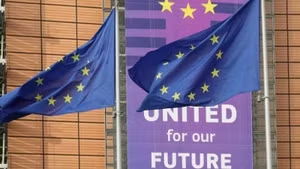
For many years, Germany in particular and the European Union (EU) in general have maintained close political and economic ties with the US — their key transatlantic ally. However, recent shifts in Washington’s policies have prompted Europe to reassess this relationship. German Economy Minister Katherina Reiche noted that as traditional alliances begin to show cracks, Germany needs to seek additional partners. This does not mean that Berlin is downgrading existing relationships, but rather avoiding “putting all its eggs in one basket”, reducing risks and multiplying opportunities.
Observers believe that the agreements reached during Chancellor Merz’s Gulf tour could help Berlin enhance its autonomy in ensuring energy security and expand export markets. This is particularly significant as the German economy faces mounting challenges. After two consecutive years of contraction, Germany’s GDP grew by just 0.2% in 2025. The outlook remains subdued, with the German government recently lowering its growth forecast for 2026 to 1%, as Europe’s economic engine recovers more slowly than expected.
The German Economy Minister has stressed that building new economic alliances will play a key role in driving growth. Following recent visits to India, Brazil and South Africa, Chancellor Merz’s trip to the Gulf helps Berlin broaden its network of economic “safe havens” amid recurring turbulence in global trade.
Beyond economic and trade cooperation, the German Chancellor and his Gulf counterparts also discussed a range of regional flashpoints during the visit, including Iran’s nuclear issue, the Middle East peace process and the situation in Syria. In recent years, Saudi Arabia, Qatar and the UAE have gained international recognition for their roles as reliable mediators in regional conflicts. In talks with Gulf leaders, Merz affirmed that Berlin stands ready to work with regional partners to help ease tensions and ensure stability in the Middle East. This underscores Germany’s awareness that cooperation with regional “mediators” is essential if Berlin is not to remain on the sidelines of Middle Eastern strategic dynamics.
Although lasting just three days, the German Chancellor’s Gulf tour yielded positive results, paving the way for a new phase of cooperation with countries in the region. Nevertheless, turning commitments and aspirations into reality will still require a long road ahead for Berlin.