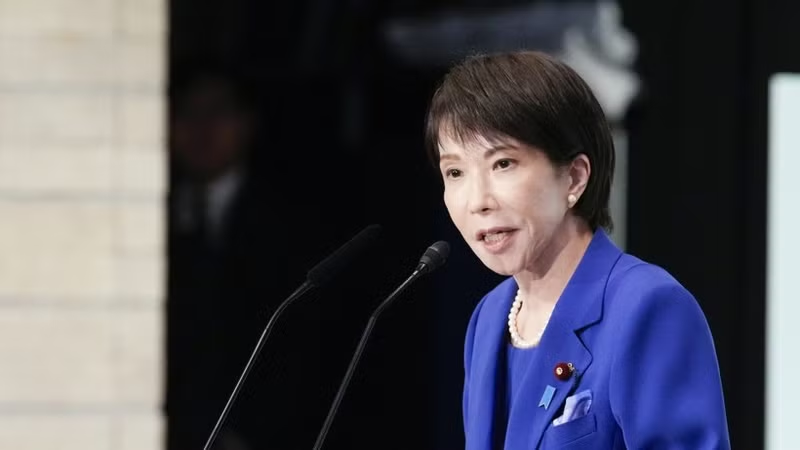
Prime Minister Sanae Takaichi is seeking voter support to continue implementing economic policies, strengthen strategic security, and pursue decisive actions aimed at consolidating the robust position of the Land of the Rising Sun.
This House of Representatives election follows the dissolution of the lower chamber. It is the first time in 60 years that the House of Representatives has been dissolved on the very day the Diet’s ordinary session opened. It is also the first election since Takaichi assumed office as Prime Minister on October 21, 2025.
As the election will be held just 16 days after the dissolution of the House, it will be the shortest House of Representatives election campaign in Japan since the end of the Second World War.
With more than 1,270 candidates expected to compete for 465 seats, the LDP-led ruling coalition is aiming to secure a majority, equivalent to at least 233 seats – the number it held prior to the dissolution of the House.
The election will also see candidates running under a new opposition force, the Centrist Reform Alliance (CRA), formed through the alliance between the Constitutional Democratic Party of Japan (CDPJ) and Komeito, the LDP’s former coalition partner of 26 years.
One of the central themes of the campaign is the proposal to temporarily suspend or abolish the consumption tax on food, against the backdrop of prolonged inflation and mounting concerns over Japan’s fiscal situation. The search for alternative sources of funding and the timing of any such measures are also subjects of intense debate.
As the ruling coalition considers suspending the consumption tax on food, while the opposition alliance proposes abolishing it entirely, the issue of securing substitute financial resources is expected to attract significant attention.
Political and financial issues, following recent slush fund scandals affecting the LDP, along with matters related to foreign residents and tourists, are also likely to become key topics of debate during the campaign.
Other critical issues drawing voter interest include Prime Minister Takaichi’s commitment to a “responsible yet decisive” fiscal policy, as well as diplomatic relations with China and the US.
Although pre-election opinion polls suggest that the ruling LDP retains an advantage and Takaichi’s government continues to enjoy relatively high approval ratings, the LDP–JIP coalition still faces uncertainty due to its minority position in the Upper House. This has forced the government to rely on opposition support to pass legislation.
In addition, the sudden decision to dissolve the House of Representatives and call a general election has drawn criticism, as it is believed to risk delaying the passage of the fiscal 2026 budget, which is scheduled to be finalised before the end of March this year.
Since its establishment in October last year, the Cabinet led by Takaichi has implemented decisive policies aimed at building a resilient economy capable of confronting global challenges and realising a vision of “a shining Japanese diplomacy”.
Her government has prioritised addressing rising prices and honoured its commitments to the public by passing a supplementary budget at last year’s extraordinary Diet session. Based on the principle of “active yet responsible fiscal policy”, the government has set clear directions for building a strong economy as well as a robust foreign and security policy.
As Japan faces a “silent crisis” marked by population decline, rising living costs and an increasingly challenging global security environment, the House of Representatives election is widely regarded as an important “test” of the policies being pursued by Prime Minister Sanae Takaichi.