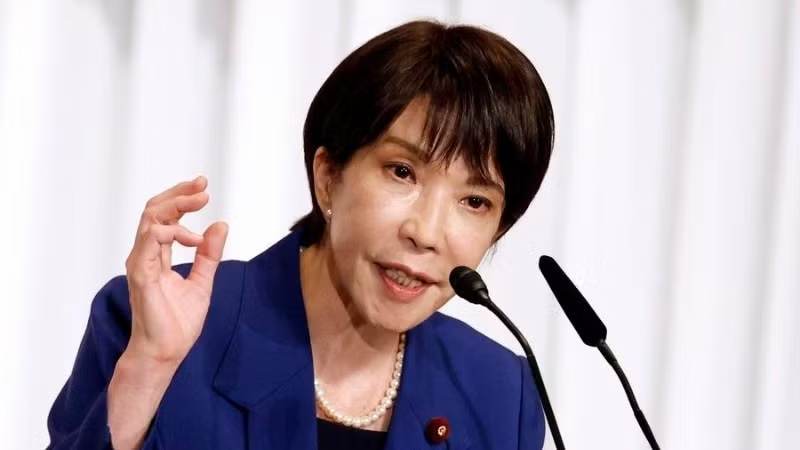
Nearly three months have passed since Takaichi Sanae won the leadership election of Japan's Liberal Democratic Party (LDP) and becoming the first female Prime Minister in the history of the Land of the Rising Sun. This victory marks a step forward in gender equality in politics, but it also presents many challenging tests of the leadership capacity for the Asian nation’s "Iron Lady".
Taking office amid domestic political, economic, and social fluctuations, and intense strategic competition in the region, the Japanese leader faces significant pressure from domestic public opinion and the challenge of balancing foreign relations with other countries.
In her New Year 2026 address, Japanese Prime Minister Takaichi Sanae stated that since its establishment in October 2025, the new government has worked tirelessly for the benefit of the people, with determination to build a strong economy and realise the goal of making Japanese diplomacy shine.
Coping with rising prices is considered a major domestic challenge for the Japanese Government. Images of people lining up for long hours at agricultural product markets in the hope of buying rice at prices lower than the average retail price reflect the heavy pressure on household spending the Japanese people.
In November 2025, the Japanese Government announced a large-scale economic stimulus package worth about 21.300 billion JPJ (equivalent to 135 billion USD). However, some experts believe this measure is unlikely to create a long-term breakthrough and could worsen the public debt situation.
Shaping Japan's position on the international arena is also an important task set by the government, in the context of increasingly fierce strategic competition among major powers. Just few days after Takaichi Sanae took office, US President Donald Trump paid a state visit to the Asian nation. This was seen as the first major foreign policy "test" for the female leader. Commitments to strengthen defence and economic cooperation between the two sides during the visit helped to resolve many obstacles in US-Japan alliance relations.
This also represents a positive step in Tokyo's foreign policy, as the US-Japan alliance had been shaken under former Prime Minister Shigeru Ishiba. Washington pressured Tokyo on defence spending and tariffs shortly after Shigeru Ishiba's visit to the US in February 2025. During their New Year 2026 phone call, Prime Minister Takaichi Sanae and President Donald Trump agreed to open a new historical chapter in the Japan–US alliance and to jointly promote stronger cooperation with like-minded countries.
Regarding relations with China, amid recent escalating tensions between China and Japan, Prime Minister Takaichi Sanae affirmed that Tokyo remains open to dialogue with Beijing and emphasised the need for a constructive and stable relationship. Japan is one of China's important economic partners and a US ally in the Asia-Pacific region. This context places Tokyo under significant pressure to balance its diplomacy.
Many challenges and difficulties await the Japanese Government in the coming time. However, in her New Year 2026 address, Prime Minister Takaichi Sanae still expressed her determination to contribute to building a more prosperous future for the country and pass it on to future generations. If she overcomes these obstacles, Japan's "Iron Lady" will not only be a symbol of progress towards gender equality in politics but also bring innovation to the country during a period of intense geopolitical competition and a crisis of confidence.