This marked the first time the CA+JAD dialogue has been elevated to the level of heads of state since the cooperation mechanism was established more than two decades ago, bringing together the Presidents of Uzbekistan, Kazakhstan, Kyrgyzstan, Tajikistan, and Turkmenistan. Against the backdrop of increasing regional and global challenges, leaders from Central Asia and Japan outlined a more comprehensive framework for political, economic, and sectoral cooperation, with three priority areas identified: transport infrastructure development, carbon emission reduction, and people-to-people exchanges.
As a region of growing geopolitical and economic significance, often described as a crossroads between Europe and Asia, endowed with abundant energy and mineral resources and experiencing strong economic and demographic growth, Central Asia is increasingly attracting investment interest from major global powers. The CA+JAD mechanism, initiated by Japan in 2004, was founded on the view that stability and development in Central Asia require regional cooperation to address shared challenges.
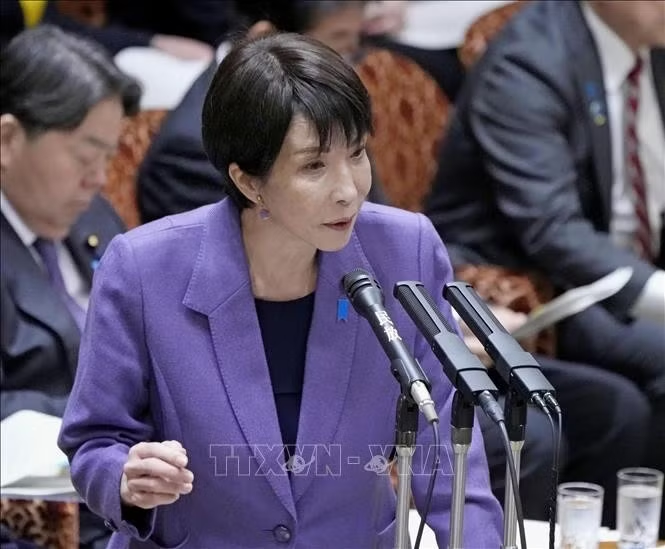
At the first CA+JAD Summit held in Tokyo, Prime Minister Sanae Takaichi announced the launch of the “Tokyo CA+JAD Initiative”, which is aimed at promoting industrial upgrading and diversification in the five Central Asian countries while strengthening mutually beneficial relations. Three new priority areas of cooperation were identified: green development and resilience enhancement; connectivity; and human resource development.
Central Asian leaders welcomed the Tokyo CA+JAD Initiative and expressed appreciation for Japan’s cooperation and support in these priority areas. Japan and the Central Asian countries set a target of implementing business projects worth a total of 3 trillion JPY (approximately 19 billion USD) over the next five years. The countries voiced their desire to develop mutually beneficial projects and expressed strong interest in further strengthening cooperation and linkages with Japan across various sectors.
To promote sustainable development and enhance resilience, Japan committed to cooperation on energy transition, climate change response, disaster risk reduction, and strengthening supply chains for critical minerals. Tokyo also announced its support for further development of the Trans-Caspian International Transport Route, known as the Middle Corridor, and the launch of the Japan–Central Asia Artificial Intelligence Partnership. These moves underscore Japan’s growing interest in regional logistics, particularly with Central Asia playing an increasingly important role as an East–West bridge.
After two decades of cooperation, Japan’s trade with Central Asian countries has reached approximately 35 billion USD. Notably, Central Asia’s reserves of rare earth elements position the region as a potential hub in the global energy transition. Amid intensifying competition, securing access to critical resources, including rare earth minerals, represents a key strategic interest for Japan.
Central Asian leaders affirmed their readiness to ensure a favourable investment environment for Japanese companies in sectors such as energy, manufacturing, transport, critical minerals, agriculture, and digital technology. The combination of Central Asia’s resource potential and Japan’s advanced technology is expected to open favourable opportunities for successful cooperation between the two sides in this new phase.