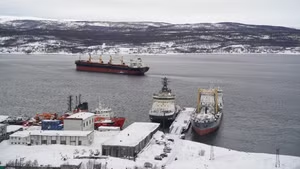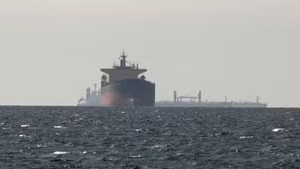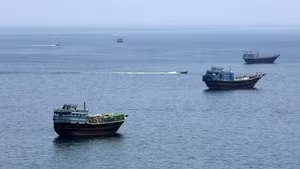
Congestion at the Strait of Hormuz, a strategic shipping route through which about 20% of the world’s oil and gas passes, has left many countries deeply concerned as oil prices continue to climb and supplies are squeezed.
To prevent a prolonged oil and gas price surge, several countries have decided to tap their strategic reserves. The United States Department of Energy announced that from next week it will release 172 million barrels from the Strategic Petroleum Reserve. The drawdown is expected to last for four months, following an order by US President Donald Trump.
The decision by the United States is part of an effort by the International Energy Agency (IEA) to persuade member countries to release 400 million barrels of emergency reserves to ease the oil price surge. If carried out as announced by the IEA, this would be the largest oil release ever undertaken. However, the agency’s determination was quickly dealt a blow when vessels passing through the Strait of Hormuz repeatedly became targets of attacks.
Iran has also set out firm demands for a ceasefire agreement, including a requirement that the United States and Israel refrain from launching any future attacks against the Islamic Republic. Observers believe that Tehran’s conditions are unlikely to receive approval from the White House.
This situation has made hopes for a swift peaceful solution in the Middle East, already fragile, even more uncertain. Investor sentiment has become increasingly uneasy as Iran’s Islamic Revolutionary Guard Corps (IRGC) threatened to close the Strait of Hormuz and attack any vessel passing through without Tehran’s permission.
Tehran’s statement is not an empty threat, as three vessels flying the flags of Japan, Thailand and the Marshall Islands were recently attacked while passing through the Strait of Hormuz.
Global consumers had only just breathed a sigh of relief when oil prices showed signs of declining following President Trump’s announcement that US forces would ensure the safety of ships passing through this perilous strait.
However, oil prices quickly reversed course and rose again to more than 100 USD per barrel. Many are reluctant to contemplate the worst-case scenario in which the Strait of Hormuz is completely blockaded and Middle Eastern countries cut exports, potentially pushing oil prices beyond 150 USD, or even 200 USD per barrel, paralysing the global energy market.
Leading global energy consultancy and research firm Wood Mackenzie estimates that attacks on energy infrastructure and shipping in the Gulf have reduced oil supply by around 15 million barrels per day. This decline is equivalent to about 15% of global oil demand, enough to deliver a significant shock to the energy market.
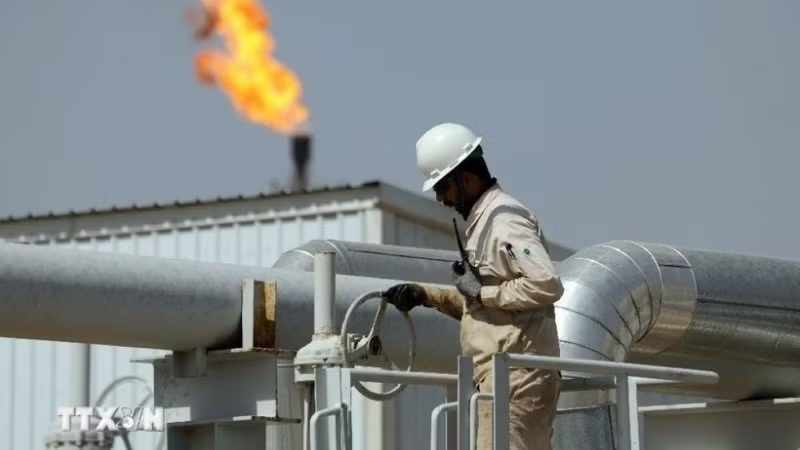
The Ras Tanura oil export port, one of the most important facilities of Saudi Arabia’s national oil company, has been forced to reduce its operating capacity to mitigate the risk of drone attacks. Several refining facilities and export terminals in the United Arab Emirates and Qatar have also temporarily scaled back operations.
Analysts note that the oil market is particularly sensitive to developments in the Middle East, which accounts for more than 30% of the world’s oil exports, while most global energy flows must pass through the Strait of Hormuz on their way to Asia, Europe and North America.
Goldman Sachs has issued an unwelcome forecast that if supply from the Gulf declines sharply and the Strait of Hormuz becomes blocked, oil prices could surge to at least 150 USD per barrel.
Morgan Stanley stated that even if the conflict in the Middle East is brought under control soon, the oil market may still face several weeks of disruption, as shipping routes and refineries will need time to recover.
The consequences of the Middle East crisis for the oil market once again demonstrate how vulnerable the global energy system is to geopolitical risks.
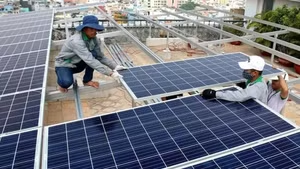
This underscores the urgent need for countries to develop long-term policies that can provide a strong buffer against such crises, including accelerating the transition towards green and sustainable energy, reducing dependence on imported sources, and expanding renewable energy to replace fossil fuels.