Ensuring security and safety for the Vietnamese community in Qatar
Qatar is one of the countries affected by the ongoing Middle East conflict. In this context, Nhan Dan Newspaper reporters contacted representatives of Vietnamese citizens living and studying there to learn about the community’s situation and the Vietnamese Embassy’s measures to protect its nationals.
Nguyen Trung Hieu, an official at the Qatar Public Prosecution Office and head of the Vietnamese community liaison, said that in recent days, security in Qatar became tense after Iran carried out missile and UAV strikes targeting Qatari territory. This affected both local residents and the Vietnamese community.
“The Vietnamese community in Qatar numbers over 500 people, working mainly in construction, oil and gas, education, research, and business. As of 24:00 on March 2, 2026 (Qatar time), no Vietnamese nationals in Qatar have been reported injured or suffered property damage,” Hieu shared.
Regarding the Embassy’s citizen protection work, Hieu noted that since the conflict began, the Embassy has closely monitored security developments in Qatar and the region, coordinating with local authorities to update official information. Vietnamese nationals regularly receive safety warnings and advisories via social media platforms such as Zalo, WhatsApp, Facebook, and the Embassy’s official channels, helping everyone stay informed and take preventive measures.
The Embassy has also urged the community to register and update personal information, addresses, and contact details to allow accurate tracking and planning for citizen protection. This demonstrates professionalism and responsibility in managing a community of around 500 people with diverse occupations.
For safety guidance, the Embassy issues daily, situation-based advisories, recommending limited movement, compliance with local authorities, monitoring official information, and preparing essential supplies such as food, water, medicine, and backup communication tools. These measures provide both practical guidance and psychological reassurance, helping the community stay calm amid complex security developments.
Hieu emphasised that the Embassy has assigned officers to work closely with community liaison points and company representatives to review evacuation plans in case of worst-case scenarios.
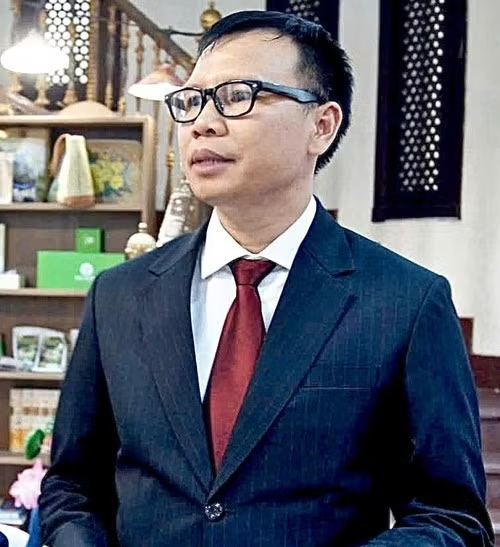
“As head of the community liaison, I assess the Embassy’s citizen protection efforts as proactive, timely, and appropriate for the current security context. Maintaining updated information, issuing advisories, collecting citizen contact data, and planning evacuations demonstrate careful preparation and responsibility. The community has responded correspondingly, following advisories, maintaining communication, and coordinating with the Embassy to ensure safety,” he said.
Similarly, Nguyen Truong Son, another liaison team member, actively relayed Embassy notifications to the Vietnamese community to ensure safety. On the first day of the conflict, when the US and Israel attacked Iran, the Embassy instructed the community to follow security advisories strictly, limit outdoor activities, shift work and school online, and stay alert.
Son noted that many Vietnamese workers are employed on offshore oil and gas projects, which caused concern when the conflict escalated. He maintained regular contact to provide updates and guidance for handling potential emergencies. The Embassy has requested citizens register personal information, including full names, birth dates, passports, and phone numbers, to facilitate protection measures in emergencies.
Regarding recent developments affecting Qatar, Son said that in his residential area in central Doha, about 20 km from a US military base, occasional explosions from missiles and UAVs were heard but did not impact civilian areas.
Authorities have requested residents limit travel, work online, and follow safety advisories. He added that offshore oil and gas facilities where Vietnamese engineers and workers operate are likely safe, as they are not US-invested. He explained, “This conflict is a direct confrontation between the US and Israel with Iran. Iran’s response targeted US military bases in some countries, including Qatar, not Qatar itself. I hope Iran will not strike oil facilities or public areas in Qatar. Nevertheless, amid escalating tensions, we remain proactive for worst-case scenarios.”
Vietnamese students in Qatar continue to receive timely support
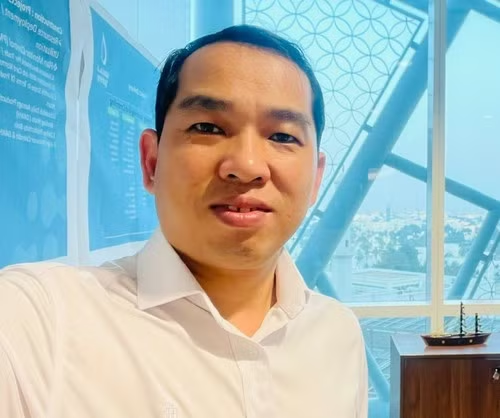
Vy Ngoc Hai, one of four students in an Arabic exchange programme at Qatar University, is witnessing a tense regional conflict firsthand. Despite the stressful news, the students’ daily life remains stable. Public services, essential goods, and security in their residential area are maintained, and all classes have shifted online until further notice.
Ngoc Hai added that amid misinformation and conflicting reports, Vietnamese students remind each other to remain vigilant, follow official news sources, and stay updated with government and Embassy announcements to prepare personally. The Embassy has contacted the students, providing guidance, safety recommendations, and emergency communication plans.
“Initially, we were understandably anxious, but thanks to the Embassy’s close attention and strong community connections, we quickly regained calm. Staying level-headed and optimistic is crucial to protect our studies and well-being,” Ngoc Hai said.
The Middle East conflict has affected many countries, including Qatar. With support from the Vietnamese Embassy and local authorities, the Vietnamese community in Qatar has acted proactively, complied with advisories, maintained communication, and is ready to coordinate with the Embassy to ensure safety amid the complex regional security situation.