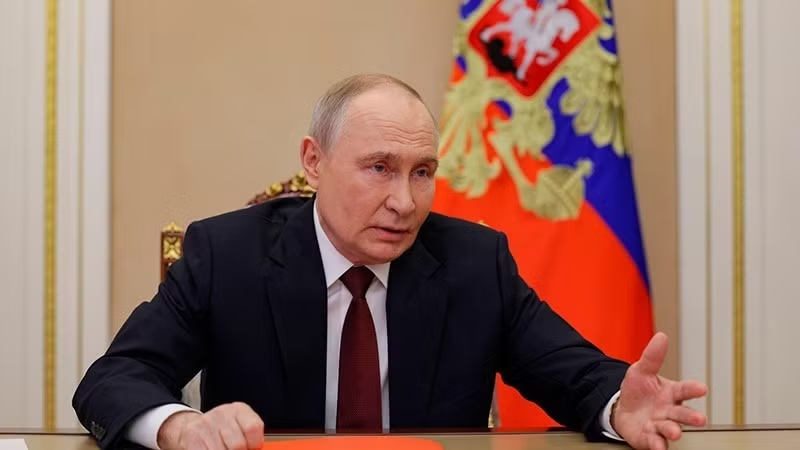
President Putin’s visit to India has been widely viewed as historically symbolic. The visit comes as New Delhi is negotiating with Washington to reduce the high retaliatory tariffs imposed by the US on Indian goods.
Analysts note that the trip carries substantial symbolic weight, serving to reaffirm the roles of two major powers — one in Asia and one in Europe — in shaping global cooperation trends.
President Putin underscored that the Russia–India friendship has been cultivated over seven decades for the benefit of both nations, and is not directed “against any other country.”
During the visit, Prime Minister Modi and President Putin signed a Joint Statement immediately following the closing session of the 23rd India–Russia Summit. The statement reaffirmed their determination to continue expanding and deepening their “special and privileged strategic partnership,” viewing Russia–India relations as an “anchor” of global peace and stability.
Both sides also welcomed the positive and comprehensive outcomes of their cooperation across politics, defence, energy, trade, science and technology, space, and education.
On the economic front, the two countries committed to raising bilateral trade from the current 67 billion USD to 100 billion USD by 2030, in a more balanced and sustainable manner, while agreeing to expand the use of national currencies in trade transactions. Prime Minister Modi even expressed optimism that the ambitious target of 100 billion USD could be achieved ahead of schedule.
Defence cooperation was another highlight of President Putin’s visit. Both sides reaffirmed defence as a traditional pillar of their ties, now being elevated to higher levels through joint research, joint development, joint production, and technology transfer in line with the “Make in India” approach.
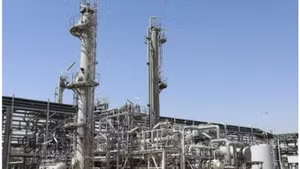
The Joint Statement also reaffirmed energy as a major pillar of bilateral relations, with extensive cooperation in oil and gas, liquefied natural gas, civil nuclear energy, and emerging energy technologies.
The deepening energy ties between the two countries, both key players in Asia and Europe, are seen by analysts as a natural development, particularly as Russia faces severe pressure from the West in this strategic sector, while India remains unsettled by the US’s retaliatory tariffs.
President Putin once again voiced his support for India becoming a permanent member of an expanded United Nations Security Council, describing this prospect as irreversible given the country’s rising international standing and its remarkable economic growth over many years.
At the India–Russia Business Forum, Prime Minister Modi emphasised that mutual trust is the strongest foundation of bilateral relations, and proposed creating a “virtual trade corridor” to link customs and logistics systems, speed up clearance procedures, cut red tape, and facilitate seamless trade flows.
Acknowledging that the current trade surplus favours Russia, President Putin pledged to increase imports of goods and services from India to narrow the gap, stressing that expanding purchases from the South Asian nation would benefit both sides.
Analysts comment that President Putin’s trip to India is not merely routine diplomacy but an important test of the emerging global power structure. It simultaneously tests India’s strategic autonomy, reflects Russia’s efforts to break free from Western constraints, and represents an opportunity to reinforce the Asia–Europe allied axis amid escalating strategic competition.