Rising geopolitical tensions, escalating conflicts, and increasingly severe climate change are compelling countries that share common values and interests to work more closely together to reinforce security and prosperity in this strategically significant region.
At the Nordic–Canada Summit held in Oslo, the capital of Norway, the prime ministers of Norway, Canada, Denmark, Sweden, Finland, and Iceland agreed to continue advancing cooperation to ensure security and create further opportunities for economic growth. These countries share many similarities, with territories in the Arctic region and close alliances within the North Atlantic Treaty Organisation (NATO).
In a joint statement, the six leaders reaffirmed that cooperation based on international law, shared values, and common interests is the most effective way to strengthen collective security and prosperity. The Norwegian Prime Minister stressed that Canada and the Nordic countries are closely coordinating to safeguard Arctic security, while supporting enhanced allied presence through NATO.
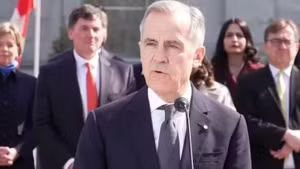
The Norwegian Government also noted that, as technology and international trade are increasingly used as tools of pressure, these countries will place high priority on economic security, job creation, and green growth. Canadian Prime Minister Mark Carney has emphasised that, in the face of growing threats, defence cooperation between Canada and its Arctic partners will help build a stronger, more prosperous, and safer world.
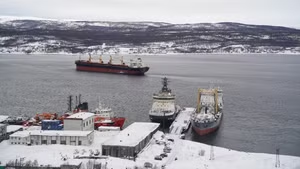
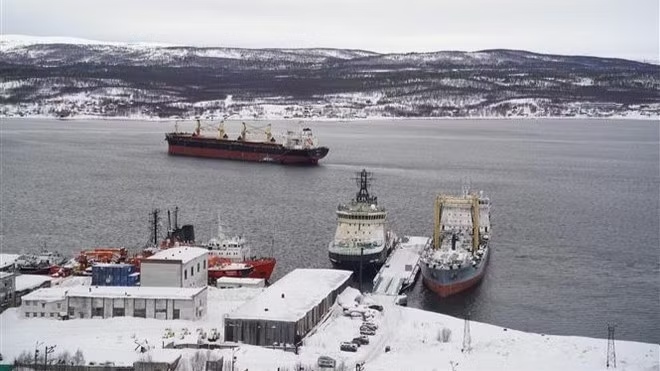
These commitments come amid intensifying competition among Arctic nations to protect their interests and maintain regional security. Such cooperation holds major strategic importance in terms of both security and energy, particularly as new shipping routes and natural resources such as oil, gas, and minerals attract global attention.
The Arctic, warming three to four times faster than the rest of the planet, is experiencing rapid ice melt, posing significant challenges in combating climate change while also opening up opportunities for resource exploitation and new maritime routes.
As close allies with shared interests in the Arctic, the Nordic countries and Canada agreed to work together to promote regional security and stability. They pledged support for NATO’s efforts to strengthen presence, deterrence, and defence in the region, following the launch of its new “Arctic Sentry” mission.
To bolster collective defence, security, and resilience, they will enhance defence industrial and production capacities, address hybrid threats, develop infrastructure, and advance interoperable, innovative and dual-use technologies. The Canadian federal government has placed strong emphasis on Arctic security, announcing in its 2025 federal budget a significant increase in defence spending to expand Arctic and maritime surveillance amid growing presence by other powers.
As open and advanced economies, the Nordic countries and Canada also committed to maintaining a rules-based international trading system, promoting cooperation, and expanding bilateral trade and investment. They reaffirmed efforts to improve access to critical minerals and reliable global supply chains, grounded in shared commitments to fair and open trade, as well as high environmental and labour standards.
Emphasising that zero-carbon energy sources and clean energy technologies can drive economic growth, create jobs, and reduce emissions, they pledged to expand cooperation to explore new trade and investment opportunities, scale up energy technologies, and build secure, sustainable energy supply chains.
With its strategic location and abundant resources, the Arctic is witnessing intensifying geopolitical competition, making enhanced regional cooperation an inevitable choice for countries with shared interests. With common values and strengths, Canada and the Nordic countries aim to deepen cooperation to ensure safety, security, and sovereignty, while building a green and prosperous economy.