Amid global market volatility caused by recurring conflict hotspots, nuclear power is increasingly seen as a strategic option for countries seeking to reduce dependence on fossil fuels and maintain a stable energy supply—the lifeblood of modern economies.
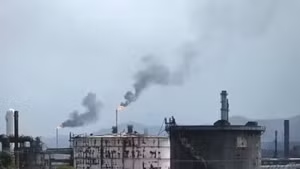
Recent conflicts have exposed numerous vulnerabilities in the global energy security landscape. Shortly after hostilities erupted in the Middle East, oil and gas supplies from the world’s “black gold” reserves were immediately disrupted, sending fuel prices repeatedly to new record highs.
Crude oil prices climbed to their highest level in four years, raising concerns over a potential surge in inflation. The shock has placed heavy pressure on many economies, particularly those heavily reliant on imported fossil fuels.
The uncertainty surrounding global energy supply has therefore intensified interest in achieving energy self-reliance through the development of nuclear power.
At the recent nuclear energy summit jointly organised by the Government of France and the International Atomic Energy Agency (IAEA), IAEA Director General Rafael Grossi stressed that nuclear power is a crucial factor in addressing supply challenges.
With advantages such as stability, high output capacity, and independence from weather conditions, geopolitical tensions, or disruptions in transport routes, nuclear power is increasingly viewed as a necessary option for ensuring energy security in a constantly volatile oil market.
For years, nuclear power development was controversial in many countries due to concerns over potential nuclear plant accidents.
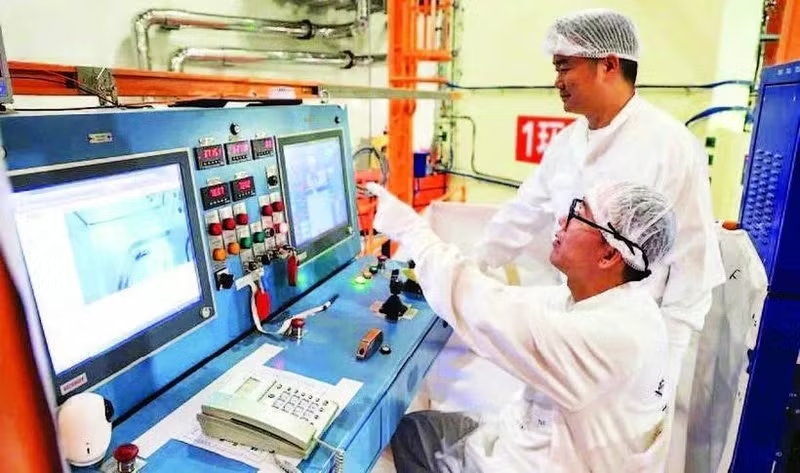
However, as production technology becomes more advanced, safer, and virtually emissions-free, nuclear energy is now regarded as a tool that enables countries to achieve the dual goals of ensuring energy supply while meeting climate commitments.
As a result, many countries in recent years have reversed their nuclear power policies. President of the European Commission Ursula von der Leyen acknowledged that the European Union had made a strategic mistake in turning away from civilian nuclear energy in the past.
According to her, heavy dependence on imported fossil fuels has left the continent vulnerable to geopolitical fluctuations and energy price shocks. Alongside EU member states, countries such as the US, the UK, India, and the Republic of Korea (RoK) are rapidly accelerating efforts to keep pace in this global race.
Recently, the RoK Government confirmed plans to build two additional nuclear reactors, expected to be completed by 2038 at the latest. Meanwhile, Indonesia is planning to construct its first nuclear power plant, which is projected to begin operations between 2032 and 2034.
IAEA Director General Rafael Grossi said that around 40 countries worldwide have already begun building or have expressed interest in developing nuclear reactors to meet rapidly growing energy demand.
The renewed interest in nuclear power is also seen as an inevitable outcome of the rapid expansion of Artificial Intelligence (AI), electrification, and digitalisation, all of which are significantly increasing energy consumption.
Data centres — facilities that store, process, and analyse vast amounts of data for applications ranging from e-commerce and digital finance to AI — require enormous and stable electricity supplies.
Recognising the rapidly growing demand for electricity, major technology corporations such as Google, Microsoft,and Amazon have recently announced investments in nuclear energy to address the “power hunger” of their data centres.
Despite growing interest, nuclear power still occupies a relatively modest position in the global energy mix, currently accounting for only about 10% of global electricity generation. Expansion of the sector has also progressed slowly due to high investment costs, lengthy construction periods, and numerous technical barriers.
To achieve the goal of tripling global nuclear power capacity by 2050, countries must address complex challenges, including maintaining stringent safety standards, ensuring fuel supply, developing supply chains,and training a skilled workforce.
The current energy price shock triggered by tensions in the Middle East presents numerous challenges but also provides strong impetus for countries to accelerate their energy transition.
In this context, the return of nuclear power appears to be an inevitable trend and an important factor in helping nations secure long-term energy security.