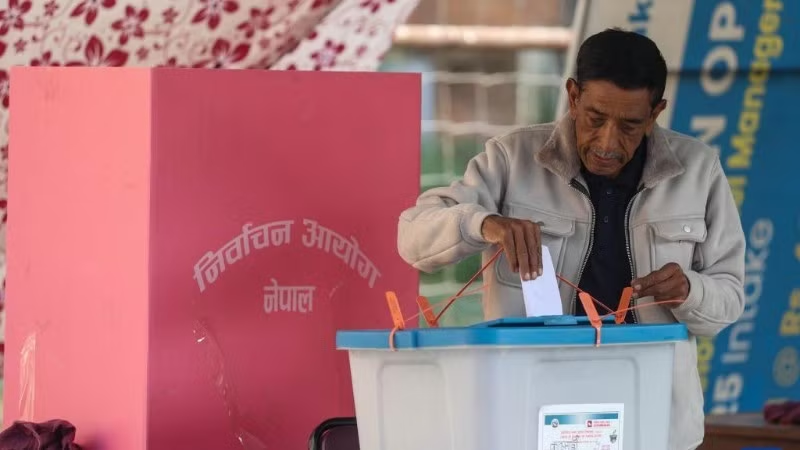
Nepali media reports that RSP’s triumph paves the way for 35-year-old leader Balendra Shah to become Prime Minister. More than a simple transfer of power, the change in Nepal’s political system is expected to be a hallmark of reform, marking the end of a period of socio-political crisis and ushering in a new chapter for the nation. The victory also carries special weight because Nepal’s path to development still faces many challenges.
Founded in 2022, RSP won 182 of 275 lower house seats in the parliamentary election on March 5 – a near-supermajority unseen since 1999, reflecting voters’ desire for renewal, particularly among the youth.
The election is a political event of great significance in Nepal, following turmoil in September 2025 when “Gen Z” protests against social media bans toppled Prime Minister K.P. Sharma Oli’s government and dissolved parliament.
The youth movement initially aimed to oppose the blocking of social media platforms, but observers believe it was the “last straw,” stemming from deeper causes: frustration over economic, political, and social issues, as well as unemployment.
World Bank data revealed youth unemployment at 20.8% in 2024. Voters sought efficient leadership and genuine reforms.
Founded in 2022, RSP won 182 of 275 lower house seats in the parliamentary election on March 5 – a near-supermajority unseen since 1999, reflecting voters’ desire for renewal, particularly among the youth.
Balendra Shah of the RSP is regarded as a fresh face on Nepal’s political scene. During his tenure as Mayor of Kathmandu, he took decisive action to address a range of the city’s problems, such as tackling illegal construction projects and improving waste management.
The demands placed on Nepal’s new leadership are not long-term or vague, but instead call for concrete, tangible results. Reuters quotes experts as saying that voters expect significant progress and innovation in Nepal, including the establishment of a stable government, zero tolerance for corruption, and effective governance.
The RSP’s action programme focuses on reforming public governance, boosting job creation for young people, and promoting a business-friendly environment for the private sector.
Nepal’s economy relies heavily on remittances, which account for about a quarter of GDP, so external geopolitical fluctuations have a major impact on the country. In particular, the conflict in the Middle East is affecting many Nepalese workers abroad. Restoring public trust in the state apparatus is also no small challenge for the government.
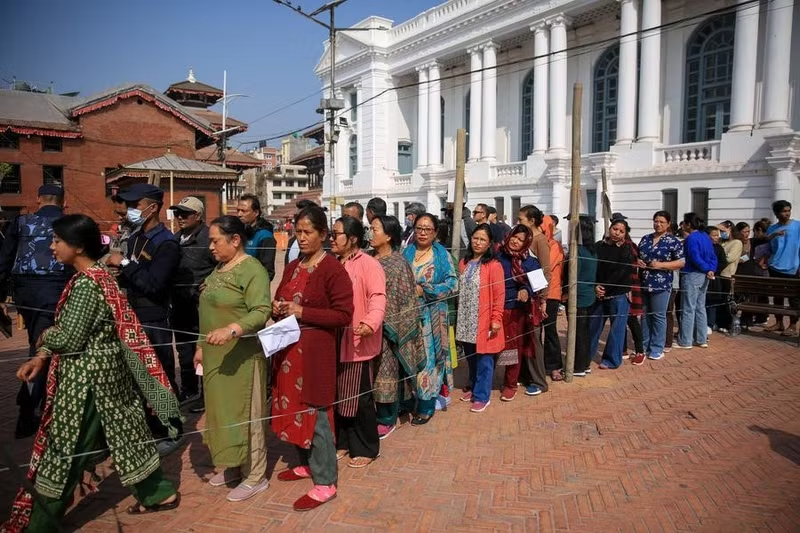
On foreign affairs, given its unique geographical position, Nepal stands at the “crossroads” of the interests of many major powers. Amid these intersecting flows of influence, the Nepalese Government will need to strive to maintain a flexible, balanced foreign policy oriented towards cooperative development, especially with major powers.
Immediately after the initial election results were announced, Indian Prime Minister Narendra Modi held a phone call to congratulate the RSP leadership and expressed his wish to strengthen cooperation between the two countries.
Victory in the election is merely the starting point; ahead lies a complex journey for the new government, under pressure to demonstrate its governance capabilities, address the country’s core issues, and meet the high expectations of the people.