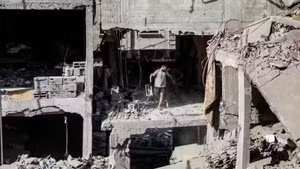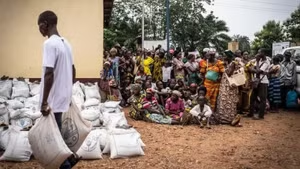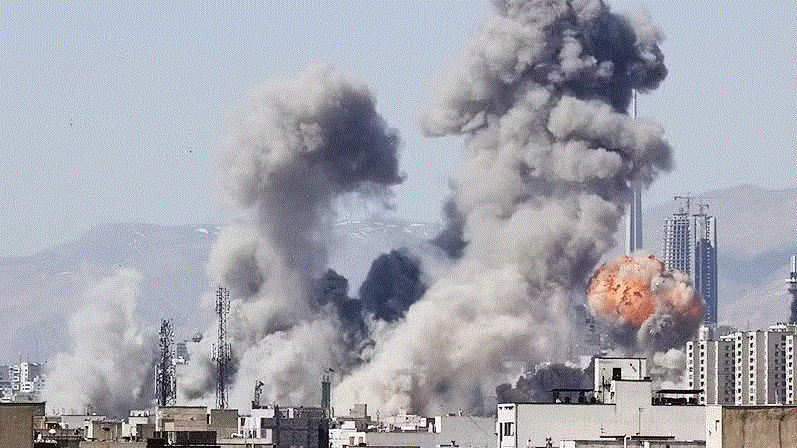
According to newly released data from the United Nations, damage to both lives and infrastructure continues to spread across Iran and Lebanon, while the humanitarian crisis in the Gaza Strip shows no sign of easing. Iran’s Ministry of Health reports that approximately 23,000 people have been affected by the conflict so far.
In response, the International Organisation for Migration (IOM) has been stretched to assist large numbers of vulnerable individuals trapped in the Middle East conflict to leave Iran.
The IOM notes that since the beginning of March, more than 130,000 people have risked crossing into Syria, while over 1 million have been displaced within Lebanon. The Office of the United Nations High Commissioner for Refugees (UNHCR) states that as many as 3.2 million people have been forcibly displaced.
Amid the prospect of a migration surge at any moment, Europe remains on high alert and shows no sign of complacency. Sweden’s Minister for Migration, Johan Forssell, observed that while there are currently no indications of a refugee wave heading towards Europe, “things can change very quickly”. The Republic of Cyprus has also warned against complacency in the face of a potential new migration crisis. The lessons of the migration crisis more than a decade ago remain vivid, when over 1 million migrants flooded into Europe.
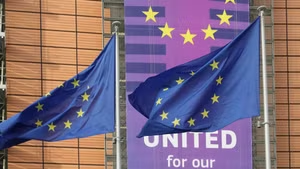
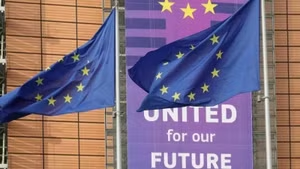
Discussing the Middle East at a summit in Brussels, Belgium, leaders of the European Union (EU) declared they would mobilise comprehensive resources, including diplomatic, legal and financial tools, to prevent a surge of migrants into the bloc and to safeguard European security.
Danish Prime Minister Mette Frederiksen and her Italian counterpart Giorgia Meloni have likewise called for tighter border controls. In a joint letter, the two leaders stressed that Europe cannot risk repeating the events of 2015, when millions fled the conflict in Syria and poured into the continent, disrupting Europe’s long-standing sense of calm and charm.
The letter underscored that the ongoing conflict in the Middle East is becoming increasingly concerning across multiple dimensions, spreading across a region already hosting large numbers of migrants, and warned of potential impacts on the EU’s security and cohesion. The two leaders urged the European Commission (EC) to approve a humanitarian aid package worth 458 million EUR (527 million USD) to help Middle Eastern countries bolster their capacity to manage migration pressures before people are left with no option but to risk dangerous journeys to Europe.
The EU is also accelerating the implementation of its Migration and Asylum Pact in June this year, aimed at curbing irregular migration flows that risk overcrowding and destabilising the bloc. Adopted in April 2024, the pact introduces stricter border control procedures and establishes a mandatory responsibility-sharing mechanism among member states, including financial and technical support for countries under significant pressure. Europol has launched the European Centre Against Migrant Smuggling in The Hague, the Netherlands, to enhance information sharing and coordination among member states.
The European Parliament (EP) has also approved a series of measures to strengthen migration control, notably endorsing the model of migrant reception and return centres located outside EU territory. These developments indicate that Europe is shifting from a reactive to a more proactive approach, reflecting a growing “iron fist” stance among EU member states in addressing increasingly severe migration challenges.