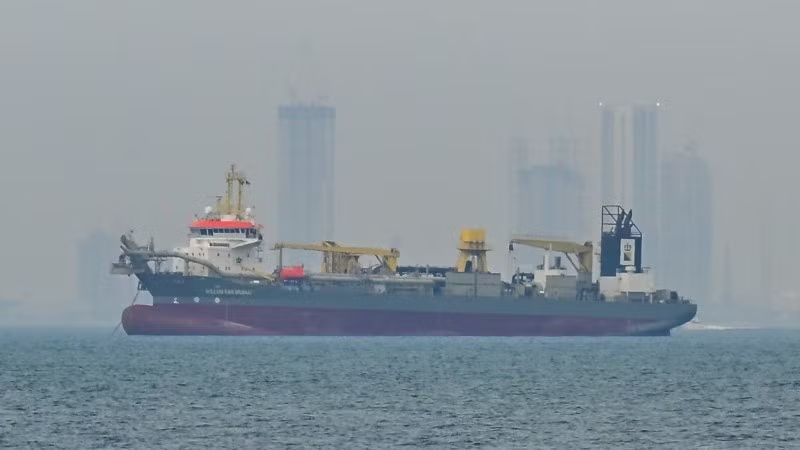
The Strait of Hormuz, a vital global energy shipping route, has become effectively paralysed. Oil and gas shipments through the strait have fallen by as much as 98%, with only one or two vessels per day permitted to pass.
Analysts note that even once the Strait of Hormuz reopens, restoring oil and gas production and maritime transport will depend on repairing damaged energy infrastructure, restarting oil and gas fields, and resolving maritime congestion, processes that could take years. Even under the most optimistic scenario, it will take months for global supply to return to normal levels.
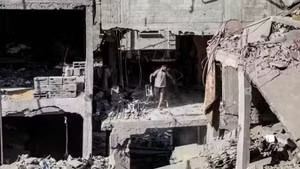
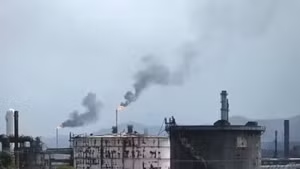
According to the International Energy Agency (IEA), more than 40 energy facilities across nine countries in the region have been severely damaged, making a swift supply recovery unlikely.
Qatar has announced that it will be unable to fulfil existing oil and gas supply contracts with multiple countries for the next five years. Major oil producers and refiners such as Saudi Arabia, Iraq, Kuwait, and the United Arab Emirates (UAE) are nearing the limits of their storage capacity.
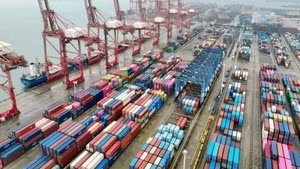
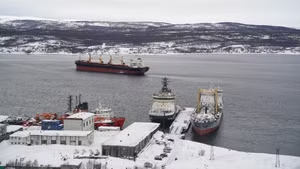
An additional 74 million barrels of oil have become stranded on tankers since late February. Currently, around 2,000 vessels carrying 20,000 seafarers remain anchored at sea, awaiting the reopening of the Strait of Hormuz.
Gas storage levels in Europe are now significantly depleted, with reserves filled to just 28.5%, compared with the ten-year average of 38.1%. Storage facilities in Germany, which holds the largest reserves in the European Union (EU), are only 22.3% full. Italy, the Netherlands, and France are facing similar shortfalls.
In Asia, soaring energy prices and tightening supplies have forced many countries to urgently implement measures to cushion the blow to their economies and daily lives.
The Republic of Korea has imposed price caps on petrol, diesel, and kerosene for the first time since 1997, aiming to ease the cost burden on households and businesses. The country is also taking strict action against unfair energy-related practices, including hoarding and unjustified price hikes. Seoul plans to release 22.46 million barrels of oil from its strategic reserves in April under an agreement with the IEA, of which it is a member.
Japan has decided to restart coal-fired power plants to address the risk of energy shortages. From April, the country will allow older coal-fired plants to operate at full capacity for one year, although such plants have long been subject to restrictions to curb CO2 emissions.
Environmental groups have acknowledged the difficulty of Tokyo’s decision, given that 90% of Japan’s crude oil and 10% of its liquefied natural gas (LNG) imports come from the Middle East and pass through the Strait of Hormuz.
The Philippines is also urgently seeking fuel supplies, with its Department of Foreign Affairs stating that it is ready to cooperate with any partner capable of supplying fuel.
The urgency facing the Southeast Asian nation is understandable, as domestic fuel prices have surged to record highs while oil reserves, according to President Ferdinand Marcos Jr, are sufficient for only about 45 more days.
The most severe energy crisis in global history has exposed the vulnerability of the Middle East’s energy system and the risks of over-reliance on a region long marked by instability.
Experts say once the situation stabilises, countries should strengthen their strategic reserves and diversify supply sources by engaging with a broader range of partners.