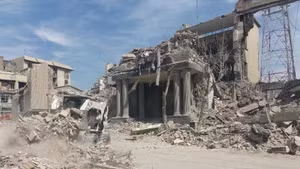
A few positive signals, though still fragile, have emerged in current security hotspots. More than a month after the conflict involving the US and Israel against Iran erupted, diplomatic efforts have continued to be intensively promoted by the international community behind the barrage of bombs on the battlefield.
In early April 2026, the US stock market at times recorded a clear upward trend, while oil prices edged down slightly. Market sentiment improved after US President Donald Trump stated that the US military campaign in Iran could end within the next two to three weeks and left open the possibility of reaching an agreement.
Clearly, volatility and disruptions will persist in the markets as military operations continue in the Middle East and no official declaration to end the conflict has been made. However, it cannot be denied that diplomatic initiatives and dialogue have fostered hope for finding a way out and helping to de-escalate tensions in a timely manner.
China and Pakistan have recently put forward a five-point initiative aimed at restoring peace and stability in the Persian Gulf and the Middle East, including calls for an immediate ceasefire and the launch of peace negotiations. Russia has also stressed its readiness to act as a mediator to promote diplomatic solutions to the conflict in the Middle East.
At other conflict hotspots, despite fierce military confrontations, the door to diplomacy remains open. Pakistan and Afghanistan have just resumed talks, with China acting as mediator, in an effort to seek a ceasefire after more than a month of clashes.
Meanwhile, on the Ukrainian battlefield, dialogues and negotiations continue along the fault lines of conflict. In late March 2026, delegations from the US and Ukraine met in Florida, the US, to discuss ways to revive negotiations, aiming to end the war in Ukraine that has lasted more than four years.
Such engagements may not yet yield breakthroughs, but they rarely disappear entirely in times of conflict. Diplomatic channels not only aim to resolve differences but also help maintain control. Moreover, diplomacy does not merely silence the guns; it also contributes to sustaining long-term peace in the post-conflict period.
However, amid today’s intense conflicts and competition, a question arises: can dialogue and diplomacy effectively fulfil their role in building peace, or do they merely act as a “pressure valve” for mounting tensions?
In reality, in some complex conflicts, dialogue mechanisms are activated intensively when crises escalate but tend to cool down once tensions show signs of easing and public attention shifts elsewhere.
The current situation in Ukraine is a case in point. The US — a key driver of peace efforts in the Ukraine conflict — is focusing on other priorities, causing the negotiation process to stall.
Other obstacles to dialogue mechanisms include deep differences in strategic interests among the parties, as well as the fact that mediating countries are themselves heavily affected by the conflict and caught in difficult diplomatic dilemmas.
Gulf countries that have long played mediating roles in Middle Eastern tensions, such as Bahrain, Saudi Arabia, Kuwait, and the United Arab Emirates (UAE), are grappling with both security and economic risks while also exercising caution in their foreign policy, as any decision could affect their relations with the US.
As military operations intensify on the ground, the prospects for achieving a sustainable ceasefire in conflicts remain highly fragile. In this context, the world is in need of pauses to ease tensions, reduce losses, and create space for parties to engage in dialogue and narrow their differences.