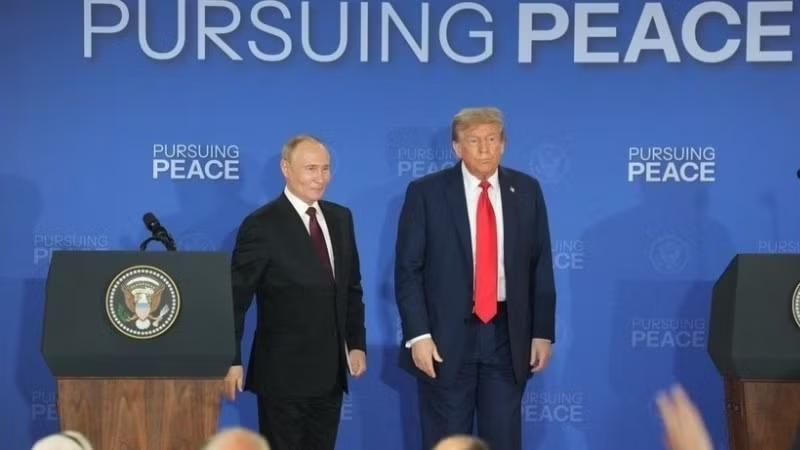
The recent Russia–US engagements, together with trilateral meetings including Ukraine, indicate that dialogue channels remain open, yet they have not been enough to generate meaningful progress. This reality continues to raise questions within the international community about the prospects for enhanced coordination to promote sustainable peace solutions to the protracted conflict.
On January 22, Russian President Vladimir Putin held hours-long talks at the Kremlin with US President’s Special Envoy Steve Witkoff, in what was described as a “frank, trusting, and constructive” atmosphere. The Russian side assessed the meeting as “useful in all respects”. However, observers note that the most crucial outcome — a concrete agreement on peace in Ukraine — remains elusive, as Moscow continues to stress territorial issues as a key condition.
A day later, on January 23, Russia, the US, and Ukraine held trilateral negotiations in the United Arab Emirates (UAE), seen as a positive sign of direct diplomacy since 2022. Nevertheless, many analysts argue that despite the launch of a new round of dialogue, the prospects for achieving a ceasefire or ending the conflict in the short term remain dim, given deep-seated differences in positions, particularly over territorial issues.
In reality, territorial disputes have long been the biggest stumbling block in diplomatic efforts. Ahead of the talks in Moscow, Witkoff suggested that after months of negotiations, the Ukraine dossier had been narrowed down to a single core issue. Although he did not specify, the territorial focus highlighted by the Russian side was hardly unexpected for observers.
With the core issue still unresolved, the absence of a major breakthrough in Russia–US talks has been widely anticipated. The limited expectations among analysts regarding immediate results also reflect a notable reality: hopes for breakthrough solutions to the Ukraine issue are gradually being adjusted downward.
This adjustment underscores the current state of the conflict in Ukraine, where a war that has dragged on for years is no longer seen as a temporary crisis but as a persistent challenge to the international security environment. Against the backdrop of rising military expenditures, mounting domestic economic pressures, and the emergence of multiple other hotspots, countries are compelled to reassess their allocation of resources and strategic attention.
In the US, Ukraine remains an important priority, but it is no longer the sole factor shaping foreign policy, as Washington simultaneously grapples with a range of other challenges, from strategic competition with major powers and instability in the Middle East to domestic economic and political issues. In Europe, signs of war fatigue are also evident in internal debates over the scale and form of support for Kyiv, even as countries continue to uphold their official stance in support of Ukraine’s sovereignty and territorial integrity.
The question, therefore, is how this fatigue, if present, is affecting national expectations in efforts to find a solution to the conflict. Recent developments suggest that while diplomatic contacts continue, many parties appear less focused on achieving comprehensive and breakthrough solutions in the short term, instead prioritising the maintenance of dialogue, the avoidance of strategic miscalculations, and the prevention of further escalation.
Despite maintaining a firm stance on the conditions for ending the conflict, Russia has repeatedly stated that it is not closing the door to dialogue. In practice, Moscow continues to engage in negotiations through bilateral and multilateral channels. For the Kremlin, keeping communication lines open is seen as essential to limiting risks and preserving room for future diplomatic manoeuvres, even though prospects for rapid progress remain limited.
Overall, the international community continues to seek answers to the Ukraine question. However, expectations of a major breakthrough have been recalibrated in a more cautious direction, in line with the reality that conditions are not yet ripe for a decisive agreement. As current diplomatic engagements focus largely on stabilising the situation, the key question is not only when the conflict in Ukraine may come to an end, but also how the international community will sustain its level of commitment and coordination in the face of a complex and protracted crisis.