At the 1955 Bandung Conference, which laid the foundations for principles of solidarity, friendship, and cooperation among nations for peaceful and prosperous development, former Prime Minister Jawaharlal Nehru, who laid the foundation for India's foreign policy, once affirmed: “We want to be friends with the West, friends with the East, and friends with everyone.” More than 70 years on, despite profound shifts in the global landscape, the spirit of friendship and cooperation he articulated remains a guiding compass for India’s foreign policy.
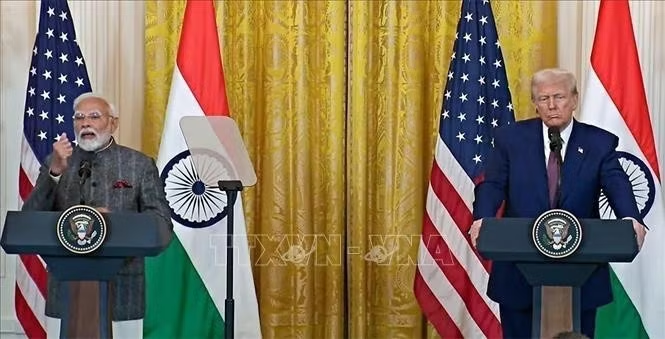
Unwilling to be drawn into a “choosing sides” mindset in international relations, India has consistently sought to balance its ties with major partners. Its deft handling of what could have been a diplomatic deadlock in relations with Russia and the US stands as a clear illustration. As one of Russia’s leading importers of crude oil, India has faced considerable pressure from the US in recent times. When Washington decided to impose hefty tariffs on Indian exports from August 2025, many analysts likened New Delhi’s position to walking a tightrope, questioning whether it could maintain balance under pressure from two giants.
Reality, however, has proven otherwise. On the one hand, through flexible diplomatic strategy, India has gradually untied knots at the trade negotiation table with Washington. In a recent statement, President Donald Trump expressed confidence that the two sides were moving closer to an agreement. On the other hand, India has continued to maintain close and durable ties with Russia, its leading partner in defence and energy.
Alongside efforts to balance relations with major powers, India has also underscored its solidarity with the Global South. As a core member of key multilateral organisations such as the major grouping of emerging economies BRICS and the Group of Twenty (G20), India has in recent years woven the concerns of southern countries into major international forums, opening up opportunities for developing nations to assert a rightful place on the global geopolitical map. New Delhi has thus increasingly emerged as a bridge between the Global North and the Global South.
India’s balanced foreign policy is also clearly reflected in the economic sphere. Contrary to the trend of “building walls and fortresses” through a series of trade protectionist measures pursued by some economies, India has opted for an open path of economic diplomacy. Over the past year alone, a number of trade agreements between the South Asian nation and various partners have been signed, further enriching its global network of partnerships.
Taken together, these diplomatic moves convey a clear message from New Delhi: flexibility in cooperation with partners and independence in foreign policy. India has skilfully promoted mutually beneficial cooperation while upholding the principle of non-alignment and steadfastly defending its positions when necessary.
This has been one of the key factors helping the South Asian nation achieve notable successes on its development path. A recently released report by the Indian Government shows that the country has risen to become the world’s fourth-largest economy, further affirming its position as a major power in the multipolar era. Persisting with an independent, balanced foreign policy grounded in national interests not only defines the distinctive character of Indian diplomacy, but also helps the country maintain strategic autonomy amid an increasingly complex and volatile international environment.