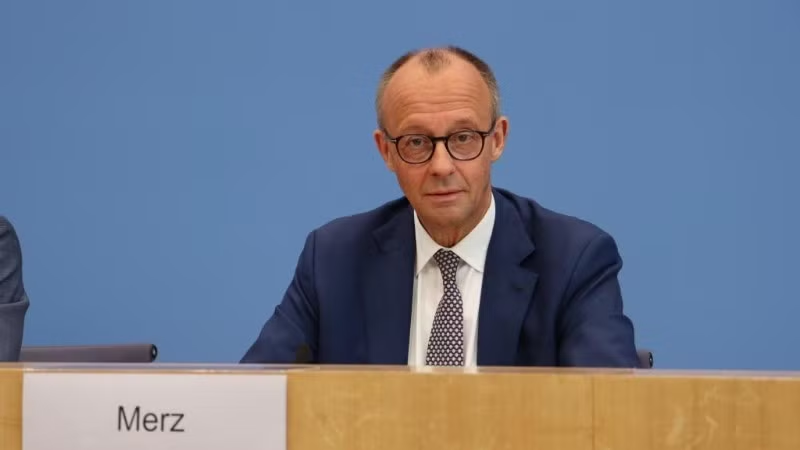
India’s Ministry of External Affairs has officially confirmed that, at the invitation of Prime Minister Narendra Modi, German Chancellor Friedrich Merz will pay an official visit to India from January 12–13. Taking place as the India–Germany Strategic Partnership marks its 25th anniversary, the visit is expected to build on the positive momentum generated by frequent high-level exchanges, while providing an important opportunity for both sides to review and assess cooperation outcomes.
During the visit, the two leaders are set to focus discussions on measures to boost cooperation in trade and investment, technology, and education and training, while expanding collaboration in key areas such as defence and security, science, innovation, and research, green and sustainable development, as well as people-to-people exchanges. The two sides will also exchange views on regional and global issues.
At a time when the international order continues to shift decisively towards multipolarity, strategic competition is increasingly overlapping, and major economies are racing to diversify partnerships, the German Chancellor’s visit to the South Asian nation carries significance beyond routine diplomacy. It offers Berlin and New Delhi an opportunity not only to reaffirm a shared vision for a future-oriented partnership, but also to reflect the calculations of both sides amid an ever-evolving global geopolitical landscape.
The visit also underscores an increasingly evident reality: India is moving from being a potential partner to becoming a strategic anchor in Europe’s foreign policy thinking, particularly for Germany, the EU’s economic engine. As Europe’s relations with major partners such as the United States and China face mounting challenges, and the continent’s security environment is deeply unsettled by the conflict in Ukraine, Berlin is increasingly seeking new avenues of cooperation beyond its traditional orbit. In this context, India, with its vast market, sustained growth momentum, and independent strategic posture, has emerged as an option that is hard to overlook.
Conversely, the trip also demonstrates Germany’s determination to adopt a more proactive role on the global stage. No longer content with focusing solely on the transatlantic space, Berlin is expanding its reach into the Indo-Pacific region. Strengthening cooperation with India across areas ranging from high-tech industries and energy transition to supply chain security and maritime security shows that Germany is not merely pursuing short-term economic gains, but is instead laying the groundwork for long-term partnerships in an increasingly fragmented world.
For India, the German Chancellor’s visit further reinforces international recognition of New Delhi’s growing role. For many years, India has pursued a policy of “strategic autonomy”, maintaining relations with multiple centres of power without becoming tightly bound to any single alliance. Deepening ties with Germany, and more broadly with the EU, helps India balance relations with major powers while expanding economic and technological cooperation with developed partners.
Viewed more broadly, the visit also carries symbolic significance for the emerging multipolar order. Germany–India relations are being advanced despite existing differences, including approaches towards Russia and other global issues, as well as divergent cooperation priorities. Yet it is precisely these differences that highlight a notable aspect of the visit: both countries are prepared to promote cooperation selectively. This reflects a new form of diplomacy, in which nations no longer seek comprehensive alignment but instead accept differences in exchange for tangible interests.
Amid an international landscape at the start of 2026 marked by complex and unpredictable shifts, the German Chancellor’s visit to India is widely seen as a calculated move, reflecting a broader trend among major economic powers to seek new partners. The closer alignment between Germany and India not only carries bilateral significance but also contributes to shaping how centres of power cooperate in an increasingly multipolar, complex, and competitive world.