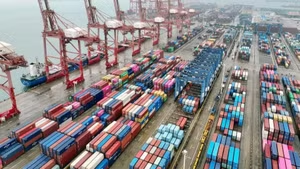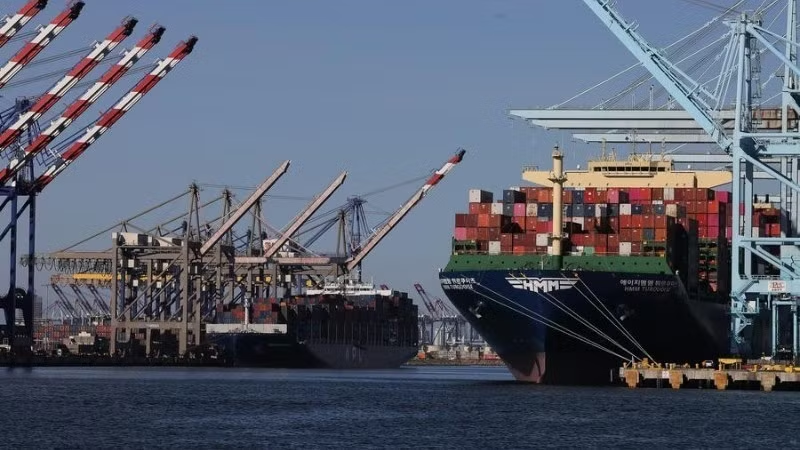
The global economy is undergoing one of the most profound transformations in decades, with the continuous erection of tariff barriers. Although the world economy has made a spectacular turnaround and shows better-than-expected recovery potential in 2025, the risk of trade wars remains, posing many new challenges. In its recently published report, “The World Economic Outlook 2026,” the United Nations noted that the consequences of protectionism will become clearer this year as the impact of tariffs begins to sink deeper and become more apparent.
However, in this volatile context, conversely, a trend of strengthening linkages between countries and regions has gradually emerged, becoming a “lifeline” helping many economies weather the storm. Bloomberg quoted Professor Ina Simonovska of the University of California (the US) as saying that the international trade map is being redrawn, with the emergence of more and more bilateral and inter-regional agreements.
A series of new Free Trade Agreements (FTAs) have emerged, opening up broader opportunities for economic cooperation and promoting the smooth flow of global trade. Accordingly, the UK recently signed an upgraded FTA with the Republic of Korea, marking the fourth trade agreement London has signed with major partners in just one year.
India, the world’s most populous country, has also completed three more free trade agreements with the UK, Oman, and New Zealand, and is striving to finalise its FTA with the European Union (EU) by January 2026, thereby gradually realising its ambition to become a major export power.
These negotiations between India and the EU are taking place against the backdrop of the Green Flag Alliance’s planned signing of a large-scale trade agreement with the Southern Common Market (MERCOSUR) on January 17, after more than 25 years of arduous negotiations and numerous near-collapses.
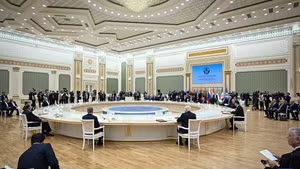
Against the backdrop of continuously erecting global trade barriers, posing a common threat to many countries, efforts to strengthen economic cooperation among nations are gradually becoming an inevitable trend, helping to anchor economies against the unpredictable fluctuations of today. This trend reflects the strategic adjustments of countries to adapt to the wave of protectionism and the restructuring of global supply chains.
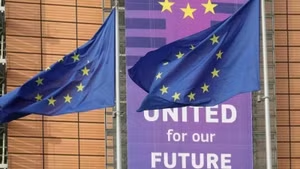
EU Commissioner for Trade and Economic Security Maros Sefcovic affirmed that the network of FTAs is becoming a key driver helping the bloc reduce dependence on traditional partners, expand markets, boost export growth, and increase the resilience of the economy.
Beyond economic benefits, the expanding network of FTAs is also clear evidence of the strong vitality of multilateralism. When the US announced new tariffs in April 2025, the world worried not only about a global recession but also about the decline of multilateralism. However, the cooperative efforts of countries and regions have significantly contributed to strengthening the rules-based global trading system, minimising pressure from protectionist measures.
Despite achieving certain successes in mitigating the impact of protectionism, countries are expected to face many difficulties in 2026, especially as tariff measures begin to deeply affect the economy. The World Bank (WB) predicts that global trade growth will decline significantly in 2026.
If current trade tensions persist, the resilience of the global economy will be difficult to sustain in the long term. In this context, expanding the network of Free Trade Agreements (FTAs) will continue to be the “golden key” helping countries open new export markets, participate more deeply in global value chains, and create momentum for sustainable economic development.