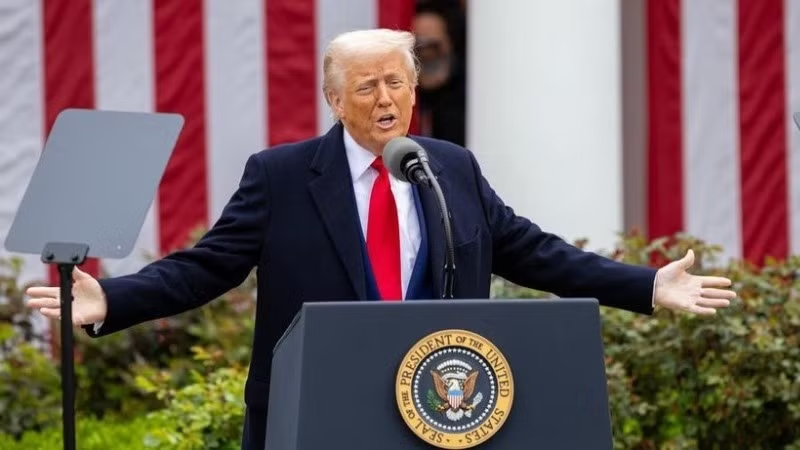
White House Press Secretary Karoline Leavitt explained that the bill is grounded in practical realities and seeks to address the root causes driving soaring healthcare costs. The first step of the plan is to “cool down” prescription drug prices through President Trump’s “Most Favoured Nation” initiative. Under this initiative, the White House expects Americans to pay prices for medicines that are no higher than those paid in other countries, rather than the exorbitant prices that are currently prevailing. The plan also allows consumers to purchase certain widely approved and commonly used medicines without a doctor’s prescription.
The next step is to put an end to billions of US dollars in budget subsidies for insurance corporations. Instead, these funds will be channelled directly to American citizens, enabling them to freely and flexibly choose insurance packages that suit their personal and family needs. The Trump administration has affirmed that it will continue to support programmes that share the burden of healthcare costs, while resolutely eliminating commissions and “under-the-table deals” between pharmaceutical companies and healthcare providers.
The Great Healthcare Plan requires all medical facilities and insurance companies affiliated with the Medicare and Medicaid programmes to publicly disclose their price lists and service fees. The objective is to put an end to abnormally high medical bills — a persistent problem over many years that has caused significant financial harm to American households. This policy has been warmly welcomed by the public, although it has yet to be fully implemented.
The draft bill also compels insurance corporations to promptly disclose premiums, payments, and compensation in the simplest and clearest manner possible. According to the Trump administration, greater transparency will help Americans make informed decisions when selecting health insurance plans, rather than having to navigate the dense maze of complex, obscure, and unclear regulations, conditions, and benefits that characterise the current insurance system.
Many Americans have expressed their delight on learning that the plan will fund programmes to reduce co-payment costs for health insurance packages, helping them save at least 36 billion USD and cut more than 10% from the cost of Obamacare insurance plans.
In support of the Great Healthcare Plan, the US House of Representatives also moved swiftly to pass a supplementary budget bill worth nearly 80 billion USD, with an overwhelming vote of 341 in favour and 79 against. In reality, this move was primarily intended to avert the risk of a government shutdown at the end of January. The rapid passage of the supplementary spending package reflects a rare moment of bipartisan consensus in American history.
However, passing budget legislation has never been entirely smooth, whether under the Democratic or Republican parties. Budgetary issues are always bargaining chips placed on the negotiating table at the most difficult moments, and funding for the Department of Homeland Security (DHS) is no exception.
Democrats have threatened to withhold support for any Republican-proposed bill to increase funding for DHS unless there is a commitment to end abuses of power by the Immigration and Customs Enforcement agency (ICE). This pressure stems from an incident in which an ICE officer fired a weapon — described by DHS as “accidental” — resulting in the death of an American citizen. The incident has exposed deep divisions within the US over the role, authority, and legal accountability of law enforcement officers, as well as fuelling public discontent.
The White House has asserted that the Trump administration’s Great Healthcare Plan is a comprehensive and bold programme designed to ease the burden of medical costs on the American people. Nevertheless, observers note that even if the bill is approved by both the House of Representatives and the Senate, it is likely to face a bruising and arduous journey across the negotiating table.