Efforts to secure an EU budget agreement for 2028–2034 by the end of 2026 are facing challenges as differences among member states become increasingly apparent.
Speaking in Berlin (Germany) after a closed-door meeting with the leaders of Denmark, Finland, Austria, the Netherlands, and Sweden, German Chancellor Friedrich Merz said the budget increase proposed by the European Commission (EC) was “too high” at a time when many member states are having to fortify their fiscal positions. Germany and the other countries called for a significant reduction in the bloc’s proposed long-term budget for 2028-2034. The six countries currently contribute about 40% of the EU budget.
The budget was a prominent issue at the EU summit in June. Establishing consensus on spending and sources of revenue to fund the bloc’s objectives in the coming period is no easy task. The EU is caught between a group of major budget contributors that favour spending controls and a group of Southern and Eastern European countries that oppose reducing the size of the budget and support, while calling for the EU to allocate more resources to agriculture and development funds.
In July 2025, the EC proposed a budget of around 1.76 trillion EUR for 2028-2034. The proposed budget plan, which EC President Ursula von der Leyen described as “the most ambitious ever”, is intended to reflect efforts to enhance the EU’s flexibility and ability to adapt to a series of major disruptions in recent years, including the COVID-19 pandemic, crises and their impact on energy security, inflation, and economic competitiveness.
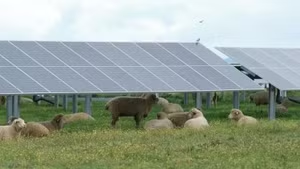
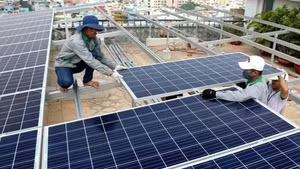
In particular, the proposal calls for a sharp increase in defence spending. This is in line with Europe’s goal of strategic autonomy amid prolonged geopolitical tensions and strained relations with the United States, its key ally across the Atlantic. At the same time, the EU is focusing on substantial investment in green technology projects, reaffirming the continent’s pioneering role in the drive towards carbon neutrality. The bloc is also prioritising spending on strengthening competitiveness through research and technological innovation. The budget proposal can therefore be seen as reflecting the EU’s ambition and determination to fortify its autonomy and elevate its standing on the international stage.
However, there is a substantial disparity between strategic ambition and practical action. Financial disparities among member states are one factor behind this gap. The EU budget is funded primarily through contributions based on member states’ gross national income. As a result, a sufficiently robust common budget to fulfil the bloc’s objectives and ambitions could place a heavy financial burden on some economies.
German Chancellor Friedrich Merz said the proposed 60% increase in the EU budget was “simply unaffordable”. Germany and several other countries argue that the overall size of the proposed budget should be reduced by hundreds of billions of euros, with cuts applied across all areas. Ireland, which currently holds the rotating presidency of the Council of the EU, is seeking to bridge the divide between the sides and is preparing a budget negotiation document for October, including a spending plan and new revenue sources for the common budget.
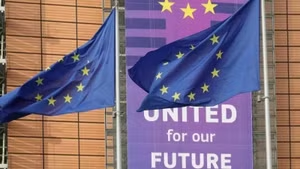
As expectations for the EU’s global role continue to grow, the bloc’s actual financial capacity has yet to fully match them. Reaching agreement on the allocation of the budget for the coming period is expected to involve arduous negotiations. The budget is not merely a financial issue; it will also remain a test of the EU’s unity in seeking ways to respond to a volatile geopolitical environment.