Against this backdrop, the government of British Prime Minister Andy Burnham is actively seeking to pursue more pragmatic cooperation with the EU, leveraging the economic and security benefits of closer ties to win public trust and support.
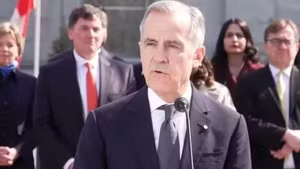
More than a decade after the referendum on Britain’s departure from the EU, the country is now accelerating efforts to move closer to Brussels. During a recent meeting with European Council President Antonio Costa aboard a train bound for the Ukrainian capital Kyiv, British Prime Minister Andy Burnham asserted that London needed to be “bolder” in pursuing closer relations with the EU, including stronger security and defence ties. The two leaders agreed that the UK–EU Summit scheduled for later this year would provide a valuable opportunity to advance bilateral relations.
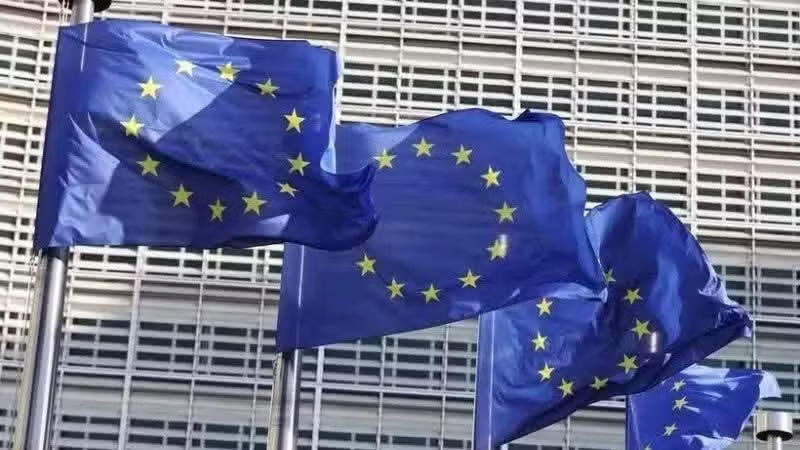
After a period in which UK–EU relations remained mired in tension and mistrust in the wake of Brexit, both sides have come to recognise the costs of separation, particularly amid today’s increasingly unpredictable global landscape. US tariff policies and uncertainty surrounding transatlantic relations with Washington have given London and Brussels further impetus to draw closer together.
Since the Labour Party came to power in Britain in 2024, relations between the two sides have improved significantly. In early August 2026, regional media reported that Prime Minister Andy Burnham had put forward a plan to expand Britain’s nuclear deterrence role in Europe in exchange for greater access to the EU Single Market for British goods. London’s strong military capabilities serve as a crucial advantage in its efforts to reconnect with the EU, particularly as Europe seeks greater defence autonomy.
Scepticism over the actual benefits of Brexit remains widespread across Britain. Over the past decade, political turmoil and sluggish economic growth have made it difficult for Burnham’s predecessors to convince the public that their lives would genuinely improve following Brexit. Research indicates that by 2025, UK GDP was 6–8% lower than it would have been had the country remained in the EU.
According to a survey released by global polling company Ipsos in June 2026, 38% of British respondents considered Brexit “a mistake”, a significant increase from 24% in 2016. Improving relations with the EU has therefore become a practical necessity for Britain as it seeks to stabilise its economy and society. Although no longer an EU member, Britain remains an integral part of Europe’s security architecture. For the EU, meanwhile, Britain’s departure deprived the bloc of a major economic and military power, leaving a substantial gap in both its security and economic strength.
Some sections of public opinion favour Britain rejoining the EU, but this remains highly unlikely given the political and legal complexities involved in re-entering the bloc. Former EU Brexit chief negotiator Michel Barnier has stressed that Britain’s departure from the EU was a sovereign decision that cannot be reversed, while noting that the future of relations between the two sides remains open.
More than a decade of political upheaval and economic and social disruption has gradually eroded expectations among some Britons of a prosperous “Global Britain” in the post-Brexit era. The international landscape has also changed significantly since the historic Brexit divorce took place. Amid mounting challenges, steering UK–EU relations towards reconciliation and closer cooperation is increasingly seen as a strategic choice for both sides to strengthen their position, capabilities, and resilience in the face of emerging challenges. The experience of recent years has shown that standing alone is rarely the path to greater strength.