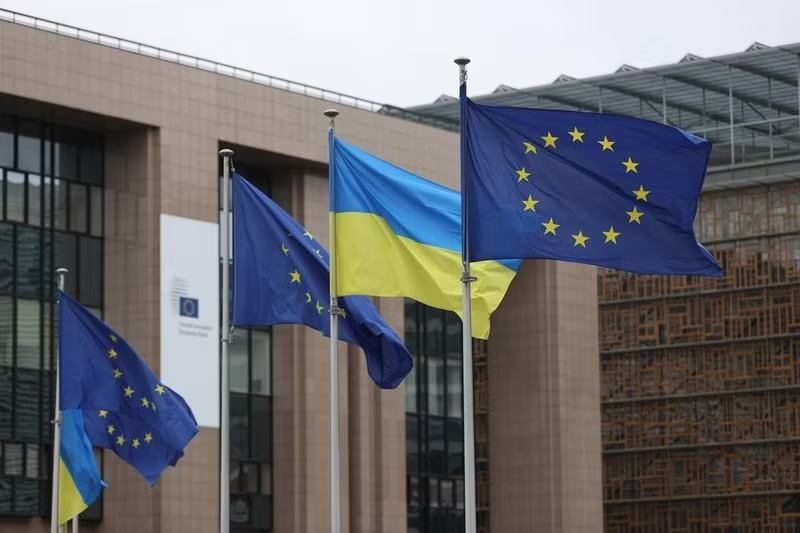
The scenario of Ukraine entering the EU from January 2027 has emerged as a hot topic in Western media.
The Financial Times, citing informed sources, reported that Ukraine would be slated to join the EU by January 1, 2027 under a peace proposal being discussed as part of US-mediated negotiations to end the Russia–Ukraine conflict. According to the report, the proposal was being negotiated by US and Ukrainian officials with the support of Brussels.
The idea of swift accession has been incorporated into an updated US-led plan to end the conflict, alongside “territorial conditions” that remain the most intractable sticking point in peace talks between Russia and Ukraine.
Ukraine would be slated to join the EU by January 1, 2027 under a peace proposal being discussed as part of US-mediated negotiations to end the Russia–Ukraine conflict.
The proposal, which may involve potential Ukrainian territorial concessions to Russia, has sparked widespread debate across Europe. Against this backdrop, Kyiv stresses it is only willing to discuss territory once Washington provides sufficiently robust security guarantees.
Ukraine has pursued EU membership for years and has enacted key reforms, but major challenges remain—particularly in tackling corruption and strengthening judicial independence. These are among the prerequisite conditions for joining the bloc. Despite strong political backing, Ukraine’s path to EU membership remains long in practice.
Ukraine must still meet stringent requirements on reforms, anti‑corruption measures, economic governance, and enforcement of EU law. Moreover, accession requires unanimous approval from all 27 member states. Ongoing opposition from some countries, particularly Hungary, continues to pose a significant obstacle.
Public opinion remains divided over the proposed 2027 timeline. For many, setting Ukraine’s accession target for early 2027 is not merely symbolic but a necessary strategic decision for European security. EU membership is expected to bolster stability on Europe’s eastern flank, narrowing the “grey zone” of political‑security concerns that has troubled Brussels for years.
Despite clear political determination, the goal of Ukraine joining the EU right from early 2027 continues to raise scepticism, with many arguing that this expectation may exceed implementation capacity and the current reality.
Completing accession standards by early 2027—amid ongoing conflict—presents an immense challenge for Kyiv.
EU membership is expected to bolster stability on Europe’s eastern flank, narrowing the “grey zone” of political‑security concerns that has troubled Brussels for years.
From the EU’s perspective, admitting a large country with massive reconstruction needs would strain the budget and force wide‑ranging policy adjustments.
More critically, pushing accession while the Russia–Ukraine conflict remains unresolved carries geopolitical risks.
Although EU membership does not equate to NATO accession, admitting a country still at war would set an unprecedented precedent, requiring utmost caution.
Support for Ukraine’s EU accession has never been stronger. Accelerating the integration process sends a clear geopolitical message that the EU is ready to anchor Kyiv’s future within Europe’s strategic structures. Some EU leaders view 2027 as a feasible target to sustain reform momentum and bolster Ukraine’s confidence.
However, realising this scenario hinges on key factors: developments in the conflict, the pace and depth of reforms in Ukraine, and the EU’s institutional readiness.
How Brussels handles the “Ukraine dossier” will be seen as a vital measure of the bloc’s geopolitical role and strategic capacity in shaping Europe’s future order.