According to the Agency for the Cooperation of Energy Regulators (ACER), EU gas storage facilities were only 28% full at the start of the summer refilling season, the lowest level recorded in the past four years.
The situation has fuelled concerns that the EU may struggle to meet its legally mandated target of filling gas storage facilities to 90% of capacity by November.
Although the European Commission (EC) has granted greater flexibility by allowing some member states to maintain minimum storage levels of 70% under exceptional circumstances, ensuring energy security remains a major challenge for the bloc.
Analysts say the EU will need to accelerate both the pace and volume of gas imports in the coming months to achieve its storage targets.
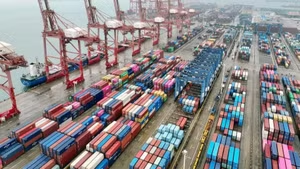
However, turbulence in the global energy market has complicated those efforts. Supplies of liquefied natural gas (LNG) have tightened significantly as production facilities in the Middle East have faced disruptions caused by regional conflicts.
Gas prices have also climbed to their highest level in a month after escalating tensions in the Strait of Hormuz raised fears that LNG shipments from the Middle East could face further disruptions.
These challenges have once again cast doubt on Europe's strategy to achieve energy independence after reducing its reliance on Russian gas.
For decades, Russian gas served as a cornerstone of the EU's energy system thanks to its stable supply, competitive prices and extensive pipeline network.
However, following the escalation of the conflict in Ukraine, the EU moved swiftly to phase out Russian gas imports. Under its roadmap, the bloc plans to end imports of Russian LNG by the end of 2026 and pipeline gas before November 2027.
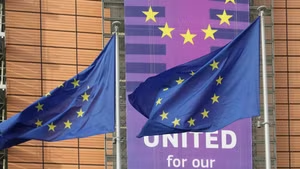
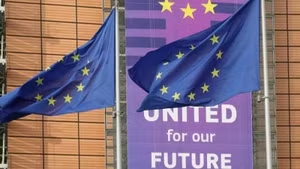
European Commission President Ursula von der Leyen described the move as a historic turning point that would usher in a new era of energy independence for the 27-member bloc.
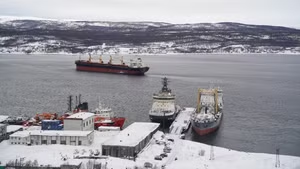
Yet significant obstacles remain, foremost among them securing alternative supplies. After scaling back Russian gas imports, the EU turned increasingly to LNG from the US, making Washington the bloc's leading energy supplier.
The Institute for Energy Economics and Financial Analysis (IEEFA) forecasts that if current trends continue, the US could account for as much as 80% of the EU's LNG imports by 2030.
Observers warn, however, that excessive dependence on US supplies could leave Europe vulnerable to a new form of energy reliance, echoing its previous dependence on Moscow.
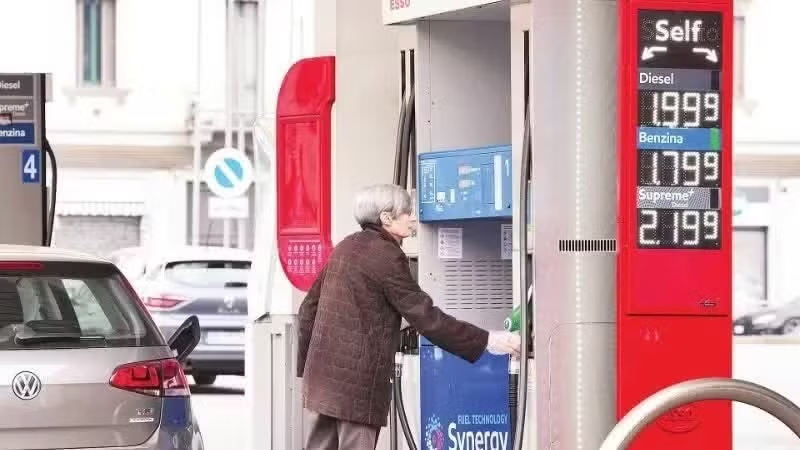
According to Modern Diplomacy, energy prices in Europe remain significantly higher than those in several of the world's leading economies, placing considerable pressure on energy-intensive industries such as chemicals, steel, cement and aluminium.
This price gap is not merely a commercial issue but one that could undermine the competitiveness of European industry.
Despite these challenges, the EU has made notable progress towards greater energy autonomy.
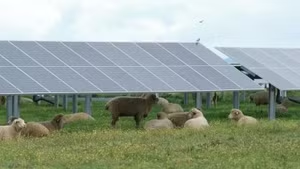
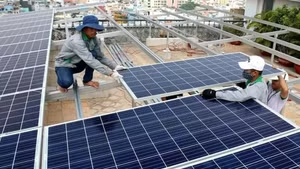
In 2025, the bloc reached a historic milestone in its energy transition when electricity generated from wind and solar power exceeded that produced from fossil fuels for the first time.
The achievement reflects the rapid shift towards a renewable-based power system and reduced dependence on imported fossil fuels.
The EU has also diversified its energy sources by replacing Russian supplies with imports from Norway, Qatar, the United States and Algeria.
While recent volatility in global energy markets presents significant challenges, it also offers the EU an opportunity to accelerate the development of a more sustainable, flexible and resilient energy system capable of withstanding future geopolitical shocks.
How successfully the bloc replenishes its gas reserves this year will serve as a crucial test of its ability to safeguard Europe's long-term energy security.