News of the US-Iran agreement immediately triggered a sharp decline in global oil prices, although they have yet to return to the more comfortable levels seen before the conflict.
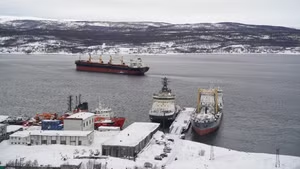
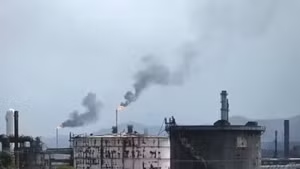
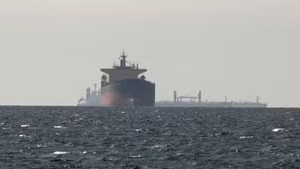
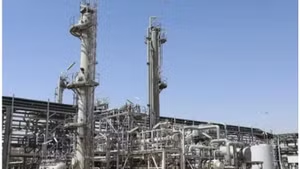
Energy companies still require time to restore extraction, refining and transportation activities. Several major oil producers in the Middle East were forced to reduce or temporarily suspend production after storage facilities reached capacity while exports were halted during the closure of the Strait of Hormuz.
According to industry experts, only Saudi Arabia and the United Arab Emirates (UAE) are likely to recover more quickly, thanks to alternative export routes that bypass the strait. Iraq and several other oil-exporting countries may require up to a year to restore production to normal levels.
Daniel Evans, Global Head of Refining and Marketing Research at S&P Global Energy, stressed that shipping and insurance companies would need additional time to assess security conditions before resuming normal operations.
Moreover, global oil supply chains operate on lengthy cycles, meaning that crude extracted from oilfields often takes weeks or even months to reach refineries and end consumers.
Nevertheless, lower oil prices are already providing positive signals for many economies that depend heavily on imported energy.
Kelly Eckhold, Chief Economist at Westpac Bank, said that if the US-Iran agreement remains in place, petrol prices in New Zealand could soon fall below 3 New Zealand dollars per litre (around 2 USD) for standard 91-octane fuel.
Some analysts argue, however, that the true impact of the agreement will depend on whether the ceasefire can be sustained over the long term.
This means that global energy markets may still need time before they can fully benefit from the positive effects of the new deal.
Meanwhile, the Middle East conflict has prompted many countries to accelerate the development of domestic energy sources, including renewable energy, nuclear power and coal, in response to what has been described as the most severe energy security crisis in modern history.
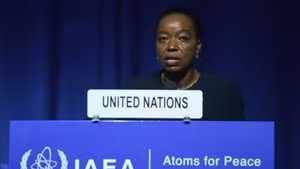
In its World Energy Investment report, the International Energy Agency (IEA) warned that the world is facing an unprecedented energy security challenge.
IEA Executive Director Fatih Birol noted that both energy-producing and energy-consuming countries are diversifying supply sources and trade routes, including by constructing new pipelines, expanding energy infrastructure and maximising the use of available domestic resources.
The IEA forecasts that global energy investment will reach approximately 3.4 trillion USD in 2026, slightly higher than the previous year.
Of this total, around 2.2 trillion USD is expected to be invested in power grids, energy storage systems, low-emission fuels, nuclear energy, renewable energy, energy-efficiency measures and electrification. A further 1.2 trillion USD will continue to be directed towards oil, natural gas and coal.
Despite higher crude oil prices, investment in oil is expected to decline for a third consecutive year in 2026, falling below 500 billion USD.
By contrast, investment in natural gas is forecast to rise to 330 billion USD, the highest level in a decade, driven by a wave of new liquefied natural gas (LNG) export projects, particularly in the US and Qatar.
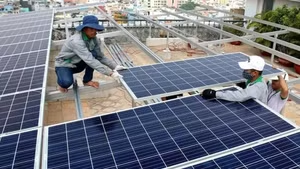
Investment in renewable energy is projected to reach 665 billion USD in 2026, including 365 billion USD for solar power alone. Investment in nuclear energy is expected to total 80 billion USD, while coal investment is forecast to reach 180 billion USD, its highest level in the past ten years.