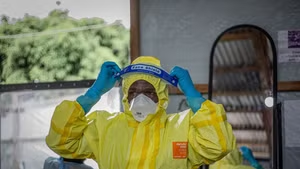
Despite many efforts by the international community to prevent and stamp out the epidemic, the 17th Ebola outbreak in the Democratic Republic of the Congo remains complicated. In just over a month, Ebola has infected at least 1,307 people and claimed the lives of 377 unfortunate victims in the country.
Officials from the World Health Organisation (WHO) expressed concern, noting that Ebola had spread to Haut-Uele, the fourth province of the Democratic Republic of the Congo, meaning that the entire north-eastern region of the Central African country, home to about 15 million people, is now caught in the epidemic.
A current issue causing further headaches for African health authorities is that nearly 300 people identified as positive for the Ebola virus are now “out of contact”, making zoning and tracing work more difficult and complicated, with the risk of going beyond control.
According to the head of the Africa Centres for Disease Control and Prevention (Africa CDC), the inability to determine the whereabouts, movements, and contacts of these patients shows serious gaps in surveillance and tracing.
Ebola has also crossed the border into neighbouring Uganda. However, Africa CDC and Uganda have shown significant efforts in epidemic prevention and control. Since the first case was detected on May 15, Uganda, together with Africa CDC and the international community, has imposed strict and effective prevention and control measures. The figures of 20 infections and two deaths in Uganda over the past more than a month and a half have demonstrated the country’s efforts to stamp out the epidemic.
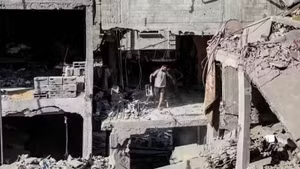
In the face of the worrying epidemic situation, WHO has forecast that the number of Ebola infections could exceed 8,000 and the death toll could reach 1,400 by mid-September this year, while assessing that there is a 70% possibility that the epidemic will spread to neighbouring South Sudan. According to WHO, in the worst-case scenario, the number of cases could exceed 60,000 by September. One of the biggest obstacles to controlling the epidemic is that more than 1 million people in affected areas are currently beyond the reach of health teams due to the prolonged conflict in eastern Democratic Republic of the Congo.
In that context, many countries have heightened vigilance over the complicated developments of the Ebola epidemic in the Democratic Republic of the Congo. The US has activated its highest response level for Ebola, while announcing the transfer of clinical trial treatments to the Democratic Republic of the Congo and Uganda.
US CDC leader Satish Pillai declared the highest response level, level 1, although he acknowledged that the risk of infection for the US remains low. US health officials warned that if it is not brought under control soon, this outbreak could exceed the scale of the Ebola epidemic in the 2014-2016 period.
Saudi Arabia, although it has not recorded any Ebola cases since 2019, has also issued an entry ban on citizens from three African countries, namely the Democratic Republic of the Congo, Uganda, and South Sudan, while tightening health control measures for people arriving from Rwanda, Burundi, Tanzania, and the Republic of the Congo to prevent the risk of the epidemic entering the country.
Saudi Arabia has suspended the issuance of entry visas to people who stayed in the three countries mentioned above within 21 days before arriving in the Middle Eastern country. Arrivals from these countries will undergo medical checks at border gates and be subject to epidemic surveillance measures.
The United Nations has warned that the current Ebola outbreak could cost Africa up to 3.6 billion USD and lead to the loss of hundreds of thousands of jobs, risking a development crisis across the region.
Health officials hope that with the joint efforts and support of the international community, Ebola will soon be brought under control, thereby bringing peace to the people of the Democratic Republic of the Congo, who have already endured too many hardships due to prolonged civil war.