Countries across Europe are recording successive temperature records, serving as a stark warning from nature about the ever-present threat facing the planet unless humanity responds with action that is commensurate in both speed and scale.
Extreme heatwaves, devastating floods, and prolonged droughts are becoming increasingly frequent.
The Danish Meteorological Institute has reported the highest temperature ever recorded in the country, reaching 36.6 degree Celsius. Poland has also issued a Level 3 heat alert, its highest warning level, from June 27 to 29.
Meteorologists say the current heatwave is unlike anything Poland has experienced in more than a century, with all-time temperature records being broken in several parts of the country.
According to estimates, more than one billion children worldwide are simultaneously exposed to the impacts of at least three different forms of extreme climate events, while temperature records continue to be broken across the globe.
Simon Stiell, Executive Secretary of the United Nations Framework Convention on Climate Change (UNFCCC), stressed that the severe heatwave currently scorching Europe is a clear warning of the escalating climate crisis.
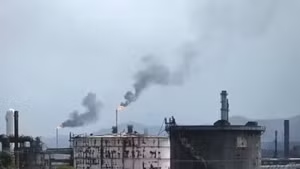
It is also the price being paid for the pollution caused by the continued burning of fossil fuels.
What is unfolding across Europe represents only part of a much broader global picture marked by increasingly extreme weather events. The world has not had a lack of warnings about the growing severity of climate change.
Numerous meetings have been held and countless commitments made. Yet the gap between promises and concrete action remains unbridged, due in part to deeply entrenched conflicts of interest among nations.
The 30th session of the United Nations Climate Change Conference (COP30), held in Brazil last year, laid bare this reality. After lengthy negotiations, the final agreement failed to establish a clear roadmap for phasing out fossil fuels.
The outcome disappointed many countries, reflecting a sharp divide between two competing interests. On one side are nations with significant economic interests in fossil fuels that seek to safeguard their core energy priorities. On the other are countries bearing the brunt of climate change, calling for decisive action to eliminate fossil fuel use.
Simon Stiell recently warned that unless the world stops burning vast quantities of coal, oil, and natural gas, extreme heat will continue to intensify.
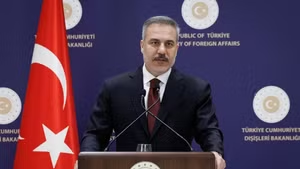
This year's COP31 conference in Türkiye is expected to revisit in depth the issue of fossil fuels as one of the principal sources of greenhouse gas emissions.
Climate finance remains another major sticking point. According to the United Nations Environment Programme (UNEP)'s Adaptation Gap Report 2025, developing countries will require between 310 billion USD and 365 billion USD annually through to 2035 to adapt to climate change.
However, current levels of funding amount to little more than a drop in the ocean, standing at only around one-twelfth of what is needed. An uncertain global economic outlook, compounded by the conflict in the Middle East and competing budgetary priorities such as responding to refugee movements and supporting post-COVID-19 recovery, has made it even more difficult to share financial responsibilities.
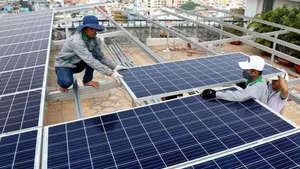
For poorer countries, every effort — from transitioning to renewable energy to developing resilient infrastructure and protecting communities from climate-related risks — requires substantial financial investment.
As the climate crisis grows more severe with each passing year, “Mother Nature” is sending humanity increasingly urgent warnings.
The world needs not only bolder and more ambitious commitments but also clear and transparent implementation roadmaps detailing the scale, resources, and mechanisms required to deliver on the agreements already reached in order to safeguard the planet.