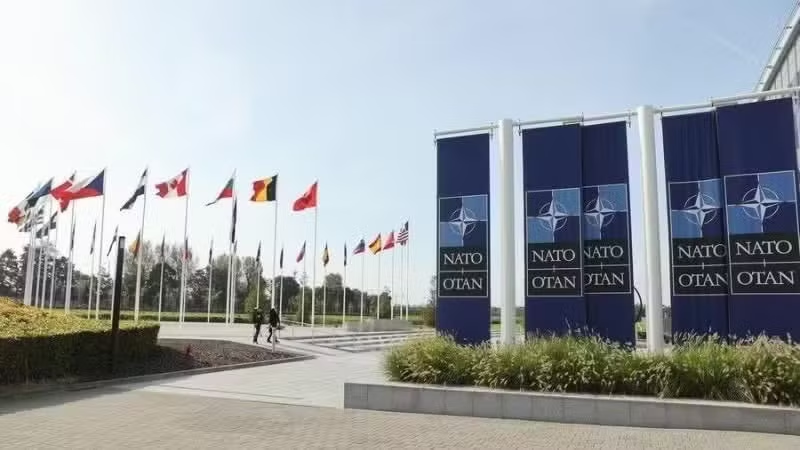
Defence expenditure has long been one of the most divisive issues within NATO. US President Donald Trump has repeatedly urged European allies to increase military spending and assume a larger share of the alliance's security burden.
The US leader urges allies to fulfil their commitment to substantially increase defence expenditure, with the long-term objective of allocating 5% of gross domestic product (GDP) to defence-related spending. Warning that Washington could reassess its level of commitment to NATO if allies fail to accelerate their military build-up, the Pentagon has announced a comprehensive review of the US military presence in Europe over the next six months. The review ensures NATO continues to move towards a model in which European countries take the leading role, and bear primary responsibility for the continent's security and defence.
Strains within the transatlantic alliance continue to deepen. In addition to US pressure on Europe to raise defence spending and strengthen strategic autonomy, relations between Washington and its allies have grown tenser after several European governments declined to join the US and Israel in the conflict with Iran.
Following the Pentagon's partial withdrawal of forces from Europe, the US Department of Defense informed its allies that Washington would adjust the scale of its contribution to the NATO Force Model — the mechanism assembling forces for deployment in times of crises or conflicts. Under the new approach, the US will review its contribution to NATO's operational costs, estimated at around 790 million USD in 2026, based on allies' fulfilment of their commitments. Countries that fail to increase defence spending urgently could face a reduction in the US share of contributions.
Washington's tougher stance has heightened concerns in Europe about the US’s long-term commitment to the continent's security. The US has decided to reduce military assets assigned to NATO, including certain F-16 and F-15 fighter aircraft, aerial refuelling aircraft, reconnaissance aircraft, bombers, unmanned systems, and a number of naval assets.
NATO Secretary General Mark Rutte acknowledged that the US is reallocating its military resources on a global scale, but stressed that this does not mean Washington is abandoning its commitment to defending its allies.
To offset the declining US role in certain military capability areas within the alliance, Washington expects its European allies and Canada to increase their contributions rapidly, particularly in manned and unmanned aerial capabilities, as well as naval assets. In practice, European countries and Canada increased their combined defence spending by more than 90 billion USD in 2025 compared with the previous year, marking a nearly 20% increase.
The forthcoming summit in Türkiye, bringing together all 32 NATO member states, aims to strengthen efforts to secure adequate defence resources and implement the alliance's security priorities. It is widely regarded as one of the most significant meetings in NATO's history, as it will address key issues requiring clarification and adjustment within the alliance while allowing member states to demonstrate their commitment to defence and their level of military preparedness.
NATO allies are expected to present concrete plans at the summit to achieve defence spending equivalent to 5% of GDP by 2035, including 3.5% allocated to core defence expenditure. European allies and Canada are currently on a trajectory to bring their defence spending closer to US levels.
Although some European countries may face domestic fiscal constraints that could delay planned defence spending increases, several NATO members, including Poland and the Baltic states, have already set targets to raise defence expenditure to 5% of GDP within the next few years. On the eve of the NATO summit, the Government of the Czech Republic instructed its delegation to reaffirm the country's commitment to increasing defence spending to 3.5% of GDP by 2035.
Despite ongoing disagreements with its allies, the US reaffirms its position as NATO's leading member and maintains that the alliance must decisively reform. Meanwhile, under mounting pressure from Washington, European allies are expected to demonstrate that they are honouring their commitments to increase defence spending and share greater responsibility in strengthening the alliance's capacity to respond to security challenges, serving the transatlantic alliance’s strategic interests.