Speaking at London Climate Action Week, currently taking place in the United Kingdom, United Nations Secretary-General Antonio Guterres stressed that, at first glance, the climate crisis and the energy sovereignty crisis appear unrelated. In reality, however, both challenges stem from the same root cause: prolonged overdependence on fossil fuels. According to the UN chief, fossil fuels are not only destroying the planet but also holding many economies hostage.
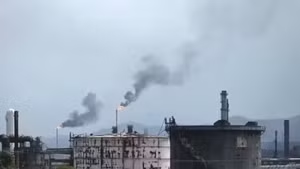
The continued rise in greenhouse gas emissions from burning fossil fuels has intensified climate change, making the goal of limiting global warming to no more than 1.5°C above pre-industrial levels increasingly unattainable. Simon Stiell, Executive Secretary of the United Nations Framework Convention on Climate Change (UNFCCC), stated that the severe heatwave currently scorching Europe is one of the consequences of pollution caused by the use of fossil fuels.
Meanwhile, excessive dependence on coal, oil and natural gas has also left economies vulnerable and increasingly exposed to geopolitical conflicts. The conflict in the Middle East has laid bare this inherent weakness. When supplies of "black gold" from the Middle East were disrupted by the closure of the Strait of Hormuz, many economies were almost immediately forced into a reactive position.
The severe heatwave currently scorching Europe is one of the consequences of pollution caused by the use of fossil fuels.
Simon Stiell, Executive Secretary of the United Nations Framework Convention on Climate Change (UNFCCC)
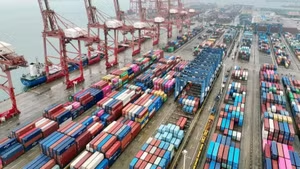
Supply shortages have rapidly disrupted global supply chains, driving up logistics costs and the prices of production inputs, thereby placing direct pressure on manufacturing activities in many countries. A development model based on fossil fuels is no longer sustainable, and renewable energy has emerged as an effective solution that enables countries to safeguard energy security while responding more effectively to climate change.
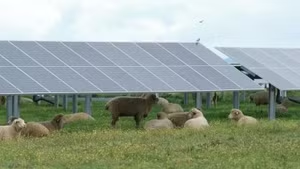
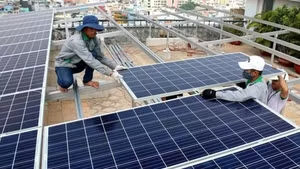
According to the United Nations, the cost of renewable energy has fallen dramatically over the past decade. Since 2010, the cost of solar power has declined by nearly 90%, onshore wind power by more than 70%, while battery storage technology costs have dropped by as much as 95%. These significant reductions in renewable energy production costs have provided strong momentum for the world to move confidently into the clean energy era. Moreover, the energy transition is an inevitable step for countries seeking to achieve energy self-sufficiency.
Secretary-General Antonio Guterres affirmed that renewable energy offers the pathway to sustainable energy security because, regardless of major geopolitical upheavals around the world, "no one can place the sun under sanctions, and no one can blockade the wind."
Thanks to the sustained efforts of countries worldwide, clean energy is gradually gaining the upper hand. Research published by the United Kingdom-based climate research organisation Ember shows that electricity generated from renewable sources met the entire increase in global electricity demand in 2025. Globally, renewable energy accounted for 34% of total electricity generation in 2025, surpassing coal's 33% share.
Although the transition to renewable energy is an urgent necessity, it continues to face several challenges. First, progress remains uneven, advancing rapidly in developed countries while lagging considerably in some regions, particularly Africa. Despite possessing around 60% of the world's solar energy potential, African countries receive only 2% of global investment in clean energy. Furthermore, where countries lack the capacity to produce sufficient clean energy domestically, fossil fuels remain the preferred option, especially as rising global temperatures continue to drive higher electricity demand. Some countries are still struggling to balance emissions reduction targets with the need to ensure an adequate short-term energy supply.
The United Nations Secretary-General stressed that the world now stands before a historic opportunity to break free from its dependence on fossil fuels. The growing frequency of extreme weather events, together with recent turbulence in global energy markets, serves as a reminder that the energy transition must be accelerated—not only to achieve climate objectives but also to strengthen energy security.