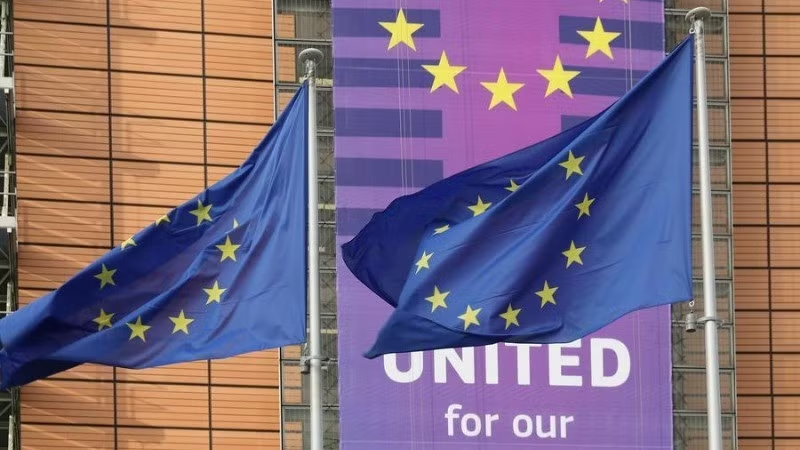
It is not hard to see why the Republic of Cyprus, which holds the rotating presidency of the Council of the European Union in the first half of 2026, is prioritising the promotion of autonomy on the EU’s agenda in the coming period.
Acknowledging that, more than ever, intense geopolitical challenges are testing the resilience, cohesion and unity of the blue-flagged bloc, President of the Republic of Cyprus Nikos Christodoulides stressed that Cyprus will steer the EU “towards becoming an autonomous union that remains open to the world”.
The year 2025 witnessed a significant weakening of the bloc’s standing. In the past, the EU has repeatedly weathered difficulties — from the 2008 global financial crisis to the UK–EU split known as Brexit in 2016, a major shock to European integration. But the challenges of 2025 did not stem from isolated events; they were the combined effect of a series of issues inside and outside the region, across multiple domains. Europe found itself “caught in the crossfire”, struggling to chart a course that would both hold the bloc together and balance its strategy while positioning itself on the international stage.
Divergences in relations with the US — its ally across the Atlantic — have made the EU more acutely aware than ever of the risks of dependence. The partnership has frayed as the two sides continue to diverge on a host of issues, from tariffs and defence spending to migration, climate change and the Ukraine conflict.
More recently, in the National Security Strategy released in December 2025, the US criticised European allies for being “lacking in confidence” on a number of issues. Analysts say the transatlantic relationship is undergoing a profound restructuring, in which Washington is gradually reducing its priority for Europe in order to focus on national interests. Under US pressure, European countries in the North Atlantic Treaty Organisation (NATO) agreed to raise defence spending to 5% of GDP by 2035. Even so, there remains a wide gap between commitments and reality.
Europe’s standing and voice in international affairs have also become more muted — even in the Ukraine conflict, which directly affects the security and politics of the Old Continent. In 2025, the US and Russia made a number of separate diplomatic moves related to Ukraine while bypassing the EU. Europe’s imprint on efforts to seek peace for the Gaza Strip has likewise been faint. Regarding Iran’s nuclear file, media reports said that in April 2025 the US decided to conduct nuclear talks with Iran in Oman without prior notice to its European allies.
In 2026, elections widely seen as shaping Europe’s future are expected to take place, including Hungary’s parliamentary election, local elections in Germany and France, and the US midterm elections.
The new year is also forecast to see rising social tensions in the region as governments try to balance swelling defence budgets with social welfare spending. Higher defence outlays may be difficult to secure public support within the bloc, given Europe’s high proportion of ageing populations. Internal divisions also remain an issue to be addressed. Persistent disputes within the EU over the use of frozen Russian assets are one example.
Even within the gloomy overall picture of Europe in 2025, there have been brighter patches, such as economic recovery policies taking effect and progress in the green transition. Strategic autonomy is an inevitable choice for the EU in particular and for Europe in general amid global turbulence. But it is a demanding path that requires strong consensus to reinforce the bloc’s internal strength.