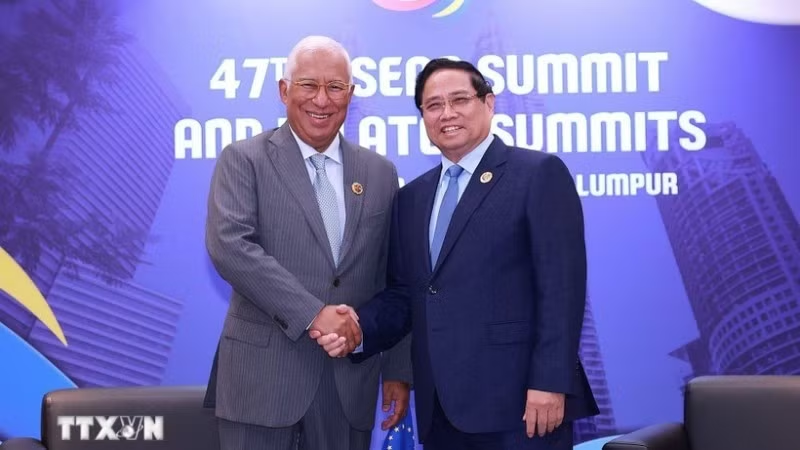
Coming against the backdrop of the successful conclusion of the 14th National Congress of the Communist Party of Viet Nam, the visit is of great significance, demonstrating the importance both sides attach to Viet Nam-European Union (EU) relations and their determination to nurture them to new heights, turning them into a model of successful cooperation between Asia and Europe.
On November 28, 1990, Viet Nam and the EU formally established diplomatic relations, embarking on a shared journey to foster friendship and cooperation. Over the past more than 35 years, the relationship has not only undergone profound transformations but has also been marked by numerous outstanding achievements.
From the signing of the Framework Cooperation Agreement (FCA) in July 1995 and the Partnership and Cooperation Agreement (PCA) in 2012 to the landmark EU-Viet Nam Free Trade Agreement (EVFTA) in 2019, the two sides have taken long and steady strides forward on the basis of mutual respect, understanding, and win-win cooperation.
Relations between Viet Nam and the EU, as well as its member states, are developing in an increasingly dynamic and positive manner. Political and diplomatic cooperation has been steadily strengthened through frequent exchanges of delegations and high-level contacts, alongside the annual meetings of the Viet Nam-EU Joint Committee and its subcommittees.
The EU is among Viet Nam’s most important partners in its foreign policy. Meanwhile, Viet Nam is the ASEAN member with the most comprehensive and in-depth relations with the EU.
Viewing Viet Nam as a key partner in Southeast Asia and an important gateway for enhancing its presence in the Asia-Pacific region, the EU has proactively proposed that the two sides consider upgrading their relationship to a comprehensive strategic partnership.
Political trust and mutual understanding provide a vital foundation for advancing cooperation across many fields, with the economy standing out as a bright spot.
After more than five years of implementation, the EVFTA has delivered strong results, making Viet Nam the EU’s largest trading partner in ASEAN, while the EU has become Viet Nam’s fourth-largest trading partner, third-largest export market, and sixth-largest investor.
Bilateral trade turnover in the first 11 months of 2025 reached over 66.8 billion USD, an increase of 6.6% compared with the same period in 2024.
In terms of development cooperation, the EU is one of Viet Nam’s leading aid donors. During the 2021-2024 period, the EU committed 210 million EUR in non-refundable aid to Viet Nam. In 2025, the EU provided 74 million EUR for two EU ODA-funded projects: the Viet Nam-EU Vocational Education and Training Programme and the Viet Nam-EU Forest Support Programme.
In a spirit of solidarity, the EU shared tens of millions of vaccine doses to help Viet Nam overcome the COVID-19 pandemic, while also actively supporting the country in addressing the aftermath of Typhoons Yagi, Bualoi, Matmo, and Kalmaegi.
In addition, cooperation between the two sides has been strongly promoted in science and technology, defence and security, culture, education, labour, healthcare, climate change response, and people-to-people exchanges. The EU prioritises cooperation with Viet Nam in green and sustainable development and climate action and is implementing several projects in Viet Nam under the Global Gateway initiative.
In December 2022, Viet Nam and the International Partners Group (including G7 and several EU countries) adopted a political declaration establishing the Just Energy Transition Partnership (JETP), mobilising 15.5 billion USD over a period of three to five years. At the second Global Gateway Forum in October 2025, the EU announced a 430 million EUR support package for the Bac Ai pumped-storage hydropower project.
Welcoming the official visit of European Council President Antonio Costa reflects the active implementation of Viet Nam’s foreign policy of independence, self-reliance, resilience, peace, friendship, cooperation, and development, as well as the diversification and multilateralisation of external relations.
It also sends a strong message that, as Viet Nam enters a new phase of development, the country wishes to continue receiving close companionship, comprehensive and substantive support, and effective cooperation from international partners, including the EU.
May President Antonio Costa’s official visit to Viet Nam a great success, laying a solid foundation for the two sides to move towards a new, more comprehensive, and deeper partnership framework.