* The Czech coalition government led by Prime Minister Andrej Babis survived a parliamentary vote of no confidence on Thursday. In the 200-seat Chamber of Deputies, the lower house of parliament, only 83 opposition lawmakers voted in favor of the motion to topple the cabinet, falling short of the required majority of at least 101 votes. A total of 94 coalition lawmakers voted against the motion.
* Speaking at the plenary session of the 23rd annual meeting of the Valdai Discussion Club on Thursday, Russian President Vladimir Putin said that bloc confrontation and the West's pursuit of unilateral security advantages lie at the heart of the current global security crisis.
* Malaysia and Singapore are set to deepen cooperation in a number of trade and economic sectors, while further strengthening supply chain resilience to face potential disruptions, officials from both sides said on Thursday.
* Mexico is seeking lower U.S. tariffs on steel, aluminum and vehicles as negotiations with Washington continue, Mexican Economy Secretary Marcelo Ebrard said Thursday.
* Russia will undoubtedly ensure the security of the Kaliningrad region, Kremlin spokesman Dmitry Peskov said on Thursday.
* Russia-launched drones struck the Southern Bridge during an attack on the Ukrainian capital on Thursday, Kiev Mayor Vitali Klitschko said. In a post on Telegram, Klitschko said that two drones hit the area near the bridge's support section.
* The Russian Foreign Ministry summoned Hungary's Charge d'Affaires to Russia Gabor Gergics on Thursday to inform him of retaliatory measures in connection with Hungary expelling a group of Russian diplomats on Sept. 8.
* The Hungarian Foreign Ministry said on Thursday that Hungary had no interest in escalating diplomatic tensions, but stood by its earlier decision, saying it was based on national security considerations.
* The Bundeswehr, Germany's armed forces, will establish its first dedicated drone regiment in 2027 to adapt to evolving modern warfare, German Defense Minister Boris Pistorius announced on Thursday.
* Polish President Karol Nawrocki on Thursday signed into law a temporary windfall tax on fuel companies aimed at curbing rising fuel prices. The tax covers the period from March 1, 2026, to March 31, 2027. Fuel producers will face a 60-percent tax on revenues above a benchmark based on their normal margins.
* Ukrainian President Volodymyr Zelensky on Thursday announced the first combat use of a domestically developed FP-7 tactical ballistic missile. Zelensky added that the missile would now move into the production stage.
* The free trade agreement (FTA) between Türkiye and Ukraine officially entered into force on Thursday, Türkiye's Ministry of Trade said. According to a statement released by the ministry, customs duty arrangements for goods trade will begin to be implemented on January 1, 2027.
* Libya and the African Union (AU) on Thursday inaugurated the AU Liaison Office in the Libyan capital Tripoli, aiming to strengthen cooperation and communication between the two sides.
* The United Nations Children's Fund (UNICEF) Executive Director Catherine Russell called for putting children at the center of Syria's recovery, according to a UNICEF statement on Thursday.
* UN Special Envoy for Yemen Hans Grundberg on Thursday urged Yemen's Houthi group to halt its military offensive in the southwestern province of Taiz, warning of mounting risks to civilians as some of the fiercest fighting in the country's latest escalation spread across the province.
* Yemeni government forces said Thursday that 30 Houthi fighters were killed and 50 others wounded in fierce battles in the southwestern province of Taiz.
* Japan's unemployment rate climbed to 2.5 percent in August from 2.4 percent in July, marking the first deterioration in five months, government data showed Friday. The number of people with jobs rose by 30,000 from the previous month to a seasonally adjusted 68.34 million, according to the Ministry of Internal Affairs and Communications.
* Republic of Korea's consumer price inflation cooled down last month, driven by increased fruit supplies and government discount subsidies for the Chuseok holiday, statistical ministry data showed Friday. The consumer price index (CPI) rose 2.9 percent in September from a year earlier, decelerating from 3.1 percent in the previous month, according to the Ministry of Data and Statistics.
* Malaysia's net capital stock (NKS), which measures the value of fixed assets, rose 4.2 percent year on year to 3.7 trillion ringgit (910 billion USD) in 2025, driven mainly by the services and manufacturing sectors, official data showed on Thursday.
* Uzbekistan's air cargo market has recorded rapid growth, with air freight volume increasing by 182 percent from 2019 to 2024, making the country one of the fastest-growing markets in Central Asia in terms of air cargo volume, a transport ministry official said Wednesday.
* The Asian Development Bank (ADB) said it plans to invest 1.3 billion USD in Mongolia by 2027, in an effort to strengthen the country's education, health and disaster preparedness, according to a press release on Thursday.
* The Shenzhou-23 astronauts aboard China's Tiangong space station sent video greetings to their motherland on Thursday, which is China's National Day and the 77th anniversary of the founding of the People's Republic of China.
* NASA and SpaceX launched a new crew rotation mission to the International Space Station (ISS) on Thursday, sending four astronauts into orbit aboard a SpaceX Dragon spacecraft.
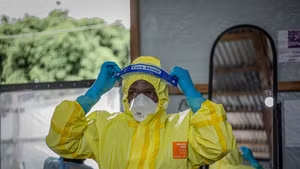
* The death toll from the ongoing Ebola outbreak in the Democratic Republic of the Congo (DRC) has surpassed 4,000, with 4,018 deaths reported among 8,300 confirmed cases across seven provinces, the latest figures released Friday by Congolese health authorities showed.
* Search teams recovered eight more bodies from an avalanche site at the base camp of Mount Himlung in Nepal's Manang district on Thursday, bringing the death toll to 15, an official said.
* New Zealand's average annual temperature increased by 1.36 degrees Celsius over the 117 years to 2025, while rainfall patterns shifted across the country, official data showed on Friday.
* September 2026 was the second-hottest September in France since records began in 1900, the national weather service Meteo-France said on Friday. France's average temperature for the month was 3.1 degrees Celsius above the 1991-2020 normal, surpassed only by September 2023, when the average temperature was 3.6 degrees Celsius above normal, Meteo-France said.