Coaches fill up
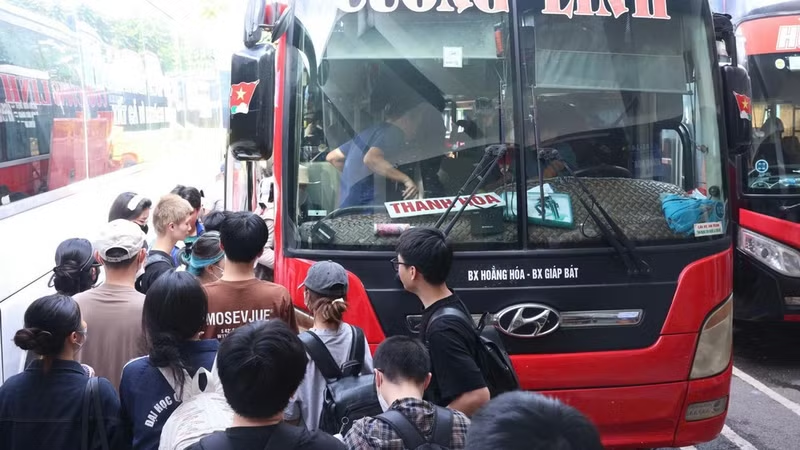
Early on August 28, office worker Le Manh Hung packed his bags and headed to Giap Bat Bus Station in Ha Noi to return to his hometown in Nghe An. He shared that, with concerns about traffic congestion, he had asked his employer to let him take the day off early so he could get home ahead of the holiday rush.
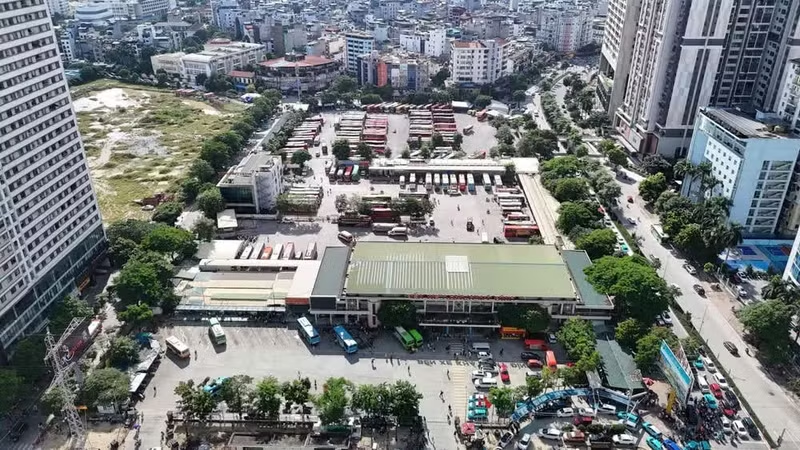
On the morning of August 28, Giap Bat Bus Station was not particularly crowded, with tickets for routes already booked and basically all seats taken. By late afternoon, the number of people heading to the station to return home increased sharply, while several roads leading out of the capital experienced prolonged congestion.
Nguyen Hoang Tung, Director of Giap Bat Bus Station, said that on August 28 and 29, the station saw 800 departures each day, about 150 more than on normal days, while passenger numbers were expected to increase by around 150-200%.
As in previous years, passengers are expected to flock to the station in the late afternoon on the final day of the holiday and throughout August 29. The station has therefore arranged vehicles in advance to accommodate the surge.
At around 5pm on August 28, Phung Van Tuan, from Thanh Hoa Province, had finished arranging his work and arrived at Giap Bat Bus Station to wait for his coach home for the holiday.
He said he had booked a ticket with Ha Hai coach operator a week earlier. A sleeper ticket on a 24-berth coach cost less than 200,000 VND, including cold towels and drinking water. For greater comfort, passengers could opt for a nine-seat limousine coach ticket priced at 220,000 VND.
On normal days, Ha Hai coach operator operates nine departures a day. During the peak period for the September 2 holiday, the operator has mobilised additional reserve vehicles to accommodate passengers as quickly as possible and meet people’s travel demands.
According to the operator, passenger numbers during this year’s National Day holiday are expected to be around 30% lower than last year, as different modes of transport are competing more strongly and the coach sector’s market share is showing a downward trend.
At My Dinh Bus Station, most passengers were travelling on routes to Lao Cai, Ha Giang (former province), Dien Bien, and Son La, among others.
On the Ha Noi–Son La and Ha Noi–Dien Bien routes, Hai Van coach operator had filled all advance bookings for nearly 30 departures a day on August 28 and 29.
In the south, according to a representative of Viet Nam Expressway Services Engineering Joint Stock Company (VEC E), traffic volumes on expressways managed by the company — including the Ho Chi Minh City–Long Thanh–Dau Giay, Dau Giay–Phan Thiet and Bien Hoa–Vung Tau expressways — are forecast to increase sharply during the National Day holiday, particularly at the beginning and end of the holiday.
The operations centre has been instructed to closely monitor traffic conditions and incidents along the routes and regularly update information channels so that people can proactively stay informed.
The company has also prepared scenarios and plans and arranged personnel to remain on standby, ready to regulate traffic and conduct remote traffic diversion to prevent vehicles from becoming congested at interchanges.
In the event of an incident, the company will deploy rescue forces to quickly clear vehicles from traffic lanes, issue warnings, and divert traffic to prevent congestion.
Currently, two petrol stations at rest areas along the Ho Chi Minh City–Long Thanh–Dau Giay Expressway have temporarily suspended operations, limiting the availability of refuelling during journeys. The company has advised drivers to check their fuel levels and refuel proactively before entering the expressway.
Rail and air services add trips
During the five-day holiday, the Viet Nam Railway Corporation’s railway transport company will operate six regular pairs of north–south Thong Nhat trains, from SE1/2 to SE11/12, while adding four Thong Nhat train services, SE23 and SE24, departing from Ha Noi and Sai Gon on August 28 and 31.
On the Ha Noi–Da Nang route, the high-quality SE19/20 pair will operate regularly, with two additional services, SE17 on August 29 and SE18 on August 30.
To cater to the influx of holidaymakers, the corporation, in coordination with Quang Tri Province and Hue City, inaugurated the eight-car HQ1/HQ2 tourist train at Dong Hoi Station on the morning of August 28.
Named “Hue Ancient Capital-Phong Nha: World Heritage Journey”, the train is the first strategic product launched since the unit began operating under the group model.
Dang Sy Manh, Chairman of the Viet Nam Railway Corporation’s Members’ Council, said the operation of the train pair was the result of strategic vision, determination and close coordination between the corporation, Quang Tri Province, and Hue City.
The aim is to establish strong regional linkages; create a chain of travel, accommodation, and restaurant services among the localities; and provide leverage for regional economic development.
Amid high operating costs in the aviation sector, airlines are still flexibly deploying aircraft and resources to add flights on key routes during the holiday.
Accordingly, Viet Nam Airlines Group — comprising Viet Nam Airlines, Pacific Airlines, and Vasco — has added 60,000 seats, bringing total capacity across its network to nearly 725,000 seats.
During this period, Viet Nam Airlines Group will operate more than 3,600 flights, up 25% from the same period last year.
Vietjet plans to add 82,000 seats, equivalent to 400 flights on domestic and international routes. From August 26 to September 5, the airline will operate more than 4,400 flights.
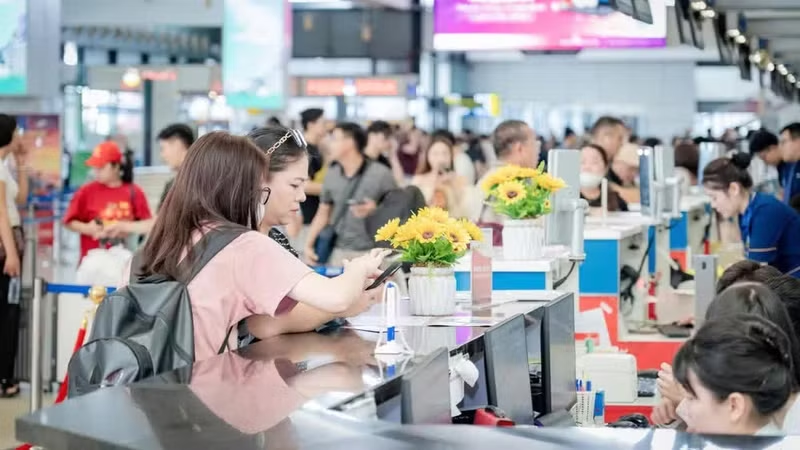
At Noi Bai International Airport, actual observations on the final working day before the holiday showed that passenger flows remained stable and smooth, with no localised congestion or overcrowding.
Passenger numbers were distributed relatively evenly across different periods and time slots, including three peak time slots for departing passengers and six for arriving passengers, with traffic exceeding 2,000 passengers per hour during each peak period. These peaks were concentrated in the afternoon and evening.
Thorough preparations in terms of infrastructure and service plans, together with the decision to increase the slot coordination parameter at Noi Bai Airport to 44 flights per hour, have improved the efficiency and capacity of flight operations during the peak period, helping passengers begin their holiday smoothly, safely, and fully.
“A notable highlight in the overall operation has been the enthusiastic response from a large number of passengers towards biometric check-in at 12 kiosks installed by Noi Bai International Airport in three halls — A, B, and E. Many passengers expressed satisfaction with the system’s rapid processing speed.
“Thanks to facial recognition technology, the process of completing airport procedures has been significantly shortened, making it much faster than traditional methods and reducing queuing time to a minimum,” said Nguyen Thi Kim Ngan, Deputy Director of Noi Bai International Airport.