Awakening the river's potential
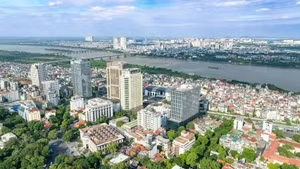
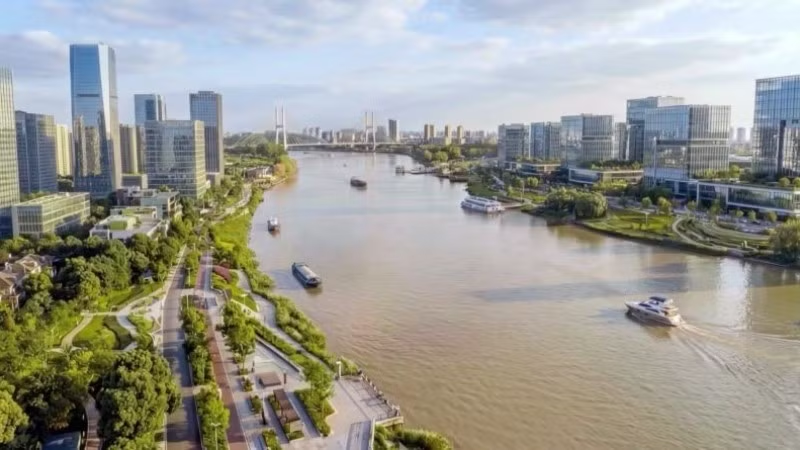
Referring to cities that have successfully made their rivers a central part of urban life, The Business Times, an English-language financial newspaper based in Singapore, described the Red River Landscape Boulevard Axis Investment and Construction Project as having the ambition to create a “Red River miracle”, similar to Seoul's “Han River miracle” (the Republic of Korea).
The newspaper emphasised that the project is the “centrepiece” of the capital's 100-year master plan, which aims to reshape the entire city, with highlights including an 80-kilometre landscape boulevard axis and a system of riverside parks.
The Business Times stressed that the city's expectation is to turn the Red River, which has long been viewed mainly as a flood-control corridor, into a “new economic, ecological, and cultural backbone” of the capital. This approach shows that the project has significance far beyond the scope of a single infrastructure project.
Several international newspapers have also pointed to similarities between Ha Noi's plan to develop the Red River area and Seoul's process of transforming the Han River from a river heavily affected by industrialisation into an internationally recognised urban space, becoming one of the city's defining symbols. However, the Red River also has the potential to create new momentum for economic, cultural, and ecological development.
From this perspective, Germany Trade & Invest (GTAI) has assessed that the Red River will become one of the key development axes as Ha Noi transforms into a modern megacity. According to the agency, the new plan could completely change the face of the city, while opening opportunities for German businesses in urban planning, construction technology, transport, and infrastructure.
Similarly, the Japan External Trade Organisation (JETRO) also expects opportunities to arise from the new plan, particularly as Ha Noi promotes public transport, green growth, and the development of high-tech industries.
Meanwhile, the Financial Times of the UK has focused on the strong participation of domestic private groups in the project, viewing this as an opportunity for Ha Noi to mobilise additional social resources for infrastructure, transport, and urban development. However, this also brings high requirements for governance and investment efficiency.
According to the Associated Press (AP) of the US, the redevelopment of the Red River area also carries particular significance: Ha Noi has an opportunity to shift from a development model focused on the central area towards a polycentric city, with the river becoming a new connecting axis.
Overall, as with Seoul having once turned the Han River into a symbol of a period of miraculous development, Ha Noi is also now presented with an opportunity to turn the Red River into a symbol of a new century.
However, many international perspectives suggest that the “Red River miracle” cannot be a copy of any model elsewhere in the world. It must be Ha Noi's own way of creating a more modern city while preserving the river, history, and identity — the elements that have shaped a city with a thousand years of civilisation.
Turning challenges into development momentum
Addressing the long-term vision, opinions suggest that if the “Red River miracle” becomes a reality, the people of the capital will be the clearest beneficiaries.
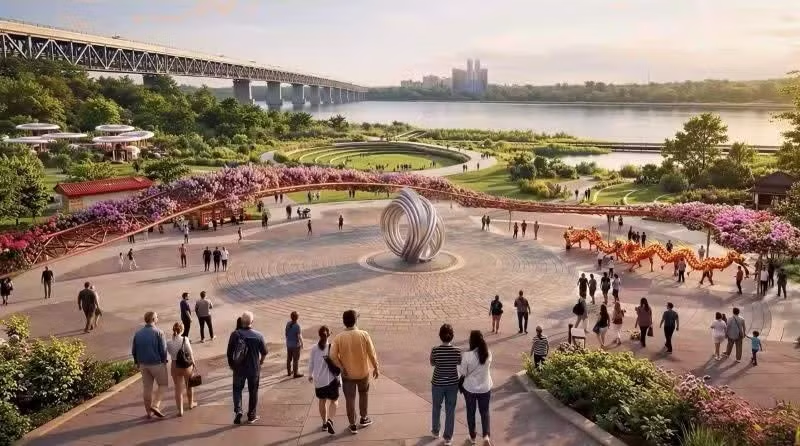
Michael Waibel, a senior researcher at the University of Hildesheim in Germany, assesses that the creation of public spaces, parks, and green spaces along the riverbanks will provide many amenities for Ha Noi residents. According to the expert, the riverside area could fully develop into an urban “frontage” featuring numerous public spaces and attractive amenities, with people at the centre.
Another benefit lies in the potential to reorganise transport and the urban structure. The new plan for Ha Noi aims towards a “polycentric, multi-centred” model, in which the Red River becomes a new development axis connecting transport, residential areas, parks, and economic centres.
When integrated with public transport, cultural spaces, heritage, and services, the Red River corridor could form a new chain of destinations, creating additional momentum for tourism and the urban economy. This is a significant opportunity for a city with a river of exceptional historical value with potential that has yet to be fully tapped in modern life.
This large-scale project also requires a sufficiently flexible approach to turn challenges into development momentum.
First is the issue of resettlement and reorganising living spaces. Some opinions suggest that Ha Noi could link resettlement with the synchronous development of housing, transport, schools, healthcare, and services, thereby ensuring better living standards for residents during the transition. At the same time, making use of international resources and experience, particularly in technology and urban governance, could help accelerate implementation.
Many opinions also stress the need to mobilise early partners with experience in urban planning, railways, green infrastructure, smart transport, and construction technology. Partner selection should not be based solely on their capacity to implement large-scale projects but should also consider their ability to transfer technology, manage projects, and accompany the city throughout its long-term development process.
For the river environment and safety, technology, and data need to be integrated from the planning stage. Hydrological modelling, meteorological data, digital maps, and green infrastructure solutions can support the identification of construction areas, open spaces, and flood drainage corridors. Instead of viewing water surfaces, alluvial areas, or flood-prone zones as obstacles, Ha Noi can implement them as part of the urban design, with floodable parks, retention lakes, and green spaces capable of adapting to climate change.
The financial challenge also requires an approach that diversifies resources. State capital can be focused on foundational infrastructure, while private capital, public-private partnerships (PPP), transit-oriented development (TOD), and the appropriate harnessing of added value from land can supplement resources for subsequent stages. Dividing the project into components capable of operating and generating benefits independently while remaining within a unified plan will help reduce capital pressures while creating additional momentum for implementation.
Riverside villages, landscapes, cultural spaces, and urban memories can become values that create the distinctive appeal of the Red River Landscape Axis. The larger the project, the more it needs distinctive highlights to avoid creating a uniform chain of urban areas. If resources, technology, and suitable partners are harmoniously combined with a long-term vision, the Red River project could not only change the face of Ha Noi but also establish a model of modern urban development that retains a strong sense of identity.
From an international perspective, the Red River Landscape Boulevard Axis Project is presented with a rare opportunity for Ha Noi to transform both its appearance and the way it operates and develops.
If the challenges concerning the environment, resettlement, resources, and preservation of identity are addressed effectively, the capital could enter a new stage of development with the Red River awakened, becoming a more modern city while preserving the values that have shaped Ha Noi's identity.