From treatment to early detection
The Ministry of Health is collecting opinions on a draft Decree stipulating increases in the level of Health Insurance coverage and the scope of Health Insurance benefits according to a roadmap and priority groups, in line with contribution levels and the capacity to balance the Health Insurance Fund. A notable provision in the draft is the proposal to expand the scope of Health Insurance Fund coverage to include screening and early diagnosis for seven types of cancer, namely cervical cancer, breast cancer, lung cancer, prostate cancer, colorectal cancer, stomach cancer and liver cancer, together with hepatitis B and C.
The new aspect of the policy is that Health Insurance will not only contribute to covering costs when patients have already developed a disease and entered the treatment process, but will gradually become involved in early detection. Under the draft, costs that may be covered by the fund include medical examinations, tests, paraclinical technical services, medicines, medical equipment, blood, supplies, chemicals and other related costs, within the scope and level of benefits of Health Insurance participants. However, coverage will not be applied universally to all participants for all diseases, but will be implemented according to specific groups of beneficiaries, individual diseases and a roadmap appropriate to the fund's balancing capacity.
Under the proposed roadmap, from July 1, 2027, Health Insurance will cover hepatitis B and C tests when they are incorporated into regular health check-ups. From July 1, 2028, payment for cervical cancer screening will be piloted, with coverage implemented from January 1, 2030. Also from January 1, 2030, payment for screening and early diagnosis of breast, lung, prostate and colorectal cancers will be implemented according to a roadmap stipulated by the Ministry of Health. For stomach and liver cancers, the draft has not yet set a date for implementation.
Thus, the new policy does not mean adding a new group of “cancer patients” to the Health Insurance scheme. Cancer patients are already covered by the Health Insurance Fund for treatment costs within the scope of their benefits. The change this time is to bring part of the costs of screening, detection and early diagnosis within the scope considered for coverage.
For cancer, the timing of detection is of great significance to the treatment process. When the disease is detected at an early stage, patients generally have more treatment options, while the risk of disease progression and the costs incurred when treatment is required at a later stage can also be reduced.
According to Tran Thi Trang, Director of the Health Insurance Department under the Ministry of Health, the expansion of Health Insurance benefits is being considered on the basis of assessing disease risks, the effectiveness of early intervention, and the potential to reduce the disease burden and treatment costs in the future. Previously, when the Ministry of Health consulted on including cancer screening in the scope of coverage, Trang cited the average annual treatment cost for Stage I cervical cancer at around 89.8 million VND; if Health Insurance covered screening for early detection, patients could save a considerable amount in treatment costs.
From the perspective of treatment practice, Prof., Dr Le Van Quang, Director of K Hospital, also emphasised the significance of early cancer detection. He said that if lung cancer is detected early, the chances of successful treatment are higher; at the same time, developing effective screening programmes and disease management systems is an urgent requirement.
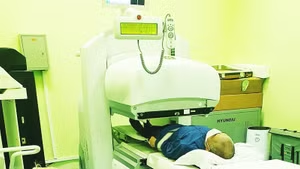
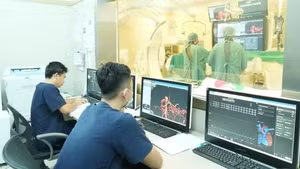
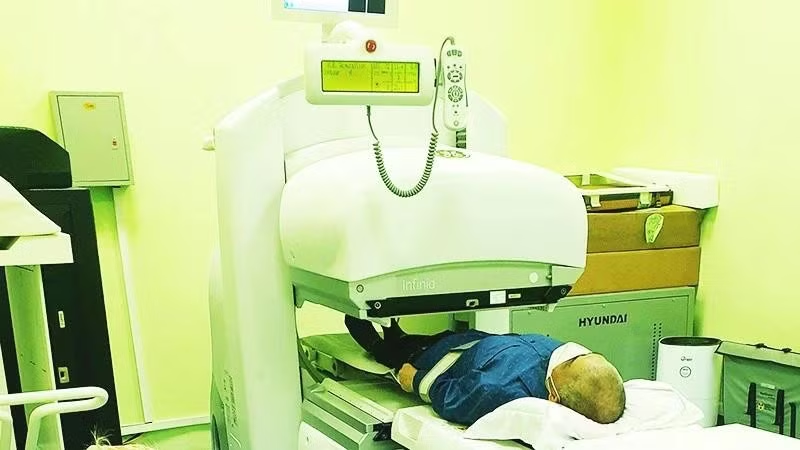
At K Hospital, diagnostic imaging capacity has been identified as one of the areas directly serving cancer screening, early detection, diagnosis and treatment. The hospital is developing diagnostic imaging systems at its facilities to meet the need for screening and early disease detection, while applying modern equipment in diagnosis and treatment.
For families with a cancer patient, prolonged treatment costs are always a major burden. If Health Insurance becomes involved from the screening stage, provided it is implemented for the right groups and in accordance with professional procedures, it could help reduce some of the financial barriers that cause people to delay health checks.
A case recorded at the Nuclear Medicine and Oncology Centre of Bach Mai Hospital further illustrates the role of a Health Insurance card when a patient enters the treatment process. Nguyen Van H, 58, residing in Ha Dong Ward (Ha Noi), was diagnosed with colorectal cancer, with average total treatment costs of around 207.4 million VND per person per year. Thanks to having continuously participated in Health Insurance for many years, most of the costs were covered by the Health Insurance Fund, helping the family significantly reduce its financial burden.
The financial burden faced by cancer patients includes the cost of treatment medicines. For some targeted therapies, although they are already included in the list of medicines covered by Health Insurance, patients may still have to make large co-payments. Therefore, cancer treatment costs do not consist merely of a single payment at a hospital but may continue throughout the treatment, monitoring and care process.
Against this backdrop, if the policy to expand coverage for cancer screening is promulgated and implemented for the right groups, the Health Insurance Fund's expenditure on a single screening should be considered in relation to the much higher treatment costs incurred when the disease is detected late. The benefits will first accrue to patients, but in the long term, early detection could also contribute to more effective use of the Health Insurance Fund's resources.
Viet Nam records around 180,000 new cancer cases and more than 120,000 deaths each year, while around 350,000 people are living with cancer. Treatment costs also vary according to the stage of the disease. The average annual cost of cervical cancer treatment is around 89.8 million VND at Stage I, compared with around 136.9 million VND, 138.4 million VND and 136.8 million VND at Stages II, III and IV, respectively. For breast cancer, early detection is also assessed as potentially reducing annual treatment costs by around 7.9 million VND to 18.3 million VND compared with late detection.
Expanding benefits alongside maintaining the fund's balance
Alongside the expansion of benefits, the question arises as to what resources will ensure this policy. The draft Decree developed by the Ministry of Health is based on the principle of increasing benefit levels and expanding the scope of benefits according to a roadmap, in line with contribution levels and the capacity to balance the Health Insurance Fund. This is an important point, because if benefits are expanded too quickly while revenue does not increase correspondingly, pressure on the fund will increase.
Under the draft, the Health Insurance Fund will cover screening and early diagnosis costs within the scope and level of benefits of participants, while coverage must also be in line with the fund's balancing capacity. Tran Thi Trang said that the multi-year roadmap allows management agencies to gradually assess actual demand, the capacity of the health system and the policy's impact on the Health Insurance Fund before fully expanding coverage. This is also why the draft does not propose universal screening for all types of cancer for all Health Insurance participants. The list of diseases, target groups, conditions and implementation dates will be developed in stages. The Ministry of Health will continue to provide specific regulations on beneficiaries, conditions, the list of services and payment levels.
Le Van Hau, a retired official residing in Nghia Do Ward (Ha Noi), commented: “Expanding Health Insurance benefits to cover cancer screening is a meaningful policy, but its effectiveness depends largely on how it is implemented. Screening must be based on professional guidelines, with groups of beneficiaries, age groups, risks and appropriate methods identified. Without clear criteria, widespread testing may increase costs without necessarily improving the effectiveness of disease detection. Conversely, if high-risk groups are correctly identified, appropriate methods are selected and screening is organised at grassroots-level facilities, the fund's resources could be used more effectively.”
For the policy to be put into practice, the services covered and payment levels also need to be clearly regulated. Under the draft, the Health Insurance Fund may cover the costs of medical examinations, tests, paraclinical techniques, medicines, medical equipment, supplies, chemicals and other costs within the scope of participants' benefits and in line with the fund's balancing capacity.