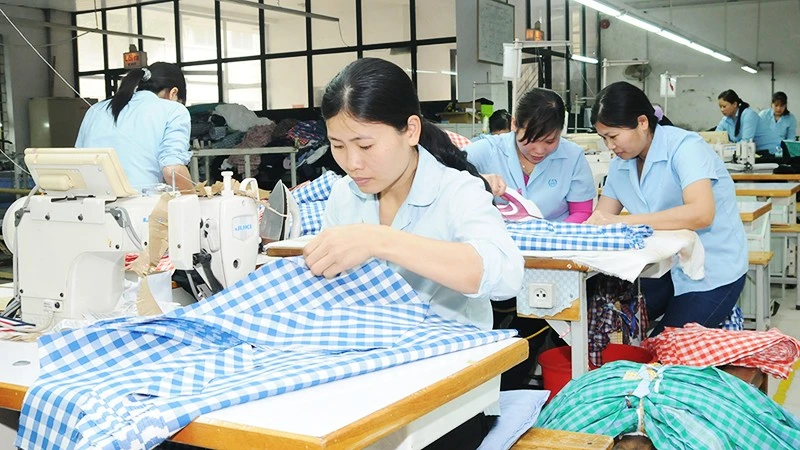
According to the Viet Nam Textile and Apparel Association (VITAS), textile and garment export turnover in 2025 is projected to reach around 46 billion USD, up nearly 6% compared with the previous year. This result reflects the significant efforts of enterprises to maintain markets and promote exports amid unfavourable global trade fluctuations caused by rising tariffs, green barriers, and increasingly stringent sustainable development requirements.
Efforts to adapt to volatility
As a leading enterprise in the sector, Le Tien Truong, Chairman of the Board of Directors of the Viet Nam National Textile and Garment Group (Vinatex), said that 2025 began with many uncertainties in international trade. The announcement of reciprocal tariffs created a major shock, disrupting markets as early as April 2025.
Vinatex promptly adjusted its strategy and stabilised production and business operations. As a result, the Group effectively leveraged the 90-day period before tariffs were officially imposed to drive strong growth in May, June, and July. These three months alone contributed nearly 30% of the overall performance for 2025.
Consequently, 2025 closed with many positive highlights, with Vinatex completing all set targets. Production and business efficiency returned to peak levels comparable to 2021, but in a completely different context.
“If 2021 marked a surge in orders after the pandemic, then 2025 represents the outcome of managerial resilience and adaptability amid prolonged global trade uncertainties.”
Not only leading enterprises, but many textile and garment companies also faced significant pressure in 2025. Phi Ngoc Trinh, General Director of Ho Guom Group Joint Stock Company, said that global trade tensions, along with geopolitical factors and adverse weather conditions in the European market, led to a decline in export orders, particularly in the final months of the year. At times, the company had to place part of its workforce on temporary leave due to a sudden drop in orders.
However, thanks to proactive adjustments to production plans, expansion of product lines for the domestic market, and active efforts to seek new customers, Ho Guom Group was still able to maintain stable operations.
“Although the initial growth target of 15–20% was not achieved, overall production and business results for 2025 are expected to be equivalent to those of 2024, reflecting the company’s efforts to adapt and maintain production momentum amid market volatility.”
From an industry-wide perspective, Vu Duc Giang, Chairman of the Viet Nam Textile and Apparel Association, said that in the context of a highly volatile global economy, the textile and garment sector did not choose a passive response, but proactively adjusted its development strategy to adapt to rapid changes in policies, markets, and supply chains.
Specifically, the sector has established and synchronously implemented three foundational strategic pillars. The first key focus is export market diversification. From being heavily dependent on a few traditional markets, Viet Nam’s textile and garment products are now present in 138 markets worldwide, thereby dispersing risks and enhancing resilience against external shocks.
Alongside market expansion, enterprises in the sector have intensified diversification of partners and customers, enabling greater proactivity in negotiations and adaptation to changes in purchasing methods, while reducing dependence on a small number of major brands. At the same time, product structures have been adjusted towards gradually reducing simple processing and increasing the share of products that meet increasingly differentiated market demands and new consumption trends.
In addition to technological and environmental solutions, strengthening supply chain linkages continues to be prioritised, focusing on developing domestic supply sources, enhancing governance capacity, and promoting experience-sharing through specialised workshops with the participation of international organisations.
Enhancing resilience
With a sustainable development and circular economy orientation, the Viet Nam Textile and Apparel Association has set a target of achieving 64.5 billion USD in export turnover by 2030, with an average annual growth rate of 6.5–7%.
However, Tran Thanh Hai, Deputy Director of the Agency of Foreign Trade under the Ministry of Industry and Trade, noted that the textile and garment sector still faces significant challenges. The international trade environment is becoming increasingly complex and unpredictable, with the proliferation of trade defence measures, technical barriers, green barriers, and labour standards. Major markets not only demand competitive pricing and quality, but also impose strict criteria on traceability, carbon emissions, circular economy practices, and social responsibility.
Notably, regional and global competitive pressure is intensifying. Many countries continue to maintain advantages in labour costs, while major competitors are recovering and upgrading technologies. Without strong innovation, Viet Nam’s textile and garment sector risks a decline in competitiveness. In particular, bottlenecks in localisation of materials remain a persistent challenge, especially in weaving, dyeing, and finishing stages, limiting domestic value added and making enterprises vulnerable to external fluctuations.
“The textile and garment sector needs to focus on several major orientations: restructuring towards higher value added; developing domestic supply chains; effectively leveraging free trade agreements; treating green transformation as a core competitive advantage; and accelerating human resource development and digital transformation.”
From an enterprise perspective, Le Tien Truong said alongside companies candidly acknowledged that maintaining growth momentum, 2025 still recorded a number of textile and garment enterprises operating at a loss or experiencing a decline in business results compared with 2024. This development shows that the sector is entering a phase of clear differentiation, where there is no longer a “one-size-fits-all formula” for all enterprises.
Based on this reality, Vinatex has identified an intensive growth strategy, focusing on three key objectives. First, in conditions where export turnover can only grow by 3–4%, the Group is focusing on reducing imports of materials by around 5% through better utilisation of domestic supply sources. Second, priority is given to improving workers’ incomes, viewing this as a direct component of economic growth. The focus is on accelerating automation, optimising processes, and enhancing production efficiency, thereby creating conditions to increase average wages by over 10%. Third, promoting total factor productivity (TFP) growth at around 5% is considered a breakthrough threshold, compared with the national average of only about 2.6% by 2025.
“We do not pursue growth through increasing capital or labour, but focus on developing new products with high value added and differentiation, while gradually mastering technology, starting from the yarn stage onwards.”
To maintain growth momentum and enhance resilience against global trade volatility, the Viet Nam Textile and Apparel Association has identified accompanying enterprises as a core, ongoing priority.
Accordingly, the Association focuses on supporting updates on market information, policies, and requirements from major export markets; strengthening linkages across the yarn–weaving–dyeing–garment supply chain to increase localisation rates and value added. At the same time, green transformation and circular economy programmes continue to be promoted, helping enterprises meet increasingly stringent standards on the environment, labour, and traceability.
Viet Nam’s textile and garment sector is expected to maintain its role as a key export industry, with the trade surplus in 2025 projected to exceed 20 billion USD.
(Vu Duc Giang, Chairman of the Viet Nam Textile and Apparel Association)