In 2025, with total import-export turnover exceeding 930 billion USD, Viet Nam joined the world’s top 18–20 largest trading economies. If the current growth momentum is maintained, many forecasts suggest that Viet Nam’s total import-export turnover could reach the 1 trillion USD mark as early as 2026.
Starting point of green transition
Dao Trong Khoa, President of the Viet Nam Logistics Business Association (VLA), said that according to growth scenarios in the National Logistics Services Development Strategy, with a target growth rate of 12–15% per year, the total revenue scale of Viet Nam’s logistics market is expected to reach 250–280 billion USD by 2035, placing it among the top 15–20 largest logistics markets in the world.
At that time, logistics would become a “super industry” playing a key role in realising Viet Nam’s goal of becoming a top 20 global GDP economy.
However, behind this increasingly large flow lies a real challenge: Transport accounts for about 16–24% of total greenhouse gas emissions, while logistics alone contributes 7–8% of global CO₂ emissions. As environmental standards in international trade become increasingly stringent, “greening” is no longer a purely symbolic choice. According to the VLA President, “green” is not a cost but a passport for Vietnamese logistics to enter the most demanding markets.
In the economy, transport gateways such as airports play a particularly important role. They are not only points of departure and arrival for passengers or goods, but also places where flows of trade, investment, and tourism converge. Therefore, the operational efficiency of these gateways can directly affect logistics costs, the competitiveness of businesses and the attractiveness of localities.
Le Hong Ha, Chief Executive Officer of Viet Nam Airlines, believes that greening transport gateways not only aims to reduce emissions but also helps enhance the operational efficiency of the logistics system and reduce the underlying costs of the economy.
As the focal point of the Northern Key Economic Region, Ha Noi plays the role of a “junction” converging international trade flows through the Noi Bai gateway and inter-regional corridors, as well as major industrial zones in Bac Ninh, Hai Phong, Quang Ninh, and Vinh Phuc. Millions of tonnes of goods pass through this airport and surrounding logistics centres each year before being distributed to domestic and international markets.
According to Ha, it is necessary to improve the efficiency of the capital’s gateway airport in Ha Noi and reduce congestion in order to enhance people’s travel experience and strengthen the northern region’s international connectivity. At the same time, stable and continuous operation of aviation and logistics gateways must be ensured to improve supply chain resilience and security amid global volatility.
Sustainable logistics chain
However, even a modern airport terminal with an investment of trillions of VND will see its efficiency decline if goods leaving the gateway face congestion on roads or lack storage and processing facilities. Therefore, airports such as Noi Bai and other airports in the region in the future need to be closely connected with nodes such as the Long Bien inland container depot (ICD) and inter-regional transport corridors (such as Ring Road 3.5 and Ring Road 4) to form a closed supply chain. These nodes play the role of transshipment and distribution points, moving goods from the airport to industrial zones, seaports, or domestic consumer markets.
When effectively connected, logistics centres can help reduce operational pressure at aviation gateways while optimising the transshipment process, ensuring connectivity and synchronisation. This also helps reduce logistics costs, which remain a “pain point” for Viet Nam as they account for 16–17% of GDP, significantly higher than the global average of about 10–11%.
More importantly, the formation of inter-regional logistics corridors with optimised costs and reduced emissions will help create sustainable supply chains.
The VLA President emphasised that the biggest challenge facing the logistics sector today does not lie in planning blueprints or the construction of new facilities, but in implementation and synchronisation. “From a logistics perspective, we often emphasise three elements: connectivity–synchronisation–operation. If a port is very modern but road, rail, ICD, and warehouse connections behind it are not smooth, overall logistics costs will still remain high. If individual projects perform well but lack inter-regional coordination, data sharing, and common operational standards, supply chain efficiency cannot be optimised,” Dao Trong Khoa analysed.
Regarding this issue, Le Hong Ha said it is necessary to supervise and accelerate the construction progress of Ring Road 3.5 and Ring Road 4 of the Capital Region to form logistics, industrial, and satellite urban corridors. At the same time, coordination mechanisms between Ha Noi and related localities should be promoted to ensure the completion of key milestones. He also supports the development of mass public transport, particularly metro networks, to reduce congestion, improve urban quality, and lower social costs. At the same time, it is necessary to promote an “infrastructure–services” approach with modern operational solutions.
Alongside physical infrastructure, green transition must also go hand in hand with the development of “soft infrastructure” based on data and digital standards. Shared data among aviation, inland ports, customs, and transport enterprises will create a smarter system with better forecasting capability. As a result, aviation and logistics gateways can ensure continuous operations, supply chain stability and stronger response capacity in emergencies or global disruptions. According to Ha, digitalisation of urban transport must be associated with ensuring data safety, personal data protection, cybersecurity, and preventing the abuse of data in the digital environment.
Overall, as green transition has become a kind of passport for Vietnamese goods to enter demanding markets, for the logistics sector to reach the scale of a 280 billion USD “super industry” and achieve the goal of reducing the ratio of logistics costs to GDP, greening the gateways is an inevitable upgrade of the infrastructure system.
Aviation - A pillar of the greening journey
Aviation is a crucial international connectivity link of the capital but also a sector that consumes large amounts of fossil fuel. Therefore, in the process of greening the logistics sector, aviation is an important pillar. The green transition strategy in this sector is materialised through two main solutions: aircraft technology and operational procedures.
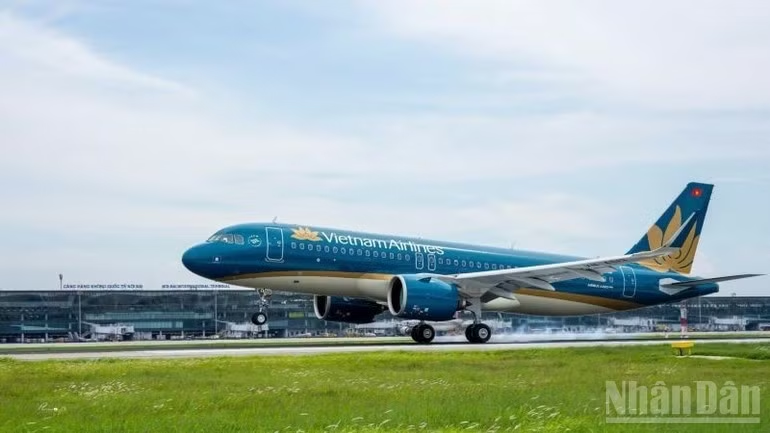
Fleet modernisation is being implemented through investment in new-generation aircraft models with more fuel-efficient engine designs, helping reduce fuel consumption by 15–25% compared with previous generations. This means a significant reduction in emissions during operations.
Currently, Vietnamese airlines are actively promoting optimisation of flight operations through technology. From optimising flight routes and reducing airborne waiting time to applying digital flight management systems, many solutions are being deployed to improve operational efficiency and reduce energy consumption.
Notably, Viet Nam’s aviation sector has joined the trend of using sustainable aviation fuel (SAF). According to studies, SAF can help reduce CO₂ emissions by up to 80% compared with traditional fuel if deployed on a large scale.