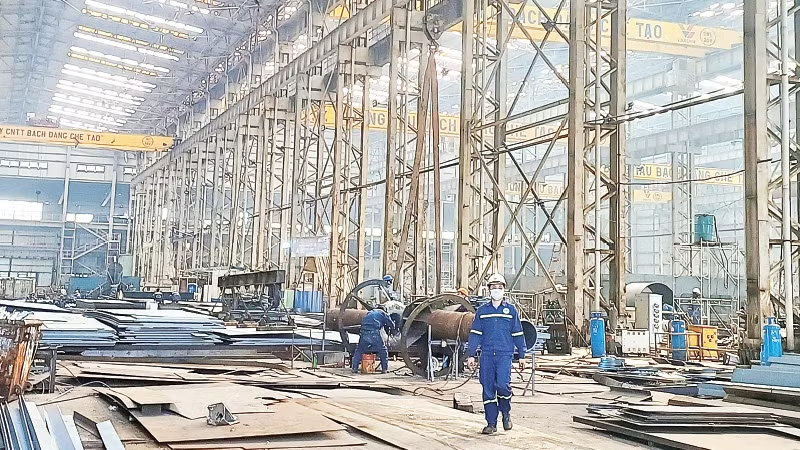
Viet Nam is developing a closed-loop “circular economy” ecosystem. This transition is well aligned with the global economic context, where mounting pressures stem from resource depletion, climate change, environmental pollution, and the limitations of the traditional linear growth model. Within this shift, industry stands as the focal point of the most vigorous and far-reaching transformation.
An inevitable trend driving a green and sustainable economic model
The circular economy is not merely a solution but an inevitable trend to promote a green and sustainable economic model, enhance both domestic and international competitiveness, and achieve the Net Zero target by 2050. In the current context, it is no longer simply a policy choice but a prerequisite for sustaining long-term economic growth, particularly in industrial production and supporting industries.
Since the early 2020s, the Party and the State’s viewpoints, orientations, and policies have consistently supported the implementation of the circular economy model. These include linking circular economy development with growth model transformation; placing enterprises at the centre while the State plays a facilitating role; combining market mechanisms with regulatory policies; and promoting innovation alongside the application of science and technology.
According to Chu Viet Cuong, Director of the Industrial Development Support Centre under the Agency for Industry under the Ministry of Industry and Trade, the viewpoints and policies on the circular economy — both across the broader economy and within industrial production — have been institutionalised through the 2020 Law on Environmental Protection, along with numerous decisions and decrees across sectors. These reflect a fundamental shift in state management thinking, from policies focused on remediation and pollution control to those centred on managing the entire product life cycle — from resource extraction, production, and consumption to waste treatment. This demonstrates that the circular economy has been designed in alignment with an inter-sectoral policy framework encompassing environment, finance, industry, trade, and investment, effectively serving as the “backbone” of a modern economy.
The viewpoints and policies on the circular economy — both across the broader economy and within industrial production — have been institutionalised through the 2020 Law on Environmental Protection, along with numerous decisions and decrees across sectors. These reflect a fundamental shift in state management thinking, from policies focused on remediation and pollution control to those centred on managing the entire product life cycle — from resource extraction, production, and consumption to waste treatment. This demonstrates that the circular economy has been designed in alignment with an inter-sectoral policy framework encompassing environment, finance, industry, trade, and investment, effectively serving as the “backbone” of a modern economy.
Chu Viet Cuong,
Director of the Industrial Development Support Centre
under the Agency for Industry under the Ministry of Industry and Trade
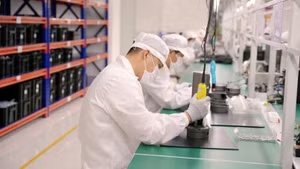
The emergence and effective operation of numerous green production facilities following circular models in Viet Nam in recent years demonstrate the adaptability of domestic enterprises. Green ecosystems such as Vingroup, Gamuda, and DoGreen have pioneered the application of waste gasification technologies, harnessing renewable energy sources and achieving negative carbon emission indicators.
In addition, many large industrial corporations and state-owned groups have begun transitioning towards greener operations in line with set roadmaps. However, it is evident that most enterprises are still implementing green transformation primarily within their own operations. Inter-firm linkages and fully closed-loop product life cycles — true to the essence of a circular economy — remain limited.
Strategic opportunities for global integration and competitiveness
Pham Van Quan, Deputy Director General of the Agency for Industry (Ministry of Industry and Trade), noted that the transition journey is far from straightforward. It poses a complex challenge for enterprises, involving multiple variables such as high initial investment costs, shortages of high-quality human resources, difficulties in policy implementation, and uncertainties in selecting technologies and partners. This underscores that while enterprises are central to implementing the circular economy, the State’s role in orientation, regulation, market allocation, and capital mobilisation remains crucial.
According to the Agency for Industry, implementing the circular economy is of particular importance in the current context. Industrial production holds significant potential for optimising resource use, recycling materials, and forming circular value chains. Therefore, deploying the circular economy in this sector requires tailored policies to support enterprises in transforming production models, developing eco-industrial parks, applying advanced technologies, and strengthening both domestic and international linkages to build highly competitive ecosystems.
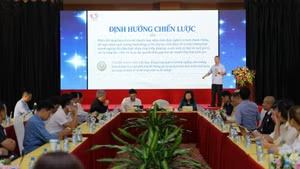
Associate Professor Dr Bui Quang Tuan, Vice President of the Viet Nam Economic Science Association, affirmed that the circular economy is an irreversible trend for the national economy. Digital technology serves as a core driver and a gateway to strategic opportunities for global integration and competitiveness. Comparing circular economy models in the European Union (institution-led), China (state management-led), and corporations such as Apple and IKEA (driven by governance and technological innovation), he noted that each has its own strengths and weaknesses. He suggested that Viet Nam should adopt a hybrid model combining all three approaches.
The 2025–2030 period will be a pivotal phase for Viet Nam’s industrial sector to seize strategic opportunities to transition from a linear to a circular economy. This also presents an opportunity for manufacturing enterprises to integrate into green supply chains, accelerate the development of the recycling industry, and research and apply new materials and high technologies to replace traditional ones.
The 2025–2030 period will be a pivotal phase for Viet Nam’s industrial sector to seize strategic opportunities to transition from a linear to a circular economy. This also presents an opportunity for manufacturing enterprises to integrate into green supply chains, accelerate the development of the recycling industry, and research and apply new materials and high technologies to replace traditional ones. However, to achieve this, it is essential to complete and synchronously implement three strategic pillars: institutions, technology, and financial mechanisms.
In addition, greater investment is needed in high-quality human resources, international cooperation in technology application, and public awareness-raising efforts. “What matters is to act now — not whether to act, but how quickly we can do so,” Dr Bui Quang Tuan emphasised.