For the collective economy, Resolution No.20-NQ/TW of the 13th Party Central Committee sets the goal of building a dynamic, effective, and sustainable collective economy. Together with the state economy, it is to form a solid foundation of the national economy; attract more farmers, households, individuals, and organisations; contribute to raising incomes and living standards for members; ensure social progress and equity; and promote rapid, sustainable national development.
According to Bui Anh Tuan, Director General of the Department of Private Enterprise and Collective Economy Development under the Ministry of Finance, this is not merely an economic target but also a strong political commitment from the Party and the State of Viet Nam.
It reflects the significance of inclusive growth: every citizen and economic sector is empowered to access development opportunities and share in the benefits of economic progress, he stated.

In recent years, the State has introduced numerous mechanisms and policies to foster a favourable business environment and support the sustainable growth of co-operatives. Despite notable achievements, co-operatives continue to face limitations and shortcomings, one of the most pressing being restricted access to credit capital.
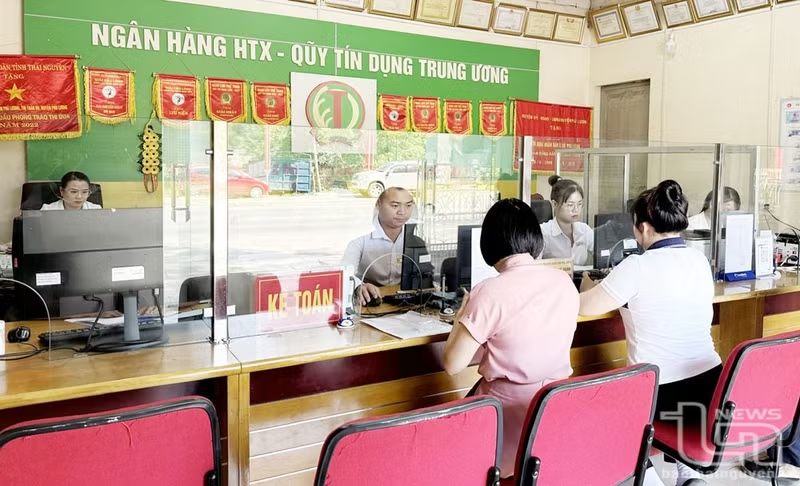
Notably, people’s credit funds represent a co-operative model in the financial sector, operating on principles of mutual assistance, autonomy, and community responsibility. Unlike commercial credit institutions, these funds are member-focused, closely connected to local communities, and directly serve the legitimate production, business, and livelihood needs of residents.
The Strategy for Collective Economy and Co-operative Development for 2021–2030 identifies these funds as a key component in promoting finance for the collective economy, supporting co-operatives to expand commodity production.
At present, more than 1,100 people’s credit funds are in operation nationwide, with total capital exceeding 191 trillion VND and outstanding loans surpassing 138 trillion VND. They have made significant contributions to socio-economic development, particularly in the collective economy sector and rural agriculture.
However, the system of people’s credit funds faces mounting challenges, including stricter requirements for governance and risk management, pressure to digitalise and modernise operations, and the need to adapt to the reorganisation of local government into a two-tier model. Access to credit capital remains one of the greatest bottlenecks for the collective economy.
At present, more than 1,100 people’s credit funds are in operation nationwide, with total capital exceeding 191 trillion VND and outstanding loans surpassing 138 trillion VND. They have made significant contributions to socio-economic development, particularly in the collective economy sector and rural agriculture.
These challenges demand comprehensive solutions, grounded in science and practice, to strengthen and enhance the role of funds in socio-economic development more broadly, and in the collective economy in particular.
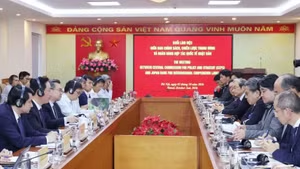
Discussing how to promote the role of the collective economy in the new context, Director General Bui Anh Tuan noted that to implement the 2023 Co-operative Law and the Strategy for Collective Economy and Co-operative Development for 2021–2030, the Ministry of Finance is finalising documents to submit to the Prime Minister for approval of the Master Programme for Collective Economy Development for 2026–2030.
This programme includes measures to develop the people’s credit fund system as a type of co-operative, while also positioning it as a leading organisation that supports other co-operatives through effective credit provision.
Currently, the Ministry of Finance and the State Bank of Viet Nam are gathering opinions both domestically and internationally to refine policies that support the collective economy sector, ensuring they are practical and aligned with international standards.
Key areas of focus include assessing the role and current state of the people’s credit fund system in socio-economic development, sharing international experience in developing credit co-operatives, and proposing solutions to strengthen and improve the efficiency of the people’s credit fund system.