This process not only helps address environmental challenges but also makes a tangible contribution to the promotion of the circular economy and sustainable development.
From waste to materials
According to the Ministry of Industry and Trade, Viet Nam currently has 31 coal-fired thermal power plants generating ash and slag. All of these plants have developed and implemented plans for the treatment and consumption of ash and slag in accordance with regulations. The utilisation rate has steadily increased over the years, from 37.5% in 2018 to 84% in 2021. During the 2022–2023 period, many plants consumed 100% of the ash and slag generated daily, while also processing a significant portion of stockpiled ash and slag accumulated over many years.
Vu Ngoc Hung, Head of the Industrial Environmental Protection Division under the Department of Safety Engineering and Industrial Environment (under the Ministry of Industry and Trade), noted that coal-fired power plants have largely completed conformity and compliance certification for ash and slag in line with national technical standards. As a result, ash and slag now meet the requirements for use as cement additives, construction materials, backfilling materials, or mineral admixtures for concrete products.
Data from Viet Nam Electricity (EVN) and its member units further indicate that, with comprehensive solutions in place, ash and slag consumption rates have risen markedly year by year, from 33% in 2015 to 100% since 2022, including the utilisation of ash and slag previously stored in disposal sites.
In the first eight months of 2025, the total volume of ash and slag generated reached 4.57 million tonnes, comprising 3.77 million tonnes of fly ash, 0.76 million tonnes of bottom ash and 43.7 thousand tonnes of gypsum. The volume consumed amounted to 5.31 million tonnes, equivalent to 116% of the volume generated, exceeding the average consumption level recorded in 2024. Thermal power plants in Hai Phong, Pha Lai, Ninh Binh, Thai Binh and Uong Bi have consumed nearly all newly generated and stored ash and slag.
The Ministry of Construction has assessed that the volume of thermal power ash and slag being utilised is rising sharply, gradually keeping pace with the amount generated. As of early this year, the cumulative volume of thermal power ash and slag consumed nationwide has exceeded 100 million tonnes.
Associate Professor Dr Luong Duc Long, former Director of the Institute for Building Materials, observed that ash and slag from coal-fired thermal power plants, when properly controlled, represent a high-quality raw material for the production of cement, concrete and unbaked bricks. In many applications, particularly as mineral admixtures, fly ash helps increase fineness, enhance strength and improve water resistance, while also contributing to environmental protection.
In practice, enterprises consuming ash and slag have reported stable market demand over many years. Using ash and slag as production inputs not only helps conserve natural resources such as sand and stone but also significantly reduces the volume of waste sent to landfills. This is regarded as a clear example of the circular economy model in the energy industry and building materials sector.
At present, many localities are using thermal power ash and slag as backfilling materials, with no major technical obstacles reported. By the end of 2024, the cumulative volume of thermal power ash and slag consumed nationwide had exceeded 100 million tonnes, of which around 55%, equivalent to approximately 55 million tonnes, was used for backfilling. The large-scale application of ash and slag for this purpose not only alleviates pressure on disposal sites but also opens up a stable and sustainable pathway for long-term consumption.
Towards the full utilisation of ash and slag
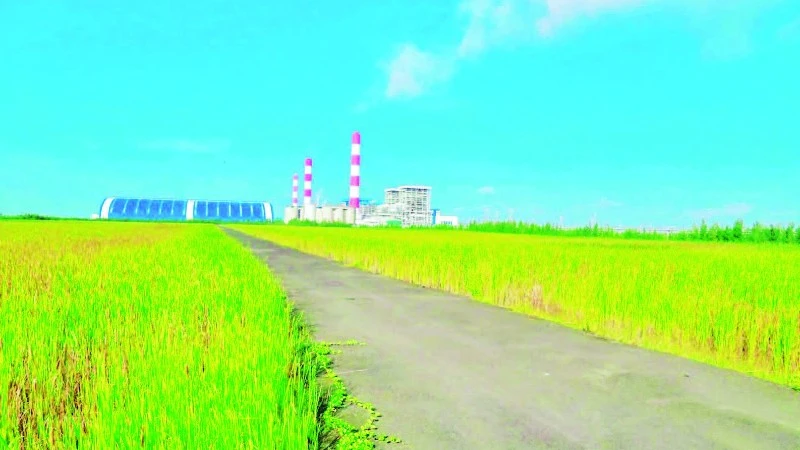
Practical experience at the Duyen Hai Thermal Power Plants shows that ash and slag are gradually becoming valuable commodities. Ash and slag disposal sites are strictly managed in accordance with technical procedures, including zoning, compaction, impermeable lining, tree planting and regular water spraying for dust control, ensuring environmental safety before being recovered as production materials. Leaders of Duyen Hai Thermal Power Company, which manages three plants including Duyen Hai 1, Duyen Hai 3 and the Duyen Hai 3 Expansion, said that the company’s ash and slag consumption rate has currently reached around 99%.
To move towards the target of 100% ash and slag utilisation by 2026, the company is working with the Institute for Construction Science and Technology to maintain sampling, assessment and testing in line with standards and technical regulations for using coal-fired thermal power ash and slag as backfilling materials, while completing conformity certification for fly ash used in concrete, mortar and cement. The enterprise continues to monitor and effectively implement signed contracts, while proactively seeking additional consumption partners.
Despite these positive results, ash and slag utilisation still faces a number of challenges, including fluctuations in supply linked to seasonal plant operations, the lack of detailed technical guidance for certain applications such as backfilling, roadbed construction and land reclamation, as well as the cautious attitude of some investors, even though ash and slag products have met national standards and technical regulations. Demand for ash and slag for backfilling also remains uneven. Several large-scale utilisation options, such as filling industrial zones and ports, roadbed construction or coastal reclamation, are still undergoing appraisal and approval processes. Long distances between power plants and points of use also increase transport costs.
According to experts, it is necessary to promptly complete the system of standards and technical regulations in the near future, creating a full and unified legal framework to give both enterprises and investors confidence in using ash and slag. Many businesses have also called on the Government and relevant ministries to study mechanisms to support transport costs and encourage the expansion of ash and slag applications.
Hung noted that the Ministry of Industry and Trade is continuing to refine mechanisms and policies to promote the development of the environmental industry, with priority given to supporting the production and consumption of recycled products derived from ash and slag, in line with the orientation of the Politburo’s Resolution No. 55-NQ/TW and the Law on Environmental Protection. As technical, transport and policy barriers are gradually removed, ash and slag will truly become a “secondary resource”, making an important contribution to the building materials industry and to emission reduction goals.