The year 2026 marks the first year of implementing the Socio‑Economic Development Plan for 2026‑2030, which sets ambitious growth targets and rising requirements for power supply, amid fluctuations in the international energy market.
Directive No. 10/CT‑TTg signals a policy shift from simply ensuring sufficient supply to easing system pressure through demand‑side management and distributed energy solutions.
The directive places electricity savings alongside load management, demand shifting and the development of on‑site generation, creating scope for energy storage solutions to play a more central role in the power system.
It sets out six specific target groups for managing electricity demand, using electricity thriftily and efficiently, and developing rooftop solar power under the self‑production, self‑consumption model. Following its issuance, localities proactively devised implementation plans and action programmes tailored to their conditions.
Promoting self‑produced, self‑consumed rooftop solar power is an appropriate approach. This clean energy source is easy to install, offers a quick payback period, and matches demand during peak hot sunny hours, thereby reducing supply pressure.
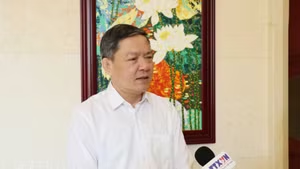
Energy expert Ha Dang Son
Mai Xuan Liem, Vice Chairman of Thanh Hoa Provincial People’s Committee, said the province had tasked functional units with developing plans containing specific targets and solutions, while preparing a programme for thrifty and efficient energy use for 2026‑2030.
Rooftop solar power development at public offices is prioritised, alongside encouragement for residents to participate. Implementing these measures synchronously not only reduces load but also improves system efficiency, lessens investment pressure on new power sources, and addresses delays in supplementing base‑load capacity. The province also focuses on flexible load adjustment in production and closer coordination with the power sector.
Energy expert Ha Dang Son assessed that promoting self‑produced, self‑consumed rooftop solar power is an appropriate approach. This clean energy source is easy to install, offers a quick payback period, and matches demand during peak hot sunny hours, thereby reducing supply pressure.
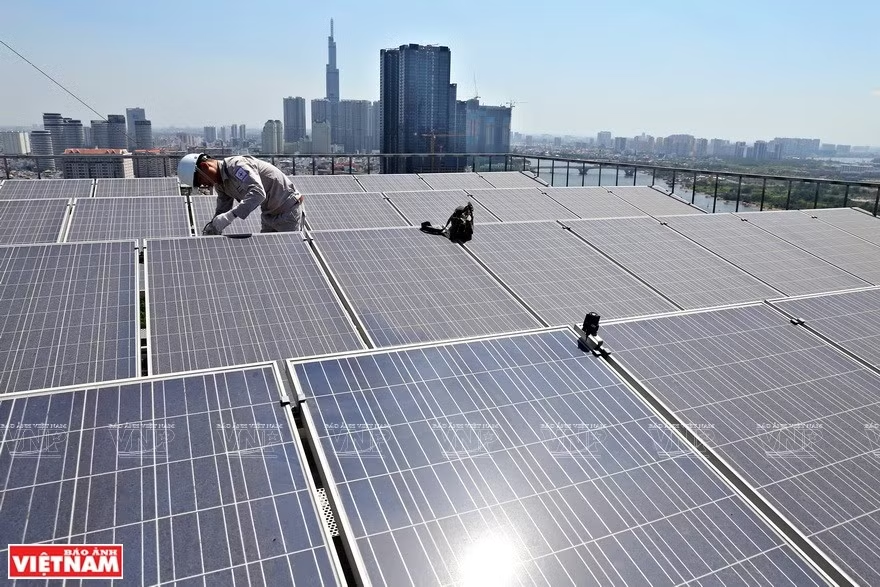
Investment costs have fallen sharply to about 40–50% of levels five years ago, shortening the payback period to around five years, even in northern regions. However, Son noted challenges, as rooftop solar is weather‑dependent and requires integration with energy storage systems to enhance flexibility.
Practical results at businesses demonstrate the model’s effectiveness. Nguyen Quang Tao, Deputy General Director of Ngai Cau Mechanical Company in Bac Ninh Province, shared that the firm has installed a rooftop solar system with a capacity of about 1 MWp.
The system not only boosts renewable energy use but also combines with greenery for cooling, significantly reducing air‑conditioning demand. On hot days nearing 40°C, workshop temperatures drop noticeably thanks to the roof system, cutting operating costs and improving working conditions.
In the service sector, many units are also actively saving electricity. Le Anh Tuan, representative of Long Thanh Hotel in Thanh Hoa Province, said that with 190 rooms, peak‑season electricity bills can reach 400–500 million VND per month.
To reduce costs, the hotel has adopted comprehensive measures such as optimising air‑conditioning operation by area and time slot, using LED lights with sensors, and strictly controlling high‑consumption equipment. The hotel has also invested in backup generators and is researching rooftop solar installation to take control of its power sources and reduce long‑term costs.
Directive No. 10/CT‑TTg also sets specific targets: around 10% of public offices and 10% of households should install rooftop solar power, or achieve an equivalent total capacity of 20% of the 2026‑2030 plan
At household level, initial effectiveness is being recorded. Le Thi Nga from Thanh Hoa Province said her family’s installation of a 3.1 kWp rooftop solar system has significantly reduced electricity bills, especially in summer. During the day, they can largely self‑supply their electricity needs.
From the perspective of system operation, Nguyen Ba Hoai from the National Power System and Market Operation Company Limited (NSMO) emphasised the importance of data in dispatching. Full information on rooftop solar installations is crucial for forecasting generation capacity and planning system operation. Without accurate data on installation scale, mobilisation planning becomes difficult, and forecasting errors can affect safe and stable supply for residents and businesses.
Directive No. 10/CT‑TTg also sets specific targets: around 10% of public offices and 10% of households should install rooftop solar power, or achieve an equivalent total capacity of 20% of the 2026‑2030 plan. At the same time, it requires ministries and sectors to improve support mechanisms for finance, green credit and technical standards.