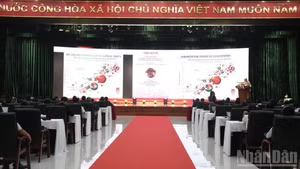
Human resources have been identified as a key factor, with a comprehensive approach covering training, recruitment, and utilisation, combined with competitive remuneration policies and a transparent working environment.
Applying special mechanisms
Da Nang is gradually asserting its position in operating Viet Nam’s IFC with a focus on digital and green finance, backed by coordinated preparations across the three core pillars of institutions, infrastructure, and the operational apparatus. The city is concretising special mechanisms approved by the National Assembly and the Government, particularly under Resolution No. 222/2025/QH15 (dated June 27, 2025) and related guiding decrees. The focus is on developing regulatory sandbox mechanisms for financial technology (fintech), refining investment incentive policies, and improving foreign exchange and capital flow management in line with international standards. This forms an important foundation to attract global financial institutions while creating space to pilot digital, green and innovative financial models.
The city prioritises the synchronous development of digital infrastructure, data systems, and dedicated working spaces for the IFC. The headquarters of the operating agency is located at Software Park No. 2, the city’s concentrated information technology zone, offering more than 4,000 square metres of workspace with modern technological infrastructure, ready to serve financial institutions and fintech enterprises. In the second quarter of 2026, the city is set to complete and put into operation a 20-storey building with a total floor area of over 27,000 square metres, built to green and smart standards to support IFC activities.
In 2025, Da Nang sent 10 officials, civil servants, and employees to study, undertake internships, and conduct research at several international financial centres and financial institutions in developed countries. This group is regarded as an initial core workforce in absorbing international knowledge and experience towards application in the development and operation of Viet Nam’s IFC in Da Nang. To date, the official operational apparatus has been established with 21 personnel and will continue to expand in line with the development roadmap, following an internationalised recruitment strategy that combines attracting global talent with developing domestic human resources.
Ho Ky Minh, Standing Vice Chairman of the Da Nang People’s Committee and Chairman of the IFC Viet Nam Operating Agency in Da Nang, said the city is accelerating investment attraction into key infrastructure projects and free trade zone models. In this context, the IFC Viet Nam in Da Nang is identified as a financial nucleus to lead capital flow, promote sustainable growth, and move towards becoming a major digital financial centre in the Asia-Pacific region by 2030.
High-quality human resources are considered a “soft key” determining the success of the IFC, particularly amid the rapid development of digital finance, fintech, and digital assets. Dang Tung Lam from the IFC Viet Nam Operating Agency in Da Nang noted that Resolution No. 222/2025/QH15 identifies the attraction and development of high-quality human resources as a key pillar of the IFC, while allowing the application of special incentive policies on salaries, accommodation, training, and skills development. In the immediate term, the agency is implementing Resolution No. 15/2025/NQ-HDND (dated June 23, 2025) of the Da Nang People’s Council to ensure policies aligned with practical conditions.
Current human resource policies in Da Nang apply flexible recruitment mechanisms under contract-based arrangements, allowing the engagement of highly qualified experts and professionals from both domestic and international sources in the public sector. Incentive policies are designed to be more competitive, including initial support, modern working conditions, and clear career development opportunities. This provides a foundation for building a team capable of operating the complex components of the IFC Viet Nam in Da Nang.
Proactively developing human resources
Da Nang is also strengthening cooperation with universities and international organisations to train interdisciplinary human resources that meet the demands of a modern financial ecosystem. Priority areas include fintech, artificial intelligence, big data, sustainable finance, carbon finance, international financial law, and risk management. Training programmes are designed to be closely linked to practical operational needs, ensuring immediate applicability upon completion.
Tran Manh Huy, Chairman of the Board of Directors of HTV Blockchain Solutions Joint Stock Company and lecturer at Da Nang Architecture University, suggested that to prepare high-quality human resources for the IFC, the city should proactively recruit and attract experts and skilled workers from outside to meet immediate demands, particularly in emerging technology fields. At the same time, it should promote on-site training through close cooperation with universities, businesses, and authorities, implementing programmes under a “learning by doing” approach rather than waiting for a standardised framework.
Da Nang and its international partners are currently promoting the establishment of a Fintech and Sustainable Development Research and Training Institute in 2026, in parallel with the operation of the IFC Viet Nam in Da Nang. This will serve as an important platform for training interdisciplinary human resources in areas such as fintech, artificial intelligence, big data, blockchain, sustainable finance, and international financial law, while also providing scientific input for policy development. The institute will also act as a bridge connecting the IFC Viet Nam in Da Nang with domestic and international partner networks.
Prof. Dr. Le Van Huy, Rector of the University of Economics – The University of Da Nang, said the university has officially signed a memorandum of understanding with the Viet Nam Blockchain Association to strengthen links between the university and the digital technology business ecosystem in training, research, and human resource development. The university is gradually innovating its training programmes and enhancing content related to the digital economy, digital governance, data analytics, entrepreneurship, and innovation, while also promoting research activities aligned with the practical needs of Da Nang and the central region.