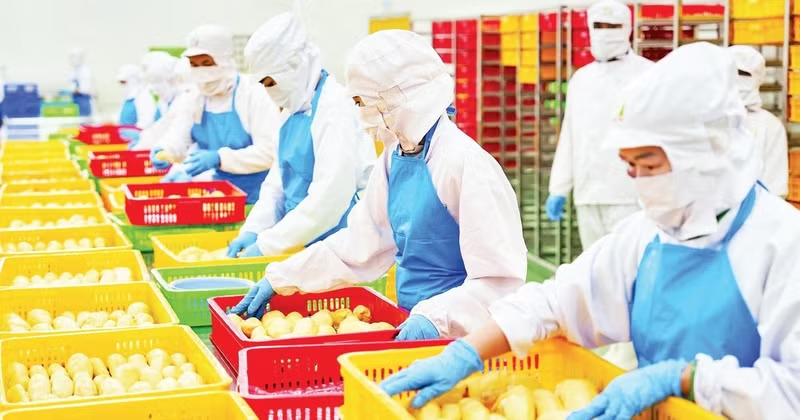
Agribusinesses are now focusing on investing in raw-material production areas, technology, and processing, gradually taking control of the entire production and distribution process.
Connecting value chain
After years of procuring agricultural products in the Central Highlands provinces, Phuc Sinh Group JSC is shifting pivoting aggressively direct investment in production and processing. The company has recently launched the Phuc Sinh Dak Nong Agricultural Export Production and Processing Centre project in Lam Dong Province, focusing on coffee, pepper, and high-value-added products. Under the plan, construction of the centre is expected to be completed and operations to begin by the end of the first quarter of 2027, with the project expected to generate revenue of trillions of dong in 2027–2028.
Phuc Sinh Group Chairman Phan Minh Thong stated the company expected the completed project to be capable of competing with advanced agricultural centres in Viet Nam and countries such as the Netherlands and Germany in agricultural processing. The company is also investing in crop varieties and working alongside farmers under a sustainable development model, with the aim of building brands and elevating the value of raw-material production areas.
Meanwhile, in an effort to cultivate an export ecosystem, Chanh Thu Fruit Import-Export Group JSC is focusing on standardising the initial stages of the supply chain. The company recently announced a set of quality standards for incoming durian materials, establishing uniform benchmarks for specifications, harvesting times, and acceptance conditions. It is also working towards developing a community technical network linking farmers, traders, suppliers, co-operatives, businesses, research institutes, universities, and local technical teams to jointly develop raw-material production areas.
The company’s Deputy General Director Le Vu Tuan Anh explained: “Under this network, farmers are at the centre, traders serve as the bridge, businesses organise the process, while research institutes and universities provide the scientific foundation. When every ‘link’ shares responsibility, raw-material production areas can be elevated to superior standards, enabling Vietnamese agricultural products to generate greater value and conquer even the most demanding markets.”
In aquaculture, a key sector of the agricultural economy, businesses’ participation in the value chain is manifested via direct assistance to individual small-scale farmers. Through the BASIN Project, funded by the Australian Government, Minh Phu Certified Shrimp Social Enterprise Co., Ltd. supports small-scale shrimp farmers in Vinh Thuan Commune, An Giang Province, helping them refine farming techniques, adopt sustainable farming practices in line with the standards of the Aquaculture Stewardship Council (ASC), enhance their capacity to adapt to climate change, and implement traceability.
According to Lam Thai Xuyen, Director of Minh Phu Certified Shrimp Social Enterprise Co., Ltd., the support activities are being executed in alignment with market requirements and product outlets. To establish long-term linkages, the company will continue to work alongside farmers even after the project ends.
Policy as a driving force
More than a year after the implementation of Politburo Resolution No. 68-NQ/TW, dated May 4, 2025, on private-sector development, many agribusinesses said that although the resolution had been in effect for a relatively short time, it provided a foundation for businesses to formulate long-term investment plans.
For agriculture — a sector exposed to considerable risks from weather and disease and characterised by long production cycles — stable and consistent policies are critically important for businesses to feel confident about making substantial investments in crop varieties, raw-material production areas, factories, and technology. In recent times, many agribusinesses have proactively overhauled their operational models to control risks, from developing production areas and standards, providing technical support, and organising supplies to investing in processing and establishing market outlets, opening up a comprehensive and sustainable development path for agricultural product sectors.
At a more direct level of engagement with production, the Government has recently issued Resolution No. 36/2026/NQ-CP, dated July 31, 2026, mandating the simplification of administrative procedures for growing-area codes and packing-house codes. The registration process, conducted entirely online under the principle of self-declaration and self-responsibility, will significantly reduce compliance time and costs.
The resolution aims to create a transparent and open administrative environment for people and businesses engaged in production and exports, thereby enhancing the competitiveness of Vietnamese agricultural products.
Deputy Minister of Agriculture and Environment Nguyen Hoang Hiep
According to Deputy Minister of Agriculture and Environment Nguyen Hoang Hiep, before advising on the issuance of Resolution 36, the ministry worked with industry associations to conduct field surveys in several localities and met with growing areas and export border gates to solicit input from relevant stakeholders. The resolution aims to create a transparent and open administrative environment for people and businesses engaged in production and exports, thereby enhancing the competitiveness of Vietnamese agricultural products. This is a significant change for businesses because more streamlined procedures will give them greater opportunities to forge synergies with farmers, expand production areas, and meet the traceability requirements of import markets; at the same time, it is consistent with the spirit of Resolution No. 68-NQ/TW, which calls for a strong shift from pre-inspection to post-inspection, alongside strengthened inspection and supervision.
The removal of administrative “barriers” and the connection of “links” across the value chain are creating a new paradigm in agricultural production. Together with the committed partnership between businesses and farmers, these efforts provide a robust bedrock for building a modern, transparent Vietnamese agricultural sector with a strong reputation on the international stage.