Under the sunlight in late April in the Central Highlands, along the red basalt road leading to Krong Pac Commune, Dak Lak Province, we still felt a sense of coolness from the lush green coffee gardens stretching on both sides, filled with young fruit.
Nguyen Van Loi from Krong Pac Commune said that the climate and soil conditions are highly favourable for industrial crops. As a result, many enterprises and cooperatives have linked with farmers to produce coffee along value chains, improving product quality. “My family has 3 hectares of coffee currently in the harvesting stage, producing more than 10 tonnes of beans per year, generating nearly 1 billion VND in revenue and around 700 million VND in profit after costs. Thanks to coffee farming, we have been able to buy a car and build a spacious house,” he said.
With guidance from agricultural officers on organic production, drip irrigation, and proper cultivation and harvesting techniques, the intercropped pepper and coffee garden of more than 1.5 hectares owned by Y Sin Nie in Ea Sol Commune, Dak Lak Province, has achieved high yields and good quality.
Y Sin Nie shared that with support from agricultural extension officers, enterprises, and cooperatives in applying organic production methods, his coffee and pepper crops have delivered stable, high yields. In addition, high market prices have helped his family earn more than 500 million VND annually, enabling them to quickly escape poverty.
As a locality with strong advantages in industrial crop production, Son La Province has, for many years, planned and applied technology in cultivation to increase value. So far, the province has nearly 55,000 hectares of industrial crops, including more than 24,000 hectares of coffee, producing over 300,000 tonnes of fresh cherries each year.
Nguyen Xuan Thao, Director of Bich Thao Coffee Cooperative in Chieng Coi Ward, said the cooperative cultivates and links with 800 households to grow 1,200 hectares of coffee. Since 2017, it has shifted to organic coffee production, ensuring proper cultivation and care processes while utilising coffee husks, pulp, and wastewater to produce microbial fertiliser. As a result, yields reach 25 to 30 tonnes of fresh cherries per hectare, with average income ranging from 700 million VND to 800 million VND per hectare per crop.
Alongside the application of science in production, many enterprises have invested in machinery and equipment, developing deep-processed products to reduce raw exports, increase added value, and enhance competitiveness in international markets.
Nguyen Tien Dung, Deputy General Director of September 2 Dak Lak Import-Export Company (Simexco Daklak), said that raw material export faces major limitations due to dependence on market price fluctuations.
Since 2004, the company has invested in modern deep-processing lines, producing a range of products such as ground and instant coffee to meet diverse consumer demand.
In the 2024–2025 crop year, the company exported 120,000 tonnes of coffee and 15,000 tonnes of pepper, with export turnover reaching 643 million USD and revenue exceeding 18 trillion VND. Simexco Daklak operates a closed production process from raw material zones to manufacturing, linking with 60,000 coffee-growing households across 62,000 hectares, applying advanced cultivation methods to produce high-standard processed products that meet increasingly stringent market requirements.
By the end of 2025, the country had 2.28 million hectares of main industrial crops, including rubber, coffee, pepper, cashew, and tea, with a total output of 5.34 million tonnes. Thanks to restructuring, strengthening linkages, applying science in production, and building planting area codes and traceability systems, these crops have achieved good quality and relatively high yields, increasing incomes for farmers.
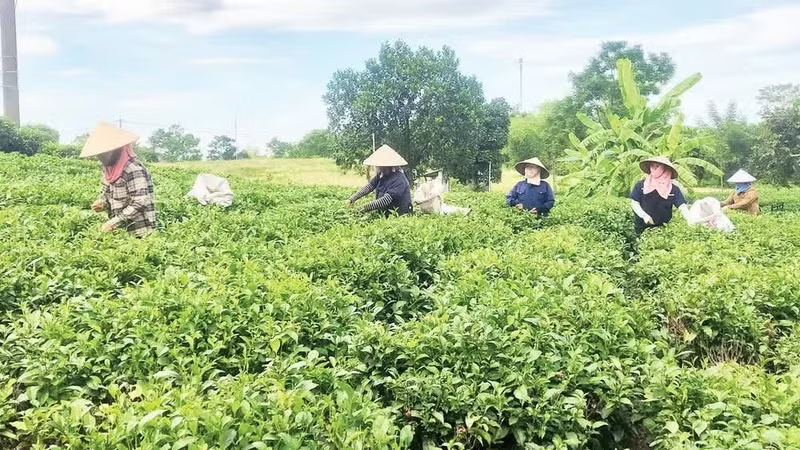
Bui Xuan Phong, Head of the Crop Production and Plant Protection Division (the Department of Crop Production and Plant Protection, Ministry of Agriculture and Environment), said that in 2025, the consumption of key industrial crop products was relatively favourable as prices remained high. Coffee generated profits of 180 million VND to 220 million VND per hectare per year, pepper from 150 million VND to 180 million VND per hectare, and tea from 40 million VND to 60 million VND per hectare.
However, industrial crop production still faces many challenges due to climate change, including storms, floods, and droughts affecting yields and product quality. In addition, consumption remains dependent on global markets, meaning that price fluctuations directly impact domestic purchasing.
Moreover, importing countries are tightening requirements on traceability, food safety, sustainable production, and deforestation prevention. Meanwhile, many enterprises still focus mainly on primary processing and have not invested adequately in deep processing, resulting in low added value.
Regarding this issue, Nguyen Bao Long, Head of the Industrial Management Division (Dak Lak Provincial Department of Industry and Trade), said that the number of enterprises engaged in deep processing of industrial crops in the province remains limited and not commensurate with its potential. Specifically, the coffee sector has more than 300 processing facilities, but very few large-scale enterprises have invested in deep processing; cashew and rubber are mainly subject to preliminary or technical processing; and crops such as pepper, durian and macadamia have not had modern processing plants.
According to Bui Xuan Phong, in the coming period, localities need to continue implementing solutions to attract enterprises to invest in developing key industrial crops, promote the formation of linkage chains from forming growing areas to processing and consumption, and apply the GAP model and equivalent standard models, linking with building planting area codes and product traceability. Circular economy practices should also be applied to maximise the use of by-products.
For enterprises, investment in modern technology and equipment for deep processing and product diversification is essential to meet both domestic and international consumer demand. In addition, localities should continue to coordinate closely with ministries, sectors, industry associations, and businesses to organise product promotion programmes, remove trade barriers, and negotiate to expand export markets.