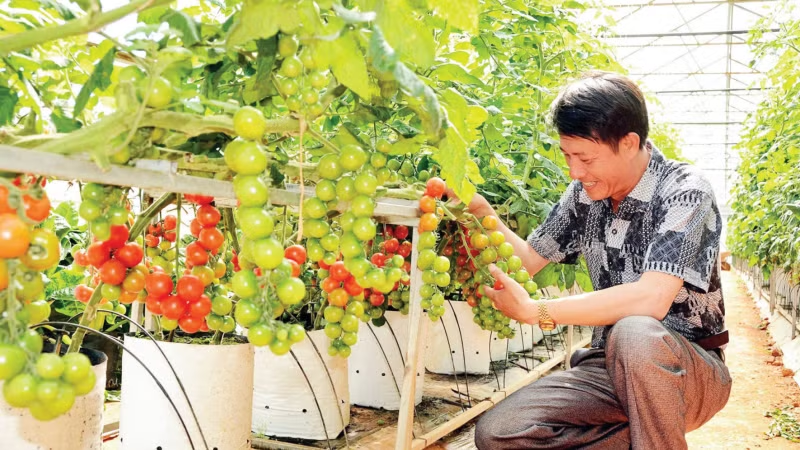
Climate change is becoming increasingly extreme, with droughts and saltwater intrusion rising in frequency and severity, while water demand for agricultural production continues to increase. As a result, technologies such as sprinkler irrigation, drip irrigation, precision, and smart irrigation integrated with sensors and digital data are being applied by farmers in many localities to save water and improve productivity and quality of agricultural products. The application of these technologies also helps reduce emissions and enhances adaptability to adverse climate conditions.
According to Luong Van Anh, Deputy Head of the Department of Irrigation Works Management and Construction (Ministry of Agriculture and Environment), by the end of 2025, more than 2.3 million ha of crops nationwide used advanced, water-saving irrigation. Of this, about 627,000 ha of upland crops utilised water-saving irrigation, including 196,000 ha in the South Central Region and the Central Highlands. Through the application of these technologies, the productivity increased by 10–40%, labour costs for crop care were reduced by 20–70%, production effectiveness rose by 14–27%, water savings compared to traditional irrigation reached 20–60%, and farmers’ incomes increased by 15–45%.
The Central Highlands is a major production region for key industrial crops such as coffee, pepper, cashew, rubber, and fruit trees, but it frequently suffers from drought and water shortages that affect crops, especially during the dry season.
“So far, more than 84,600 ha in the province have applied advanced, water-saving irrigation for high-value industrial crops. To achieve these results, the province has institutionalised policies of the central agency on supporting the development of small-scale irrigation, on-farm irrigation, and advanced, water-saving irrigation in line with local conditions,” said Nguyen Thanh Long, Head of the Sub-Department of Irrigation and Natural Disaster Prevention of Dak Lak Province.
At the same time, the province has researched, applied, and transferred irrigation technologies suitable for each type of crop, soil conditions, and water sources in each ecological zone. In addition, enterprises, agricultural service cooperatives, and farmers have all shown strong interest in investing in advanced, water-saving irrigation technologies, using soil moisture and weather sensors as well as remote control via mobile telecommunications devices in production, in order to reduce costs and use water resources more efficiently.
Currently, water demand for agricultural production accounts for a very large proportion (over 80%), while traditional irrigation methods cause high levels of water loss and waste. Nevertheless, the application of advanced, water-saving irrigation remains low, at only about 7.3% of the total upland crop area, and is concentrated in only a few regions and localities. Moreover, many localities with high potential for application have so far achieved results only through pilot models supported and invested in by the State and local authorities, without spreading widely.
The reasons include high initial investment costs, unstable agricultural product prices, limited access to support policies, in-depth technical consultancy, and infrastructure. Also, the irrigation and power infrastructure fails to meet the requirements of modern and smart irrigation. For example, in Dak Lak, the cost of investment in advanced, water-saving irrigation systems for upland crops is around 50–60 million VND/ha, which makes farmers hesitant. In addition, farmers’ awareness of advanced, water-saving irrigation remains limited; in some places, farmers have not kept pace with the operational requirements of the technology.
Viet Nam is facing major challenges regarding water resources. Therefore, advanced, water-saving irrigation for upland crops is not only a technical solution but also an inevitable requirement to restructure the agricultural sector towards a modern and sustainable direction, contributing to ensuring water security.
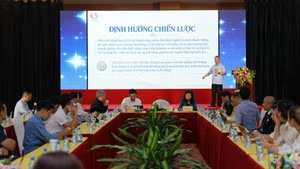
Discussing this issue, Nguyen Hoai Nam, Deputy Head of the Department of Irrigation Works Management and Construction, said: “The Viet Nam Irrigation Strategy to 2030, with a vision to 2045, sets a specific target that by 2030, 70% of upland crop areas will be irrigated, of which advanced, water-saving irrigation will account for at least 30%. This is not only a numerical target, but a fundamental shift in thinking from water exploitation to effective water governance.”
Accordingly, in the coming time, ministries, sectors, and localities need to review and adjust planning for key upland crop production regions in conjunction with irrigation planning, ensuring proactive water sources for the development of advanced, water-saving irrigation; encouraging socialisation and attracting enterprises, cooperatives, and investment organisations and production links to apply advanced, water-saving irrigation technologies.
At the same time, it needs to research and propose preferential credit support mechanisms and interest rate reductions for farmers and cooperatives investing in advanced, water-saving irrigation systems, especially in concentrated production areas of key upland crops. In addition, digital transformation in advanced, water-saving, and smart irrigation should be promoted to respond to climate change and ensure water security; and mechanisms and policies for financial support should be studied to promote the application of AI, other strategic technologies, and digital transformation in advanced, water-saving irrigation.