This is not only an immediate operational requirement, but also a strategic direction for the country’s development model.
High growth is only meaningful when each percentage point increase in GDP is accompanied by higher productivity, greater added value, stronger competitiveness, and a significant improvement in people’s lives.
Simply chasing numbers is impossible
General Secretary To Lam emphasised that the first principle is substantive growth, meaning not sacrificing quality and sustainability for mere growth speed. At the same time, Viet Nam must resolutely eliminate the mindset of chasing achievements for their own sake. This is a very accurate and correct directive. High growth is not just a target, but also the sustainable upward capacity of the entire economy.
An economy can grow rapidly in the short term by expanding investment, loosening credit, or more aggressively exploiting traditional input factors. But these drivers all have limits. If growth is not accompanied by increased productivity, technological innovation, improved institutional quality, and increased domestic value added, then today's rapid growth could weaken the foundations of tomorrow.
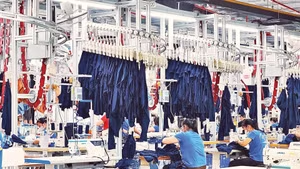
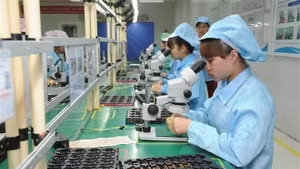
Practice showed that Viet Nam has grounds to set a higher growth target. In 2024, GDP increased by 7.09%. Entering 2025, GDP increased by 8.02%; GDP per capita reached approximately 5,026 USD; and the manufacturing industry alone increased by 9.97%, the highest rate in the 2019-2025 period. These figures reflect the positive recovery and expansion of the economy.
However, high growth over many years can easily lead to significant imbalances and increased structural risks. Viet Nam will not accept this trade-off. In other words, the country does not need growth at all costs; What is needed is growth driven by productivity, efficiency, innovation, and enhanced internal strength. Double-digit growth is only truly meaningful when it is the result of a healthier economy, not an overheated one.
The second principle, clearly stated by General Secretary To Lam, is the need to steadfastly maintain macroeconomic stability, control inflation, and ensure major balances. This is a prerequisite. The higher an economy's growth target, the more it needs a solid macroeconomic foundation. When inflation is controlled, interest rates and exchange rates move within manageable limits, market confidence is strengthened; businesses will feel secure in long-term investment, people will be more confident in consumption, and the State will have sufficient room to respond to external fluctuations.
Recent results showed that this foundation is being held quite firmly. In 2025, the average consumer price index (CPI) is projected to increase by 3.31%, still within the target set by the National Assembly. This is a crucial pillar for growth. However, in the context of a global economy still fraught with uncertainty, increasingly fierce strategic competition, and the persistent trend of protectionism and geopolitical risks, macroeconomic stability must be considered the “railway” for growth, not a secondary task.
The third principle is the efficient use of all available resources, prioritising key projects and promoting public-private partnerships. General Secretary To Lam demanded that resource allocation be scientific, with clear economic and social accounting, avoiding inefficiency and waste. Resources must be concentrated on projects with real strategic impact, creating substantial added value and strengthening key national infrastructure. This requirement addresses a major bottleneck in the economy.
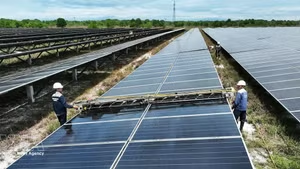
The country does not lack resources. The issue is how to allocate them, where to prioritize them, and how to use them effectively. Public investment must be the driving force that leads and activates social investment. However, public investment only plays its role when capital is channeled into the right “main arteries” of the economy: strategic transportation infrastructure, energy, digital infrastructure, logistics, education, healthcare, science and technology, and projects with regional and inter-regional spillover effects.
Ultimately, all achievements must belong to the people.
The fourth principle set forth by General Secretary To Lam is that high economic growth must serve the interests of the people, improve their material and spiritual lives, and be linked to social justice. All policies, projects, and investment resources must aim to create real value for the people, increase their income, reduce poverty, narrow the development gap, improve social welfare, and ensure the legitimate rights and interests of all segments of the population. The fruits of growth must be shared fairly. This is both the essence of our system and the ultimate measure of all development policies.
Growth is not an end in itself. The ultimate goal of development is to improve the lives of the people. If GDP increases but real income does not improve proportionally, if the development gap between regions and population groups widens, and if people do not have more equitable access to education, healthcare, housing, employment, and social security, then that growth is not fully meaningful.
Experience shows that when growth is linked to social welfare and sustainable poverty reduction, development achievements will have a more solid social foundation. In 2024, the multidimensional poverty rate was 4.06%, a decrease of 1.65 percentage points compared to 2023; the percentage of poor households according to the multidimensional poverty standard decreased to 1.93%, exceeding the set target. This is a commendable result. But sustainable poverty reduction is not just about reducing a percentage, but about expanding access to basic services, increasing the resilience of households to risks, and preventing re-poverty when changes occur.
In the same spirit, General Secretary To Lam’s suggestion to promptly develop a Resolution on a model for national development in the new period based on science, technology, innovation, and digital transformation is of particular importance. As traditional drivers of growth reach their limits, new drivers must be knowledge, technology, data, innovation, governance capacity, and institutional quality. Only by shifting the focus of development to these foundations can high growth be sustainable, more self-reliant, and more deeply permeate social life.
Therefore, the message from the Second Plenum of the 14th Central Committee of the Communist Party of Viet Nam is not merely a call to promote growth. More profoundly, it establishes a new standard for development: Growth must be substantive; governance must maintain macroeconomic stability; resources must be used efficiently, with a clear focus and priorities; and all ultimate achievements must benefit the people. When these four principles are consistently applied in policy planning and implementation, the goal of double-digit growth will no longer be a slogan, but a feasible, solid, and compelling roadmap.
The country is entering a new phase of development, with greater aspirations, higher demands, and heavier responsibilities. In this phase, the most important thing is growth driven by intellect, discipline, efficiency, innovation, and responsibility to the people. This is the path for Viet Nam to move faster yet steadily, to reach higher yet sustainably, and to realise the aspiration for a prosperous and happy nation in the new era.
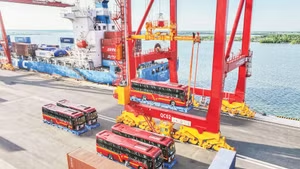
By the end of December 2025, disbursement of public investment capital reached over 755 trillion VND, equivalent to 83.7% of the plan assigned by the Prime Minister. Along with this, foreign direct investment (FDI) attracted in 2024 reached approximately 25.35 billion USD, the highest ever; FDI attracted in 2025 is projected to reach 27.62 billion USD, the highest for the same period in the past five years. These figures demonstrate the enormous potential for mobilising resources. But speed must be accompanied by quality allocation and efficient use.