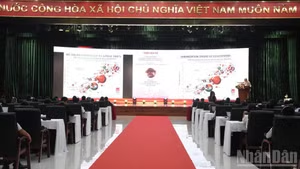
Human resource “links” within the system
Nguyen Xuan Bach, a member of the 9x generation who graduated with an excellent degree from the Banking Academy (Ha Noi), was once an intern at the headquarters of Joint Stock Commercial Bank for Foreign Trade of Viet Nam (Vietcombank) before successfully securing a position at Transaction Office No. 1 of the Joint Stock Commercial Bank for Investment and Development of Viet Nam (BIDV) immediately after graduation.
“I feel that I have been trained in a collective with highly qualified colleagues. The decisiveness in work processing and standardised operating procedures help young people mature quickly,” Bach shared.
From a governance perspective, Dinh Quang Hoa, Head of the Organisation and Personnel Department of the State Capital Investment Corporation (SCIC), pointed out that the biggest difficulty currently lies in quality and governance mindset rather than quantity.
According to Hoa, the shortage of capable managers with innovative thinking and modern management skills has slowed the transformation of operational models. Many leaders of state-owned enterprises still come from administrative management backgrounds and have not adapted to modern corporate governance models. Skills in risk management, financial management, and market strategy remain limited, making it difficult for enterprises to compete in an increasingly integrated environment.
Hoa analysed that the proportion of highly qualified workers in state-owned enterprises is lower than in the private sector, particularly in terms of soft skills and foreign languages, limiting participation in global value chains. A reluctance to change has led to a lack of cooperation during restructuring processes. Traditional corporate culture, which emphasises “safety and stability”, also hinders innovation.
“If human resource issues are not addressed, policies on capital, technology, or markets will struggle to be effective. To successfully transform into a national investment fund model, SCIC needs individuals with global vision, legal expertise, and the ability to manage complex investment portfolios. Professionalising the management team is a prerequisite for maximising the effectiveness of state investment capital,” he added.
Reforming mechanisms to unlock intellectual resources
From the challenges in local governance quality, there is an urgent need for mechanism breakthroughs to unlock the creativity of the workforce. On that basis, Nguyen Chi Thanh, Chairman of SCIC, affirmed that improving human resource quality in association with sustainable development (ESG – Environmental, Social, and Governance) is a top priority.
Implementing the Politburo’s Resolution No. 79-NQ/TW dated January 6, 2026, on developing the state economy, SCIC is undergoing comprehensive restructuring towards professional capital investment operations and forming a national investment fund. This model requires the participation of independent economic experts and experienced policymakers in the Members’ Council and Executive Board to enhance oversight and decision-making quality.
Thanh outlined key solutions, including reviewing and completing core competency frameworks and the job description system in line with leading global financial investment institutions. Staff evaluation at SCIC is conducted objectively, based on KPIs to accurately measure their performance. Regular competency assessments are implemented to classify, screen, and reorganise personnel. The corporation also collaborates with leading regional investment organisations such as Temasek to send staff abroad for practical training. A special salary mechanism for senior experts, combined with output-based management, is expected to create strong motivation.
According to Thanh, improving a transparent and fair working environment, with promotions linked to actual performance, will encourage greater dedication from employees. State-owned commercial banks are also actively preparing human resources for the digital era.
Le Ngoc Lam, Chief Executive Officer of BIDV, emphasised that workforce quality is a key pillar directly determining competitiveness. The principle that “each employee must be a competitive advantage” is consistently applied. To address the shortage of specialised personnel, Lam highlighted a comprehensive strategy based on three pillars: recruiting the right people, providing appropriate training, and retaining staff through a supportive working environment.
From the perspective of state management agencies, Vu Hong Phuong, Head of the Department for State-Owned Enterprise Development (Ministry of Finance), said that state-owned enterprises are still an important material force for the state in regulating the economy. Although their number has declined significantly, there are currently 703 state-owned enterprises nationwide, holding about 7% of total assets and 10% of the equity of all enterprises in the market.
These enterprises contribute up to 28% of state budget revenue and employ around 1.2 million employees. However, attracting high-quality human resources remains difficult due to recruitment and appointment mechanisms still being constrained by regulations governing civil servants and public employees. The Government recently issued Resolution No. 29/NQ-CP dated February 24, 2026, outlining an action programme to implement Resolution No. 79-NQ/TW, with breakthrough solutions such as competitive salary mechanisms and bonus schemes based on performance exceeding targets.
Notably, there is a pilot mechanism allowing the hiring, recruitment, and appointment of directors or general directors who are non-Party members or of foreign nationality at certain state-owned enterprises. The Ministry of Home Affairs and the Ministry of Finance are currently completing policies to bring these initiatives into practice.