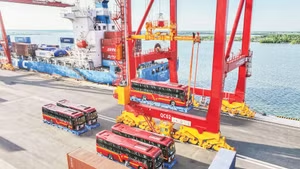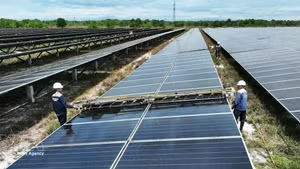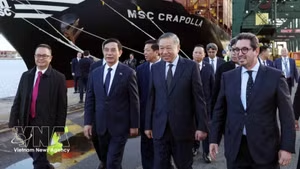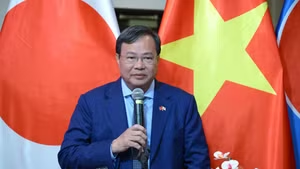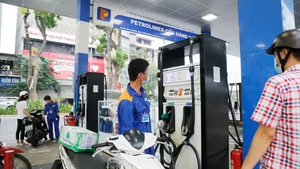
The resolution affirms the state sector as a particularly important component of the socialist-oriented market economy, ensuring macroeconomic stability, major economic balances, a strategic development orientation, and the safeguarding of national defence and security.
Charting a development roadmap
The resolution sets out a roadmap for developing state-owned enterprises (SOEs) towards regional and global stature. Specifically, by 2030, Viet Nam aims to have 50 SOEs among the 500 largest enterprises in Southeast Asia and one to three SOEs among the world’s top 500 enterprises. By the 2045 milestone, these figures are expected to rise to 60 and five, respectively.
Commenting on these targets, Dr Nguyen Minh Thao of the Institute for Strategy and Economic-Financial Policy said that Resolution 79 would provide an important foundation for SOEs, particularly large, well-performing ones, to make breakthroughs and truly become key drivers of development.
The resolution clearly signals a focus on concentrating resources and creating favourable conditions for the formation and growth of SOEs that play a leading role, guide markets and transmit growth momentum to other economic sectors.
This reaffirms the consistent policy of promoting the private sector as an important driver of the economy, while the State continues to restructure and develop SOEs in a focused and selective manner.
State resources will be concentrated on SOEs operating in key sectors and strategic industries, in order to create traction, trigger growth and generate spillover effects across the entire economy.
This approach is seen as appropriate for achieving balance in the enterprise development structure, in which large private enterprises and large SOEs jointly play leading roles and complement one another, rather than competing head-on.
Notably, the resolution also makes clear that the State will ensure capital for SOEs to carry out projects and political tasks assigned by the State, while production and business activities will be accounted for separately.
This reflects the Politburo’s policy of clearly separating SOEs’ different activities to enable a more accurate assessment of investment and business efficiency.
A range of solutions is also outlined to improve SOE performance and ensure more efficient resource allocation. These include applying governance standards in line with OECD principles, comprehensively restructuring the SOE sector, concentrating capital on key areas, and continuing equitisation and divestment from inefficient fields.
Dr Bui Quy Thuan, Head of the Research Division of the Viet Nam Industrial Park Finance Association (VIPFA), noted that no Vietnamese SOE currently features in the Fortune Global 500. Vietnamese SOEs would need to double or even triple their revenues over the next five to ten years.
He argued that these targets would become feasible with the introduction of Resolution 79, which establishes a new framework allowing the state sector to maintain its stabilising role while leading growth and attracting participation from other economic sectors.
“The resolution emphasises the need to optimise resources, unblock bottlenecks, build leading enterprises, promote an autonomous economy, and accelerate institutional and governance reforms in line with international standards,” Thuan said.

Creating substantive change
In practice, SOEs are still subject to intervention from multiple ministries and agencies. Major investment decisions often have to pass through numerous stages and layers of approval, slowing decision-making and causing enterprises to miss critical timing that can be vital to business operations.
Moreover, the current oversight mechanism remains heavily focused on ex ante controls while remaining weak on ex post supervision. Monitoring largely concentrates on procedural compliance, whereas the ultimate effectiveness of projects has not received due attention. This fosters a risk-averse mentality, as SOE leaders can easily be held accountable if projects fail due to market fluctuations.
At the same time, evaluation systems lack substantive performance indicators, such as value added or return on equity that truly reflect corporate capability.
In terms of human resources, the bottleneck lies not in capacity but in the working environment. Salary and remuneration policies in SOEs remain less competitive than those in the private sector and multinational corporations, while the boundary between business risk and legal violations is not sufficiently clear. As a result, many talented individuals opt for the private sector, which offers greater creative space and stronger legal certainty.
Against this backdrop, one notable innovation of Resolution 79 is that it allows SOEs greater autonomy in selecting and employing senior management personnel with the capacity to develop business strategies and operate enterprises effectively.
According to Dr Nguyen Minh Thao, this mechanism helps create a level playing field between SOEs and private enterprises, as the latter have long enjoyed full autonomy in hiring senior managers, while SOEs have been constrained by numerous procedural and appointment requirements.
However, hiring executives and granting them executive authority must go hand in hand with clear commitments to business performance and appropriate oversight mechanisms.
This model should be piloted in selected enterprises, with salary and bonus schemes based on agreements and closely linked to performance outcomes. Such an approach would ensure genuine empowerment while strengthening accountability.
For the resolution to truly take effect, relevant ministries and agencies need to promptly issue guiding documents to fully institutionalise the Politburo’s major orientations, including provisions that need to be specified in laws and government decrees.
Dr Bui Quy Thuan added that the resolution opens up mechanisms to protect officials who dare to think and act, while clearly distinguishing between business risks and legal violations. This is regarded as a key solution to reducing risk aversion among enterprise leaders, encouraging innovation, initiative and creativity in management.
These orientations not only aim at institutional reform and improved governance transparency, but also help create a level playing field, enabling SOEs to operate more flexibly, attract high-quality human resources and enhance international competitiveness.
At a deeper level, Resolution 79 reflects a fundamental shift in mindset from administrative management to development facilitation, a breakthrough of foundational significance.
It also introduces new financial mechanisms, allowing all proceeds from equitisation and divestment to be used to supplement enterprises’ charter capital, thereby strengthening financial capacity and expanding investment potential.
At the same time, oversight mechanisms are adjusted towards a strong shift from ex ante to ex post supervision, focusing on final outcomes rather than procedures alone.
“This approach is expected to create room for dedicated and capable officials to make bold, breakthrough decisions for the common good, while improving efficiency and accountability in the operations of state-owned enterprises.”
Major SOEs such as Viettel (12-15 billion USD in annual revenue), Petrolimex (around 10 billion USD) and EVN (8-10 billion USD) rank only between 500th and 1,000th globally under some criteria, well below the top 500 firms, which typically post revenues of at least 30-35 billion USD.