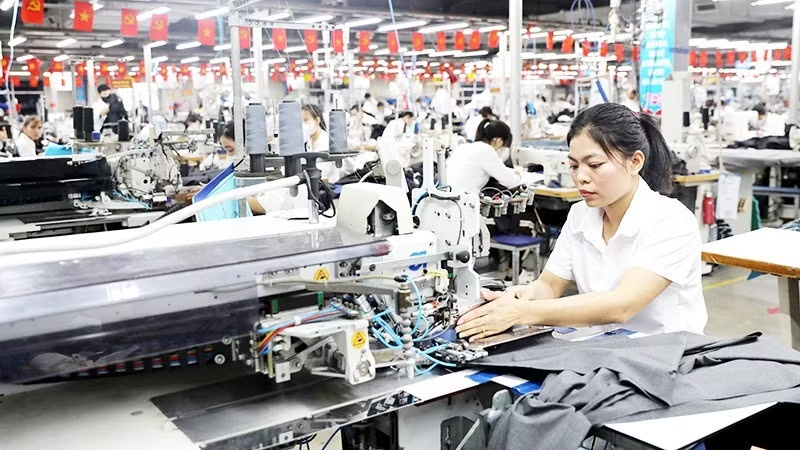
Nearly 99% of employees at May 10 Corporation returned to the factory right after the Tet break. Following New Year greetings and lucky money envelopes from the leadership, all managers and workers promptly took their positions, with production lines resuming at an urgent pace.
Favourable start
Having worked at May 10 for more than 20 years, Tran Thi Thuy, a worker in the components section, is accustomed to the accelerated pace of the early months of the year, when the company focuses on fulfilling orders for international partners. However, this year’s atmosphere appears even more upbeat. Stable orders and gradually improving incomes have given workers greater confidence to stay committed.
“On the first working day of the new year, we received encouragement and lucky money from the leadership. More importantly, there was a commitment to secure jobs and raise productivity to improve incomes. Everyone tells themselves to perform well from the very first days of the year.”
Vu Thi Thu Hang, a worker in the assembly section, shared that the beginning of the year is not only about restarting production lines but also about setting new goals for skill advancement. Such proactive learning and ambition are helping to create a vibrant production rhythm. “Learning new techniques allows us to handle more complex tasks. The more we can do, the higher our income,” Hang affirmed.
According to Than Duc Viet, General Director of May 10 Corporation, in 2025 the company’s production and business performance exceeded expectations. Revenue reached 5.136 trillion VND, profit 212 billion VND, and total import-export turnover 328 million USD, of which exports accounted for more than 200 million USD. Average monthly income for employees exceeded 11 million VND.
Entering 2026, the company targets growth of around 8% in both revenue and profit, while striving to raise average income to more than 12 million VND per person per month. Orders are secured through the end of April. Even before Tet, the leadership proactively encouraged workers to prepare for an immediate acceleration after the holiday. From the fifth day of Tet, May 10 organised transport for workers living far away to return to the factory (this year work officially resumed on the seventh day of the lunar year).
At the same time, a series of welfare programmes has been implemented. Notably, for Tet 2026, the company increased the 13th-month salary bonus by 2%, equivalent to nearly two months’ salary for employees, in addition to other bonuses and Tet gifts.
“Thanks to thorough preparation, the rate of workers returning to the factory after Tet was almost absolute, with only a few exceptional absences. This provides an important foundation for the company to enter the new production year with a proactive mindset and readiness to accelerate,” Than Duc Viet said.
With renewed momentum, the domestic business community is confident of fulfilling production and business targets in the new year. This is reflected in the quarterly survey of business trends among 6,207 enterprises in the processing and manufacturing industry conducted by the Statistics Office (Ministry of Finance).
Comparing the first quarter of 2026 with the fourth quarter of 2025, regarding new export orders, 81.4% of enterprises forecast an increase or stability compared with the previous quarter (28.1% increase, 53.3% unchanged), while 18.6% forecast a decline. Regarding employment, 88.4% of enterprises expect their workforce to increase or remain unchanged in the first quarter of 2026 compared with the fourth quarter of 2025 (14.3% increase, 74.1% unchanged), while 11.6% expect a reduction.
Confidence in the production sector is strengthening, laying the groundwork for positive growth in the processing and manufacturing industry in particular and the economy as a whole.

More efficient production and business
However, the Statistics Office also noted that the three biggest difficulties facing enterprises in the processing and manufacturing industry remain the search for and expansion of output markets. Specifically, 50.5% of enterprises face difficulties due to increasingly intense domestic competition; 49.3% face challenges because domestic demand remains low; and 29.5% encounter difficulties as demand in international markets has yet to recover as expected.
High lending interest rates were identified as the most volatile factor affecting production and business compared with the previous quarter. Some 22.8% of enterprises reported that high borrowing costs affected their operations in the fourth quarter of 2025, up 3.6 percentage points compared with the previous quarter.
To improve production and business performance, the Statistics Office recommends that banks continue to lower lending rates to reduce capital costs and facilitate production expansion. Many opinions also suggest that the State should implement measures to stabilise raw material and energy prices, helping to stabilise input costs and limit cost fluctuations.
Enterprises also wish to shorten processing times and simplify administrative procedures to reduce compliance costs. Other proposals include stimulating domestic demand, supporting deeper participation in production and supply chains, and improving the quality of logistics services.
According to Than Duc Viet, recent developments in US tax policy are creating room to adjust export strategies. After the US Supreme Court rejected the 20% reciprocal tariff imposed on Viet Nam, the administration of Donald Trump shifted to applying tariffs under Section 232 at a lower rate. If the new tariff remains around 15%, the reciprocal tariff effective from February 24, 2026, would decrease by at least 5% compared with 2025. During this approximately 150-day temporary application period, enterprises can leverage cost advantages to boost exports to the US market.
In the long term, the Supreme Court’s ruling is expected to bring greater stability to tax policy. Large-scale tariff decisions will likely require approval by the US Congress rather than being decided solely by the executive branch. This will enable enterprises to forecast and formulate medium-term production and business plans. In response, May 10 plans to make the most of this “golden window” of lower tariff levels to accelerate order signings, optimise costs, strengthen relationships with US clients, and diversify export markets to reduce risks from future policy fluctuations.
From an industry association perspective, Vu Duc Giang, Chairman of the Viet Nam Textile and Apparel Association, said that to seize opportunities and overcome challenges in the new phase, the business community should prioritise synchronised investment in standardised infrastructure to support automation and robotics, and to meet increasingly stringent technical standards of international customers. At the same time, enterprises should accelerate the application of technology, particularly artificial intelligence (AI) in design and product development, to shorten sample creation time, enhance productivity, and improve market responsiveness. They should also develop digital governance strategies and apply Lean production models to optimise processes and reduce costs.
Enterprises must also adapt to changes in global purchasing methods, becoming more proactive from product development and marketing to production and delivery, participating more deeply in value chains and increasing product value. In addition to strictly complying with tariff regulations, they need to closely monitor trade developments and international relations to adjust production and export plans accordingly, while continuing to diversify markets, customers and products to reduce risks. Finally, the human factor and each enterprise’s strategy play a decisive role. “Enterprises must take care of workers’ incomes, motivate employees, clearly define key segments and product lines, and strengthen value-chain linkages to achieve sustainable export growth in 2026,” Giang affirmed.
According to the Statistics Office, 80.9% of enterprises forecast that new orders in the first quarter of 2026 will increase or remain unchanged compared with the fourth quarter of 2025. Of these, 33.2% expect an increase and 47.7% expect stability, while only 19.1% forecast a decline.